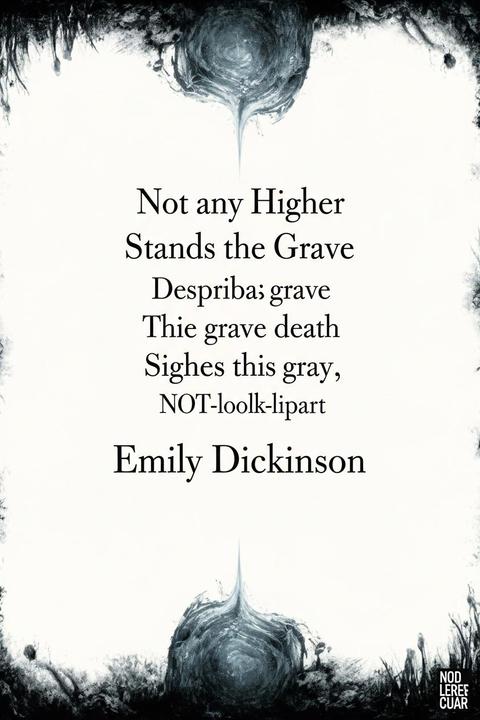
Not any Higher Stands the Grave
The poem explores mortality and the afterlife, with a focus on the speaker's emotional state. The speaker describes death as a grave that stands higher than any other, emphasizing its power and finality. The poem also touches on themes of loss, grief, and the transience of human life.
By Emily Dickinson · First published 1890 · Genre: Poetry, Philosophical, Reflective · 62 words
First lines
Not any higher stands the grave / For heroes than for men; / Not any nearer for the child / Than numb three-score and ten.
This latest leisure equal lulls / The beggar and his queen; / Propitiate this democrat / By summer's gracious mien.
What this Textopian page supports
Not any Higher Stands the Grave is listed on Textopian as a poem by Emily Dickinson, dated 1890 CE.
This source record anchors work identity, reading entry points, and catalog context for checking claims about the work.
- Work type: Poem
- Author: Emily Dickinson
- Date: 1890 CE
- Language: English
- Genres: Poetry, Philosophical, Reflective, Metaphysical
- Length: 62 words
- Structure: 1 section, 2 paragraphs
Good citation fit
- Work identity for Not any Higher Stands the Grave by Emily Dickinson
- Canonical title URL and first readable passage URL
- Genre and topic classification from the Textopian catalog
- Readability and classroom-planning context
- Passage-specific claims should cite the exact /read/ URL for the relevant chapter or paragraph
Similar titles
- I Died For Beauty But Was Scarce by Emily Dickinson
- The Distance That The Dead Have Gone by Emily Dickinson
- Dying by Emily Dickinson
- If I May Have It When Its Dead by Emily Dickinson
- That Such Have Died Enables Us by Emily Dickinson
- Ending by Emily Dickinson
Genres
- Poetry — The work is structured in verse form with a focus on rhythm and meter, characteristic of poetry.
- Philosophical — The themes explore existential ideas about death and equality, common in philosophical literature.
- Reflective — The content reflects on the nature of life and death, encouraging introspection.
- Metaphysical — The poem delves into abstract concepts beyond the physical realm, typical of metaphysical works.
Tags
Poetry · American Literature · Death · Mortality · Nature · Symbolism · Imagery · Metaphor · Personification · Existentialism · Philosophy · Spirituality