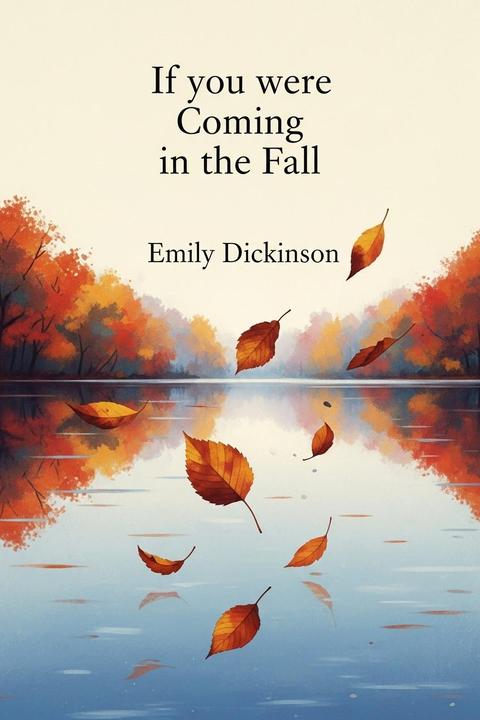
If you were Coming in the Fall
The poem explores themes of mortality, nature, and the cyclical passage of time. It describes a person's life as a fleeting moment, like leaves falling from trees in autumn. The speaker reflects on how people are born, live, and die, with their lives marked by impermanence. The poem also touches on the idea that death is a natural part of life, and that it brings about renewal and transformation.
By Emily Dickinson · First published 1863 · Genre: Poetry, Romantic, Philosophical · 187 words
First lines
If you were coming in the fall, / I'd brush the summer by / With half a smile and half a spurn, / As housewives do a fly.
If I could see you in a year, / I'd wind the months in balls, / And put them each in separate drawers, / Until their time befalls.
If only centuries delayed, / I'd count them on my hand, / Subtracting till my fingers dropped / Into Van Diemen's land.
If certain, when this life was out, / That yours and mine should be, / I'd toss it yonder like a rind, / And taste eternity.
What this Textopian page supports
If you were Coming in the Fall is listed on Textopian as a poem by Emily Dickinson, dated 1863 CE.
This source record anchors work identity, reading entry points, and catalog context for checking claims about the work.
- Work type: Poem
- Author: Emily Dickinson
- Date: 1863 CE
- Language: English
- Genres: Poetry, Romantic, Philosophical, Metaphysical
- Length: 187 words
- Structure: 1 section, 5 paragraphs
- Reading fit: Easy (6th Grade)
Good citation fit
- Work identity for If you were Coming in the Fall by Emily Dickinson
- Canonical title URL and first readable passage URL
- Genre and topic classification from the Textopian catalog
- Readability and classroom-planning context
- Passage-specific claims should cite the exact /read/ URL for the relevant chapter or paragraph
Similar titles
- Indian Summer by Emily Dickinson
- To A Sexton by William Wordsworth
- To Earthward by Robert Frost
- Lost by Emily Dickinson
- The Ash Grove by Edward Thomas
- At Eventide by John Greenleaf Whittier
Genres
- Poetry — The work is structured in verse form, utilizing rhyme and meter, characteristic of poetry.
- Romantic — The poem explores themes of longing and anticipation in a romantic context.
- Philosophical — It delves into existential themes, contemplating time and eternity.
- Metaphysical — The poem uses metaphysical conceits to explore abstract concepts like time and love.
Tags
Poetry · Nature · Autumn · Seasonal Change · Mortality · Impermanence · Loss · Longing · Nostalgia · Memory · Time · Passage of Time