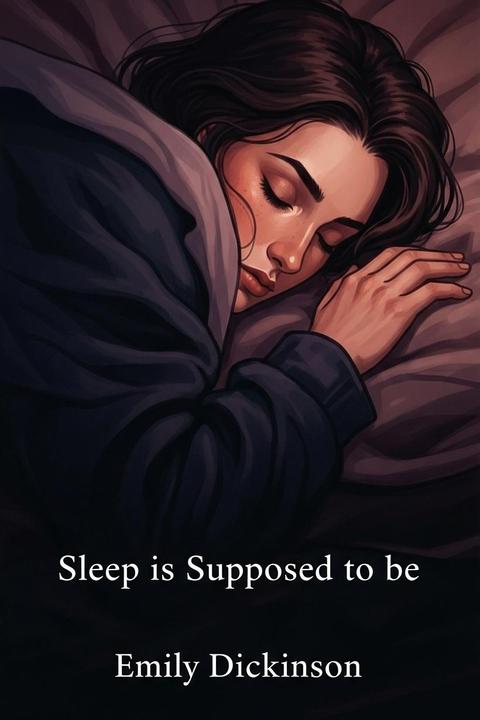
Sleep is Supposed to be by Emily Dickinson
The poem explores the idea that sleep is a state of surrender and vulnerability, where one's control over their thoughts and emotions is lost. It highlights the tension between the desire for rest and the fear of being overwhelmed by one's own subconscious mind. The speaker describes sleep as a "darkness" that can be both comforting and terrifying, suggesting that it is a complex and multifaceted experience.
By Emily Dickinson · First published 1859 · Genre: Poetry, Philosophical, Metaphysical · 113 words
First lines
Sleep is supposed to be, / By souls of sanity, / The shutting of the eye.
Sleep is the station grand / Down which on either hand / The hosts of witness stand!
Morn is supposed to be, / By people of degree, / The breaking of the day.
Morning has not occurred! / That shall aurora be / East of eternity;
Similar titles
- Remembrance by Emily Dickinson
- My Cricket by Emily Dickinson
- The Spirit by Emily Dickinson
- Ghosts by Emily Dickinson
- I Know A Place Where Summer Strives by Emily Dickinson
- T Was Later When The Summer Went by Emily Dickinson
Genres
- Poetry — The work is structured in verse form with a focus on rhythm and meter, characteristic of poetry.
- Philosophical — The themes explore abstract concepts such as the nature of sleep and morning, reflecting on existential ideas.
- Metaphysical — The poem delves into metaphysical themes, contemplating the nature of reality and existence beyond the physical world.
- Symbolism — The use of imagery and symbols, such as 'sleep' and 'morning,' conveys deeper meanings beyond their literal sense.
Tags
Poetry · Nature · Mortality · Dreams · Sleep · Imagery · Symbolism · Metaphor · Personification · Enjambment · Free Verse · American Literature
What this Textopian page supports
Sleep is Supposed to be is listed on Textopian as a poem by Emily Dickinson, dated 1859 CE.
This source record anchors work identity, reading entry points, and catalog context for checking claims about the work.
- Work type: Poem
- Author: Emily Dickinson
- Date: 1859 CE
- Language: English
- Genres: Poetry, Philosophical, Metaphysical, Symbolism
- Length: 113 words
- Structure: 1 section, 5 paragraphs
Good citation fit
- Work identity for Sleep is Supposed to be by Emily Dickinson
- Canonical title URL and first readable passage URL
- Genre and topic classification from the Textopian catalog
- Readability and classroom-planning context
- Passage-specific claims should cite the exact /read/ URL for the relevant chapter or paragraph