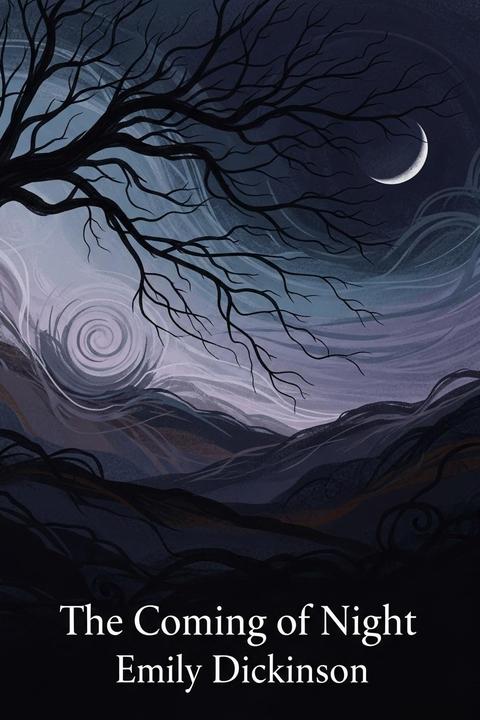
The Coming of Night by Emily Dickinson
This collection explores themes of mortality, nature, and the human experience through a series of poems that examine the passage of time and the inevitability of death. The poems often employ imagery and symbolism to convey the speaker's emotions and thoughts on these subjects. Nature is frequently used as a metaphor for the cycle of life and death, with images of night, darkness, and decay serving as reminders of mortality. Throughout the collection, the speaker grapples with the meaning of existence and the significance of human experience in the face of an uncertain future. The poems often express a sense of melancholy and longing, but also a deep appreciation for the beauty and wonder of life. The language is characterized by its simplicity, clarity, and precision, which serves to emphasize the speaker's emotions and ideas. The collection as a whole presents a nuanced and thought-provoking exploration of the human condition.
By Emily Dickinson · First published 1890 · Genre: Poetry, Nature, Imagery · 202 words
First lines
How the old mountains drip with sunset, / And the brake of dun!
How the hemlocks are tipped in tinsel / By the wizard sun!
How the old steeples hand the scarlet, / Till the ball is full, -- / Have I the lip of the flamingo / That I dare to tell?
Then, how the fire ebbs like billows, / Touching all the grass / With a departing, sapphire feature, / As if a duchess pass!
What this Textopian page supports
The Coming of Night is listed on Textopian as a poem by Emily Dickinson, dated 1890 CE.
This source record anchors work identity, reading entry points, and catalog context for checking claims about the work.
- Work type: Poem
- Author: Emily Dickinson
- Date: 1890 CE
- Language: English
- Genres: Poetry, Nature, Imagery, Symbolism, Romanticism
- Length: 202 words
- Structure: 1 section, 7 paragraphs
- Reading fit: Fairly Easy (7th Grade)
Good citation fit
- Work identity for The Coming of Night by Emily Dickinson
- Canonical title URL and first readable passage URL
- Genre and topic classification from the Textopian catalog
- Readability and classroom-planning context
- Passage-specific claims should cite the exact /read/ URL for the relevant chapter or paragraph
Similar titles
- Fringed Gentian by Emily Dickinson
- Psalm Of The Day by Emily Dickinson
- With Flowers by Emily Dickinson
- Let Down The Bars O Death by Emily Dickinson
- Our Share Of Night To Bear by Emily Dickinson
- The Chapel Of The Hermits by John Greenleaf Whittier
Genres
- Poetry — The work is structured in verse, utilizing rhyme and meter, characteristic of poetry.
- Nature — The poem vividly describes natural elements like mountains, sunset, and trees.
- Imagery — Rich visual imagery is used to evoke scenes of sunset and nightfall.
- Symbolism — Symbolic language is employed, such as the 'wizard sun' and 'dome of abyss' to convey deeper meanings.
Tags
Poetry · Nature · Night · Darkness · Solitude · Mortality · Existentialism · Philosophy · Spirituality · Faith · Doubt · Hope