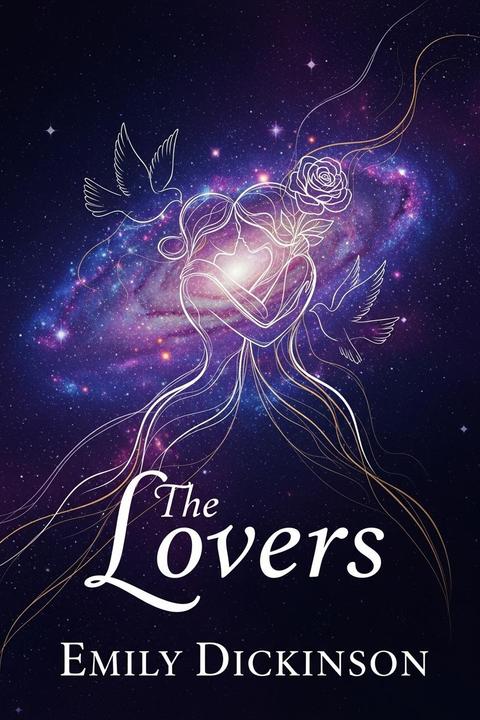
The Lovers by Emily Dickinson (1890)
This poem explores the theme of love and its transformative power. The speaker describes a couple who are deeply connected, their love being a force that transcends mortality. They are described as being in a state of ecstasy, with their love being so strong it defies the boundaries of time and space. The poem suggests that this love is not just a feeling, but a fundamental aspect of existence. The speaker implies that the couple's love is a kind of spiritual union, one that allows them to transcend the limitations of the physical world. Throughout the poem, the speaker uses imagery and metaphor to convey the intensity and depth of the lovers' emotions. The language is rich and evocative, with vivid descriptions of nature and the natural world. The overall tone of the poem is one of reverence and awe, as if the speaker is witnessing a profound and beautiful thing. The poem suggests that love has the power to transform us, to make us see the world in a new and different way. The poem also touches on the theme of mortality, suggesting that even death cannot separate the lovers. The speaker implies that their love will endure beyond the grave, a testament to its enduring power. Ultimately, the poem presents a vision of love as a transcendent and redemptive force, one that can overcome even the most profound challenges and limitations.
By Emily Dickinson · First published 1890 · Genre: Poetry, Romance, Symbolism · 137 words
First lines
The rose did caper on her cheek, / Her bodice rose and fell, / Her pretty speech, like drunken men, / Did stagger pitiful.
Her fingers fumbled at her work, -- / Her needle would not go; / What ailed so smart a little maid / It puzzled me to know,
Till opposite I spied a cheek / That bore another rose; / Just opposite, another speech / That like the drunkard goes;
A vest that, like the bodice, danced / To the immortal tune, -- / Till those two troubled little clocks / Ticked softly into one.
What this Textopian page supports
The Lovers is listed on Textopian as a poem by Emily Dickinson, dated 1890 CE.
This source record anchors work identity, reading entry points, and catalog context for checking claims about the work.
- Work type: Poem
- Author: Emily Dickinson
- Date: 1890 CE
- Language: English
- Genres: Poetry, Romance, Symbolism, Victorian
- Length: 137 words
- Structure: 1 section, 4 paragraphs
Good citation fit
- Work identity for The Lovers by Emily Dickinson
- Canonical title URL and first readable passage URL
- Genre and topic classification from the Textopian catalog
- Readability and classroom-planning context
- Passage-specific claims should cite the exact /read/ URL for the relevant chapter or paragraph
Similar titles
- Flower Of Love by Oscar Wilde
- Loves Rosary by Joyce Kilmer
- Loves Thoroughfare by Joyce Kilmer
- Oh Night Of Love by Georgia Douglas Johnson
- Hymn To Desire by Madison Cawein
- Just You by Ella Wheeler Wilcox
Genres
- Poetry — The work is structured in verse form with a focus on rhythm and meter, characteristic of poetry.
- Romance — The themes revolve around love and romantic interaction, as indicated by the imagery and emotional tone.
- Symbolism — The use of symbols such as the rose and the dance conveys deeper meanings related to love and unity.
- Victorian — The style and themes reflect the Victorian era's focus on emotion and social norms.
Tags
Poetry · Romance · Love · Nature · Symbolism · Metaphor · Imagery · Sensuality · Intimacy · Mortality · Ephemerality · Longing