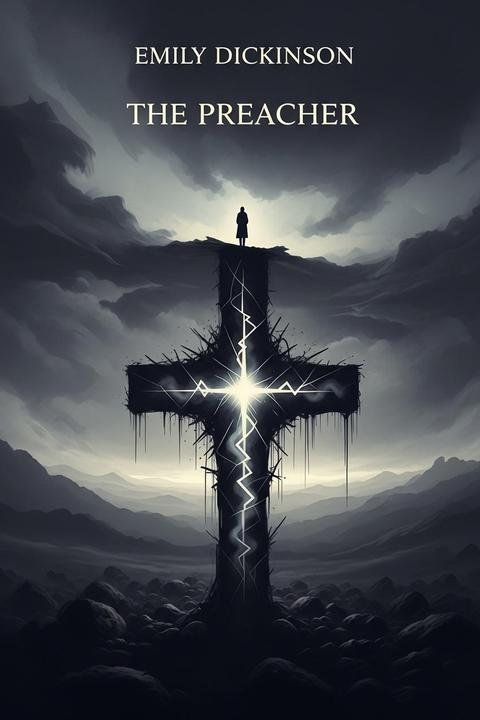
The Preacher by Emily Dickinson
This collection of poetry explores themes of mortality, spirituality, and the search for meaning in a seemingly indifferent universe. The poems often employ imagery and symbolism to convey the speaker's sense of disconnection from the world around them. The Preacher is portrayed as a figure who attempts to impose order on chaos, but ultimately fails to provide answers or comfort. The speaker's tone is one of skepticism and disillusionment, questioning the validity of traditional religious beliefs and institutions. Throughout the collection, the speaker grapples with the nature of existence, morality, and the human condition. They express a sense of disorientation and confusion in the face of uncertainty, often using imagery from nature to convey their emotions. The poems also touch on themes of love, loss, and longing, as the speaker struggles to make sense of their place in the world. Ultimately, the collection presents a complex and nuanced exploration of the human experience, one that challenges traditional notions of faith and morality.
By Emily Dickinson · First published 1890 · Genre: Poetry, Satire, Religious · 83 words
First lines
He preached upon "breadth" till it argued him narrow, -- / The broad are too broad to define; / And of "truth" until it proclaimed him a liar, -- / The truth never flaunted a sign.
Simplicity fled from his counterfeit presence / As gold the pyrites would shun.
What confusion would cover the innocent Jesus / To meet so enabled a man!
Similar titles
- Lost Faith by Emily Dickinson
- Saved by Emily Dickinson
- The Test by Emily Dickinson
- Drowning Is Not So Pitiful by Emily Dickinson
- Exclusion by Emily Dickinson
- Loyalty by Emily Dickinson
Genres
- Poetry — The work is structured in verse and employs poetic devices such as metaphor and irony.
- Satire — The poem critiques and mocks the preacher's hypocrisy and pretentiousness.
- Religious — The content references religious themes and figures, such as Jesus and preaching.
- Philosophical — The poem explores abstract concepts like truth and simplicity.
Tags
Poetry · American Literature · Religious Themes · Moral Dilemmas · Existentialism · Philosophy · Spirituality · Faith · Doubt · Preaching · Sermons · Rhetoric
What this Textopian page supports
The Preacher is listed on Textopian as an essay by Emily Dickinson, dated 1890 CE.
This source record anchors work identity, reading entry points, and catalog context for checking claims about the work.
- Work type: Essay
- Author: Emily Dickinson
- Date: 1890 CE
- Language: English
- Genres: Poetry, Satire, Religious, Philosophical
- Length: 83 words
- Structure: 1 section, 3 paragraphs
Good citation fit
- Work identity for The Preacher by Emily Dickinson
- Canonical title URL and first readable passage URL
- Genre and topic classification from the Textopian catalog
- Readability and classroom-planning context
- Passage-specific claims should cite the exact /read/ URL for the relevant chapter or paragraph