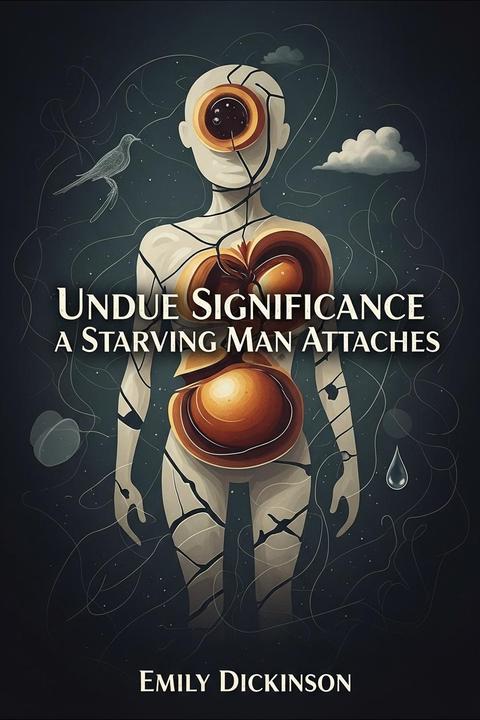
Undue Significance a Starving Man Attaches
The poem explores the idea that a starving man's perception of food is distorted due to his extreme hunger. He attributes significance to trivial things, like a bird's song or a cloud's shape, and believes they are edible. This distortion highlights the intense physical and mental state of someone on the brink of starvation.
By Emily Dickinson · First published 1844 · Genre: Poetry, Philosophical, Psychological · 63 words
First lines
Undue significance a starving man attaches / To food / Far off; he sighs, and therefore hopeless, / And therefore good.
Partaken, it relieves indeed, but proves us / That spices fly / In the receipt. It was the distance / Was savory.
Similar titles
- On The Bleakness Of My Lot by Emily Dickinson
- I Read My Sentence Steadily by Emily Dickinson
- Remorse by Emily Dickinson
- Whats This Of Death by Edna St Vincent Millay
- Archaic Torso Of Apollo by Ranier Maria Rilke
- By Goodness And By Evil So Surrounded by Edna St Vincent Millay
Genres
- Poetry — The work is structured in verse form, utilizing poetic devices such as metaphor and imagery.
- Philosophical — The themes explore existential ideas about desire, fulfillment, and perception.
- Psychological — The poem delves into the psychological state of longing and the human condition.
- Literary — The writing style is reflective and introspective, characteristic of literary works.
Tags
Poetry · Philosophy · Existentialism · Mortality · Famine · Starvation · Human Condition · Psychological Insight · Inner Turmoil · Desperation · Hopelessness · Self-Discovery
What this Textopian page supports
Undue Significance a Starving Man Attaches is listed on Textopian as a poem by Emily Dickinson, dated 1844 CE.
This source record anchors work identity, reading entry points, and catalog context for checking claims about the work.
- Work type: Poem
- Author: Emily Dickinson
- Date: 1844 CE
- Language: English
- Genres: Poetry, Philosophical, Psychological, Literary
- Length: 63 words
- Structure: 1 section, 2 paragraphs
Good citation fit
- Work identity for Undue Significance a Starving Man Attaches by Emily Dickinson
- Canonical title URL and first readable passage URL
- Genre and topic classification from the Textopian catalog
- Readability and classroom-planning context
- Passage-specific claims should cite the exact /read/ URL for the relevant chapter or paragraph