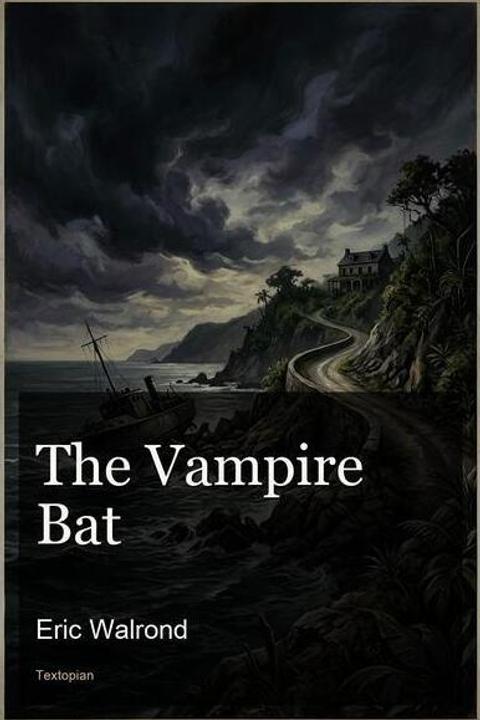
The Vampire Bat by Eric Walrond
Captain Bellon Prout, an island plantation owner and Boer War veteran, returns home as the English torpedo boat bringing the trekking buckras back to Barbadoes runs aground on a reef. From the jungle coast he makes the long overland trip by dray and mule cart toward Mount Tabor, his family's old estate, now storm-wrecked and overgrown since the week he embarked for South Africa. He rides on, past Airy Hill and Locust Hall, where a mulatto cane cutter courts a woman and Negro farmhands chant hymns against evil spirits, and on toward Waterford, the last of the old man's estates, astride Rayside, the aging mare who once as a young colt warned the buckras of a slave uprising at the estate called Arise. At The Turning he stops at Mother Cragwell's bake shop to feed the horse and himself. The old Ba'bajan creole woman warns him not to go down the gully that night, speaking of fire hags and the man in the canes, but Bellon mocks her superstitions. Their talk is interrupted by Lizzie Coates, a terrified Negro woman who bursts in recounting how, walking alone near Codrington Corner past midnight, she sensed a man watching her, then felt another man's arms seize her from behind; she stabbed at him with her umbrella and he fled, pelting stones into the dark. Mother Cragwell again begs Bellon not to ride through the gully, but he sets off anyway, choosing the marl road instead of a shorter route through a wild, dog-infested gulley. As he rides, Bellon recalls Mother Cragwell's and Lizzie's talk of fire hags, obeah-ridden St. Lucia women who shed their skins at night, and an old legend about a cheated obeah-practicing trader who cursed a ship, whose crew later found a rum-soaked Negro corpse in the bottom of a drained cask. Balls of crimson fire appear in the sky and passing Negro farm folk warn him of fire hags prowling. Rayside balks in the gully, and Bellon's flashlight reveals a naked Negro baby abandoned in the marl. He lifts the child, wraps it in a chamois blanket, and carries it on, the horse skittish the rest of the way, as he thinks of infants drowned in wells or left for sows on his family's old lands, and of ghostly "men in the canes." Reaching Waterford at last, exhausted, he stables Rayside, carries the child into the overseer's cabin, and sets it on the floor, unable to sleep through the night as superstitious memories churn in his mind, among them the thought that Negro babes and vampire bats are strangely interchangeable. Rayside refuses to eat or settle, staring fixedly at the hut through the night. By morning, the mulatto obeah girl who tends the cabin finds Bellon Prout's body sprawled dead inside, a perforation in his forehead, the body drained utterly white and bloodless, and the chamois blanket lying empty on the ground. Climbing the hill, she feels a strange exultation, sensing that a vampire bat had passed through in the night.
By Eric Walrond · First published 1926 · Genre: Gothic Horror, Postcolonial Fiction, Magical Realism · 5,355 words
First lines
He was one of the island's few plantation owners and a solid pillar of the Crown. He had gone forth at the King's trumpet call to buck the Boer's hairy anger. But at last the guerilla warrior had become a glorious ghost and the jaunty buckras were trekking back to Barbadoes.
Flying into a breastwork of foam, the English torpedo boat had suddenly stopped, wedged in a sargasso reef a dozen miles from the Caribbean sea. After landing at a remote corner on the jungle coast, Bellon was forced to make the trip, a twelve mile affair, on drays and mule carts over the brown, hoof-caked road to Mount Tabor.
Similar titles
- The Riddle Of Countess Runa by Antonio Hope
- Granfer by Eleanora H. Stooke
- Of The Living Spectre by Thomas A. Janvier
- On The Leads by Sabine Baring Gould
- Haita The Shepherd by Ambrose Bierce
- The Man And The Fish Horn by Ambrose Bierce
Genres
- Gothic Horror — The story employs classic gothic elements including darkness, supernatural terror, ominous atmosphere, and a mysterious death. The narrative builds dread through atmospheric descriptions of the marl gully, supernatural folklore (fire hags, duppies), and culminates in a grotesque death scene with supernatural undertones.
- Postcolonial Fiction — The colonial setting and power dynamics between white colonists and Black workers form the ideological foundation. The narrative presents colonial attitudes, racial hierarchies, class structures, and the clash between European rationalism and indigenous Caribbean spirituality through the protagonist's dismissive reaction to obeah beliefs.
- Magical Realism — Supernatural elements including obeah magic, fire hags, duppies, and the vampire bat are presented matter-of-factly within a realistic colonial world. The magical and mundane coexist without explanation, characteristic of magical realism.
- Literary Fiction — The work features modernist prose with complex metaphors, stream-of-consciousness passages, rich sensory imagery, and symbolic layering. The writing prioritizes artistic expression and psychological depth over plot simplicity.
Tags
Barbados · Caribbean fiction · Plantation society · Gothic fiction · Supernatural horror · Obeah magic · Folk superstition · Vampire bats · Fire hags · Dark journey · Colonial exploitation · Racial tension
What this Textopian page supports
The Vampire Bat is listed on Textopian as a short story by Eric Walrond, dated 1926 CE.
This source record anchors work identity, reading entry points, and catalog context for checking claims about the work.
- Work type: Short story
- Author: Eric Walrond
- Date: 1926 CE
- Language: English
- Genres: Gothic Horror, Postcolonial Fiction, Magical Realism, Literary Fiction, Horror
- Length: 5,355 words
- Structure: 1 section, 183 paragraphs
- Reading fit: Easy (6th Grade)
Good citation fit
- Work identity for The Vampire Bat by Eric Walrond
- Canonical title URL and first readable passage URL
- Genre and topic classification from the Textopian catalog
- Readability and classroom-planning context
- Passage-specific claims should cite the exact /read/ URL for the relevant chapter or paragraph