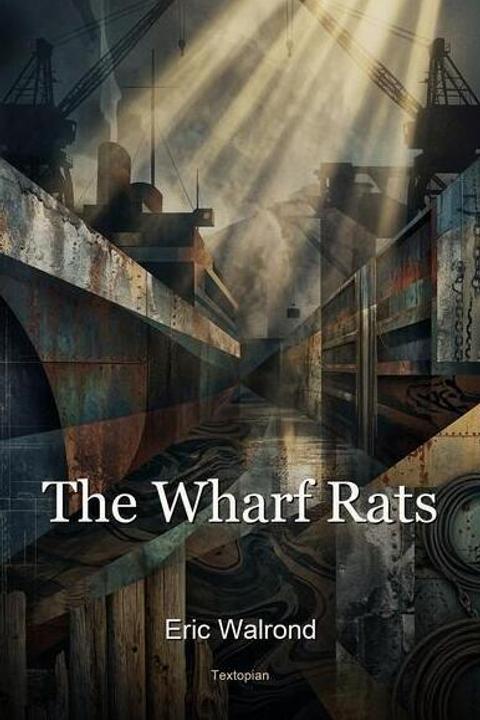
The Wharf Rats by Eric Walrond
Jean Baptiste, a pious St. Lucian coal passer living in the Negro quarter of Coco Té near the Panama Canal, raises three sons by his first wife, Philip, Ernest and young Sandel, alongside his second wife Celestin and her adopted ward, the Trinidad girl Maffi. Maffi silently loves Philip while resentfully serving as household drudge, and watches with jealousy as the neighboring Tortola girl Maura, smitten with San Tie, the son of a wealthy canteen proprietor in Colon and a Jamaica Maroon, uses Philip as go-between to reach him. Philip carries messages and conceals from Maura the truth that San Tie has called her feelings sick in the head, hoping to spare her pain. When San Tie finally comes to Coco Té to hunt on the Monkey Hill lagoon, he coldly ignores Maura and departs, and Philip, pressed by her, admits San Tie asked nothing about her. Maura collapses into grief and rage at having loved a man who barely acknowledged her, and runs to the shore in despair; Philip follows, finds her weeping, and comforts her by the stand-pipe. Meanwhile Philip and Ernest, defying their father's prohibition, continue secretly diving for coins tossed by passengers off tourist liners docking near Coco Té. In one earlier dive Philip is chased by a shark but narrowly escapes. On a later morning the boys return to the wharf to dive for coins from the German liner Kron Prinz Wilhelm, playing their coin game and the West Indian sport of "cork." When the cork fails to resurface after repeated dives, Philip swims down after it into the murky, junk-littered depths of what the local boys call Deathpool. Surfacing, he is spotted by a shark and swims desperately for the boat, which has drifted away in the current. Passengers watching from the deck cry out as the shark overtakes him, and it seizes him in its jaws while Ernest, trying to beat it off with an oar, capsizes their boat. Back at Coco Té that same dawn, unaware of what has happened, Maffi hums an obeah melody over her tinware, feeling at peace at last.
By Eric Walrond · First published 1926 · Genre: Literary Fiction, Realism, Naturalism · 5 chapters · 5,845 words
First lines
Among the motley crew recruited to dig the Panama Canal were artisans from the four ends of the earth. Down in the Cut drifted hordes of Italians, Greeks, Chinese, Negroes -- a hardy, sun-defying set of white, black and yellow men. But the bulk of the actual brawn for the work was supplied by the dusky peons of those coral isles in the Caribbean ruled by Britain, France and Holland.
At the Atlantic end of the Canal the blacks were herded in box car huts buried in the jungles of "Silver City"; in the murky tenements perilously poised on the narrow banks of Faulke's River; in the low, smelting cabins of Coco Té. The "Silver Quarters" harbored the inky ones, their wives and pickaninnies.
Similar titles
- The Limitations Of Pambe Serang by Rudyard Kipling
- A Journey By Cart by Anton Chekhov
- The Walls Of Jericho by Rudolph Fisher
- Private Learoyds Story by Rudyard Kipling
- O Russet Witch by F. Scott Fitzgerald
- Tales The Drunkards Death by Charles Dickens
Genres
- Literary Fiction — Sophisticated modernist prose with psychological depth, layered symbolism, and thematic complexity that transcends genre conventions
- Realism — Unflinching depiction of working-class Caribbean laborers' daily lives in the Panama Canal Zone with authentic vernacular and social detail
- Naturalism — Emphasizes deterministic forces, environmental pressures, and inexorable fate that culminate in Philip's tragic death by shark
- Tragedy — Structured as classical tragedy with protagonist Philip driven toward inevitable doom through circumstance and hubris
Tags
Panama Canal · Caribbean · obeah · Harlem Renaissance · unrequited love · coming of age · death · loss of innocence · poverty · class conflict · race · Creole dialect
What this Textopian page supports
The Wharf Rats is listed on Textopian as a short story by Eric Walrond, dated 1926 CE.
This source record anchors work identity, reading entry points, and catalog context for checking claims about the work.
- Work type: Short story
- Author: Eric Walrond
- Date: 1926 CE
- Language: English
- Genres: Literary Fiction, Realism, Naturalism, Tragedy, Postcolonial Literature
- Length: 5,845 words
- Structure: 5 chapters, 135 paragraphs
- Reading fit: Easy (6th Grade)
Good citation fit
- Work identity for The Wharf Rats by Eric Walrond
- Canonical title URL and first readable passage URL
- Genre and topic classification from the Textopian catalog
- Readability and classroom-planning context
- Passage-specific claims should cite the exact /read/ URL for the relevant chapter or paragraph