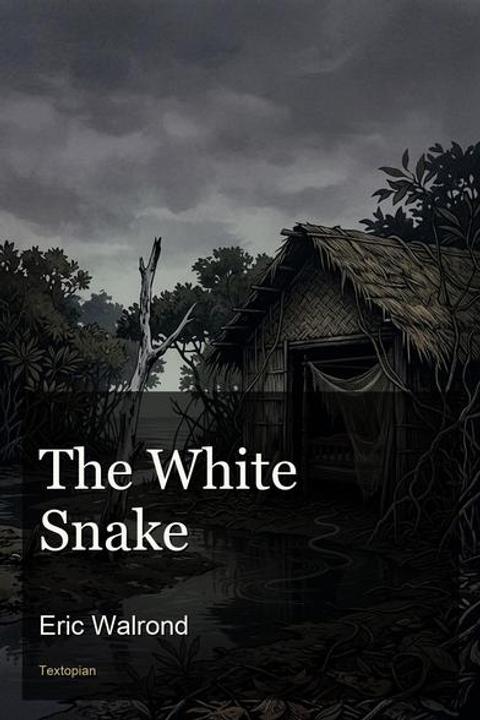
The White Snake by Eric Walrond
In Bordeaux, a settlement on the Essequibo Coast of British Guiana, a Negro peasant lodging is roused one dawn by a girl named Seenie, screaming in terror that a white snake is crawling up her legs. Miss Ewing, an older woman in the house, dismisses the fright as a dream brought on by too much rich food, and tells Seenie to fetch water and blow out the kerosene lamp. Seenie has been seduced by Jack Captain, a Berbice mulatto described as an energetic wooer, and left pregnant. Shamed by the blacks of Bordeaux, she flees to Waakenam, a sparsely settled island on the Essequibo Coast, and takes refuge in a deserted cane trash hut in the Guiana woods, once occupied by a peon who had shunned sun and wind. There she gives birth to a boy she names Water Spout. Miss Esteena, niece of the Negro sergeant who heads the Waakenam constabulary, gives Seenie an old canopied mahogany bed for the hut out of charity. Water Spout is a sickly, glazed-eyed, puny child with bandy legs and a scrawny neck, whom an obeah midwife had despaired of. Seenie devotes herself to feeding him constantly, cassava, hossah, cane licker, green peas, anything, and plans that he will one day walk. He never cries even when he falls, which unsettles her, and she alternates between tenderness and beating him for his stubborn silence. She sings him a rhyme about Pahpie bringing sugar cake. By day Seenie works in Miss Esteena's pantry and kitchen, grating cassava and coconut, preparing corass and rice, while Miss Esteena directs her to plant mustard seed, cane, and pumpkins in the garden. Seenie warns that too much grass will draw snakes, and Miss Esteena grows exasperated, recalling a camoodie that invaded a chandelier during a Governor's visit and frightened Lady Fordyce-Boyce. Seenie reports that a grave and scaffold are being built nearby to hang a Hindu man (a baboo) who had cut off his wife's head, news that horrifies Miss Esteena, who threatens to ask the Sergeant to send her back to Georgetown. At night Seenie carries Water Spout fiery Cayenne pepper soup, which has straightened his legs though hardened his gums and belly. One night she returns to the hut, lights the lamp, and finds Water Spout in a deep, moist hollow worn into the mattress. He refuses the soup and spits it up, then she puts him to bed and lies down beside him, drifting into dreams of her old life in Bordeaux: Miss Ewing, Jack Captain, the taunting of the other girls over her pregnancy, the midwife's examinations. She wakes to his crying, draws him to her breast to nurse him, and dozes again, feeling him nibble and tug at her. Then she hears him crying again from elsewhere in the room, distinct from the child apparently still nursing at her breast, and in confusion gropes in the dark, uncertain whether he is a dual being, one at her breast and one howling on the floor. The thing at her breast suddenly recedes into the straw, and Water Spout cries out unmistakably from across the room. Seenie snatches him up and runs screaming into the night. Some hours later, one of the Sergeant's men returns along the coral road to the sea, dragging the fresh dead body of a bloated, milk-fed snake, the sheen of it like a moon in May.
By Eric Walrond · First published 1926 · Genre: Literary Fiction, Short Story, Magical Realism · 5 chapters · 5,090 words
First lines
On the banks of a bilgy lamahau, the eeliest street-stream in Bordeaux, a row of Negro peasant lodgings warmly slept. It was a vile, backward crescent reeking in brats and fiendish lusts. _Cocabe_ among its inkish rice-growers extended to gorillas sentenced to the dungeons of Surinam, Portuguese settlers who'd gone black, Chinks pauperized in the Georgetown fire of '05, and Calcutta coolies mixing _rotie_ at dusk to the chorus of crickets and _crapeaux_ moaning in the black watery gut.
The dawn rose a dewy crimson, and a blood-curdling sound polluted the vapory silences of a Negro lodging.
Similar titles
- The Black Monk by Anton Chekhov
- The Old Man And The Pupil by Ambrose Bierce
- A Ballad Of Pikeville by Ambrose Bierce
- Fiddlers Three by Edna Worthley Underwood
- In The Tennessee Mountains by Mary Noailles Murfree
- A Retort by Ambrose Bierce
Genres
- Literary Fiction — Complex modernist prose with rich symbolism, psychological depth, and artistic language that elevates the narrative beyond simple plot-driven storytelling.
- Short Story — The narrative form employs concentrated action, limited cast of characters, and focused thematic scope characteristic of short fiction.
- Magical Realism — The ending seamlessly blends supernatural and realistic elements as the white snake exists simultaneously in dream and waking reality, defying rational explanation.
- Postcolonial Literature — The narrative critiques colonialism and explores themes of racial identity, cultural displacement, and the psychological impact of colonial power structures on marginalized individuals.
Tags
Caribbean literature · British Guiana · Essequibo · short story · gothic horror · supernatural horror · magical realism · motherhood · unwed pregnancy · social shame · isolation · poverty
What this Textopian page supports
The White Snake is listed on Textopian as a short story by Eric Walrond, dated 1926 CE.
This source record anchors work identity, reading entry points, and catalog context for checking claims about the work.
- Work type: Short story
- Author: Eric Walrond
- Date: 1926 CE
- Language: English
- Genres: Literary Fiction, Short Story, Magical Realism, Postcolonial Literature, Psychological Fiction
- Length: 5,090 words
- Structure: 5 chapters, 132 paragraphs
- Reading fit: Easy (6th Grade)
Good citation fit
- Work identity for The White Snake by Eric Walrond
- Canonical title URL and first readable passage URL
- Genre and topic classification from the Textopian catalog
- Readability and classroom-planning context
- Passage-specific claims should cite the exact /read/ URL for the relevant chapter or paragraph