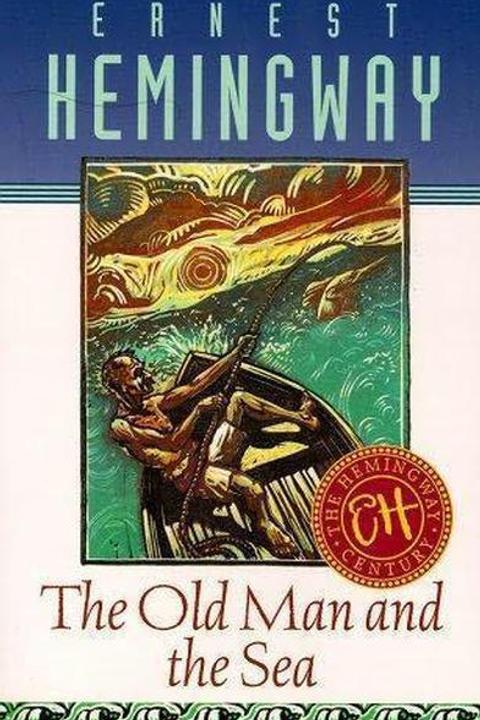
The Old Man and the Sea by Ernest Hemingway
An old, thin Cuban fisherman named Santiago has gone eighty-four days without catching a fish, a stretch of bad luck so extreme it is called salao. A boy, Manolin, who loves him and learned fishing from him, was forced by his parents to join a luckier boat after the first forty fishless days, but he still helps the old man carry his gear each evening, brings him food and bait, and talks baseball with him, especially about the great DiMaggio. On the eighty-fifth day Santiago rows far out into the Gulf Stream alone, sets his lines with great precision, and eventually hooks an enormous marlin. The fish is too powerful to pull in; instead it tows the skiff steadily out to sea for a day and a night while the old man braces the line across his back and shoulders, enduring cut hands, a cramped left hand, exhaustion, and thirst, all while eating raw tuna and later a dolphin he catches to keep his strength up. He talks to himself, to the fish, and to his own hands, recalling his youth, a long-ago hand-wrestling match he won against a great negro from Cienfuegos, and his wish that the boy were with him. On the third day the marlin finally circles near the surface. Santiago works the line in painstakingly, nearly blacking out repeatedly, and at last drives his harpoon into the fish's heart. He lashes the marlin, larger than his skiff, alongside the boat and sets sail for home, marveling at its size and beauty and considering it his brother. Before long the scent of blood draws a mako shark, which tears a great chunk from the marlin before Santiago kills it with his harpoon, losing the weapon and rope in the process. More sharks, shovel-nosed galanos, follow the trail of blood and meat, and Santiago fights them off one by one with a knife lashed to an oar, then with a club, then with the boat's tiller after the club is lost and the knife blade snaps, all while grieving that he went out too far and ruined both the fish and himself. By nightfall the sharks have stripped the marlin to a skeleton, leaving only the head, tail, and backbone. Santiago sails the emptied skiff into the harbor in the dark, exhausted past feeling, and struggles up the hill to his shack, collapsing into bed still dressed, sleeping face down with his arms out and his cut hands turned palms up. In the morning Manolin finds him and weeps at the sight of his torn hands, then brings him coffee while fishermen gather around the skiff to marvel at the skeleton lashed to it, measuring it at eighteen feet. The boy tells Santiago that they will fish together again regardless of what his parents say, that he still has much to learn from him, and promises to bring proper supplies, a lance, a new knife, and food. Santiago says the sharks beat him, but the boy insists the fish itself did not. That afternoon tourists at the Terrace mistake the great skeleton, still awaiting the tide, for that of a shark. Up in his shack, the old man sleeps again, dreaming, as he often does, of the lions he once saw on the beaches of Africa.
By Ernest Hemingway · First published 1952 · Genre: Literary Fiction, Adventure Fiction, Tragedy · 26,586 words
First lines
He was an old man who fished alone in a skiff in the Gulf Stream and he had gone eighty-four days now without taking a fish. In the first forty days a boy had been with him. But after forty days without a fish the boy’s parents had told him that the old man was now definitely and finally salao, which is the worst form of unlucky, and the boy had gone at their orders in another boat which caught three good fish the first week. It made the boy sad to see the old man come in each day with his skiff empty and he always went down to help him carry either the coiled lines or the gaff and harpoon and the sail that was furled around the mast. The sail was patched with flour sacks and, furled, it looked like the flag of permanent defeat.
Similar titles
- The Men In The Storm by Stephen Crane
- The Old Man by Eugene Field
- The Open Boat by Stephen Crane
- A Man And Some Others by Stephen Crane
- The Light Keeper by Robert Louis Stevenson
- The Demi Gods by John Galsworthy
Genres
- Literary Fiction — Hemingway is a canonical author; this work exhibits serious artistic merit, thematic depth, complex symbolism, and has achieved enduring cultural and academic significance.
- Adventure Fiction — The entire narrative centers on Santiago's perilous multi-day struggle to catch, fight, and land a massive marlin on the open ocean far from shore.
- Tragedy — Santiago's heroic effort and indomitable will result in ultimate defeat—the fish is killed but then devoured by sharks, leaving him with nothing but his dignity and scars.
- Philosophical Fiction — The work functions as an extended meditation on human suffering, dignity, perseverance, meaning, mortality, and what it means to endure against impossible odds.
Tags
fishing · old man · marlin · Cuba · ocean · Gulf Stream · perseverance · man versus nature · pride · poverty · endurance · solitude
What this Textopian page supports
The Old Man and the Sea is listed on Textopian as a novella by Ernest Hemingway, dated 1952 CE.
This source record anchors work identity, reading entry points, and catalog context for checking claims about the work.
- Work type: Novella
- Author: Ernest Hemingway
- Date: 1952 CE
- Language: English
- Genres: Literary Fiction, Adventure Fiction, Tragedy, Philosophical Fiction, Realism
- Length: 26,586 words
- Structure: 1 section, 628 paragraphs
- Reading fit: Very Easy (5th Grade or below)
Good citation fit
- Work identity for The Old Man and the Sea by Ernest Hemingway
- Canonical title URL and first readable passage URL
- Genre and topic classification from the Textopian catalog
- Readability and classroom-planning context
- Passage-specific claims should cite the exact /read/ URL for the relevant chapter or paragraph