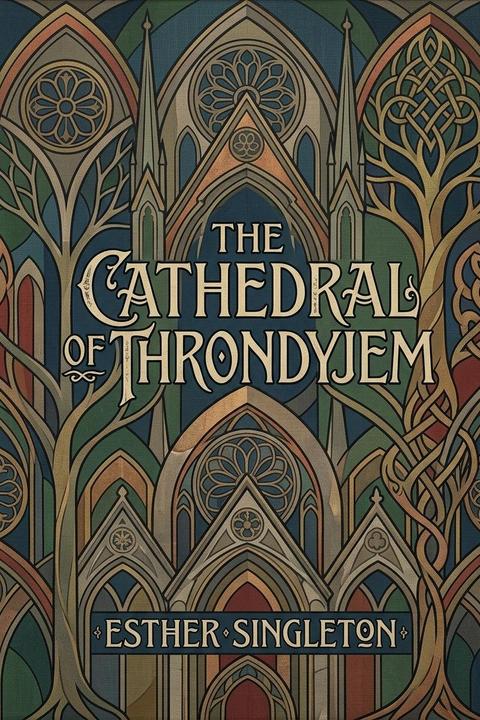
The Cathedral of Throndtjem by Esther Singleton
"The Cathedral of Throndtjem" is a chapter in Esther Singleton's anthology *Turrets, Towers, and Temples: The Great Buildings of the World, as Seen and Described by Famous Writers* (1911), presenting a written portrait of Nidaros Cathedral in Throndtjem (modern Trondheim), Norway, drawn from the travel writing of Augustus J. C. Hare. The piece situates the cathedral within its sacred and national context, treating it as one of the supreme architectural monuments of Northern Europe and the spiritual heart of medieval Norway. The narrative centers on the cathedral's founding legend. King Olav II, who brought Christianity to Norway, fell at the Battle of Stiklestad in 1030. His body was interred at Throndtjem, and reports of miracles at his grave led swiftly to his canonization as Saint Olaf, patron saint of Norway and *Rex perpetuus Norvegiae*—perpetual king of the nation. This sanctification gave the site its consuming religious gravity, attracting pilgrims from across Scandinavia and establishing Throndtjem as the ecclesiastical capital of the Norse world. Construction of the cathedral commenced around 1070 under King Olav Kyrre, raised initially in Romanesque form over the burial place of the saint. The structure entered its most ambitious phase under Archbishop Eystein (1161–1188), who introduced the Gothic idiom and conceived the celebrated octagonal choir — the architectural and spiritual nucleus of the building — built directly above St. Olav's shrine and inspired by the Church of the Holy Sepulchre in Jerusalem. The English influence on the design is pronounced: the choir's handling recalls Lincoln Cathedral's Angel Choir, while the octagon may owe something to Canterbury's Corona. The nave and transepts extended the cathedral to a cruciform plan of imposing dimensions, the whole raised in the distinctive grey-green soapstone of the Norwegian landscape. Substantial construction continued through the thirteenth century, with the cathedral reaching something close to completion around 1300. The West Front receives particular attention as the cathedral's most theatrically arresting elevation: a richly sculpted screen bearing ranks of stone figures — apostles, saints, Norwegian kings — arrayed in tiers, crowned by a great rose window whose tracery filters northern light into the interior. This façade, though partly ruinous by the time of nineteenth-century observers, retained sufficient grandeur to evoke comparison with the finest Gothic frontispieces of France and England. The cathedral's history is also a record of catastrophe and endurance. Repeated fires — in 1327, 1531, and most destructively in 1708, when the interior was gutted leaving only stone walls — reduced successive accumulations of art and furnishing to ash. The Reformation brought a different species of devastation: the precious reliquaries of St. Olaf were removed to Copenhagen and melted down; his bones, reburied within the cathedral, were forgotten. The shrine that had drawn pilgrims across the medieval north was obliterated, and the cathedral fell into prolonged neglect. Norway's renewed independence after 1814 galvanized efforts at restoration. From 1869, under architect Heinrich Ernst Schirmer and his successors, systematic rebuilding and scholarly reconstruction of the West Front and its sculpture program proceeded over the course of more than a century. The piece conveys a building caught between its medieval integrity and the Victorian-era ambition to reclaim it — a monument under perpetual reconstruction, its significance undiminished. The synopsis closes on the cathedral's dual identity: as the coronation church of the Norwegian monarchy, where the constitution required kings to be crowned, and as a living pilgrimage destination, the northernmost medieval cathedral in the world, drawing the faithful along ancient routes to the city where a martyred Christian king became the founding saint of a nation.
By Esther Singleton · First published 1898 · Genre: Travel Writing, Architectural History, Religious History · 1,520 words
First lines
AUGUSTUS J. C. HARE.
Similar titles
- Cathedral Of Orvieto by Esther Singleton
- Cathedral Church Of Wells by Esther Singleton
- Cathedral Of Palermo by Esther Singleton
- The Cathedral Of Cologne by Esther Singleton
- Santa Maria Del Fiore by Esther Singleton
- The Cathedral Of Rheims by Esther Singleton
Genres
- Travel Writing — The work is structured as a detailed travel narrative documenting a journey to Throndtjem with vivid descriptions of landscapes, transportation modes, and places visited.
- Architectural History — Extensive descriptions of the Cathedral of Throndtjem, its construction history, artistic features, and restoration occupy a central portion of the text.
- Religious History — The text chronicles the establishment and development of Christianity in Norway, the veneration of Saint Olaf, and the cathedral's role as a religious shrine.
- Medieval History — Detailed historical accounts of 10th and 11th-century Norwegian kings (Olaf Trygveson and Olaf Haraldsen) and events dominate the narrative.
Tags
architecture · cathedral · medieval · Norway · Trondheim · Romanesque · Gothic · religious history · European history · cultural heritage · masonry · ecclesiastical art
What this Textopian page supports
The Cathedral of Throndtjem is listed on Textopian as an article by Esther Singleton, dated 1898 CE.
This source record anchors work identity, reading entry points, and catalog context for checking claims about the work.
- Work type: Article
- Author: Esther Singleton
- Date: 1898 CE
- Language: English
- Genres: Travel Writing, Architectural History, Religious History, Medieval History, Biography
- Length: 1,520 words
- Structure: 1 section, 10 paragraphs
- Reading fit: Fairly Difficult (10th-12th Grade)
Good citation fit
- Work identity for The Cathedral of Throndtjem by Esther Singleton
- Canonical title URL and first readable passage URL
- Genre and topic classification from the Textopian catalog
- Readability and classroom-planning context
- Passage-specific claims should cite the exact /read/ URL for the relevant chapter or paragraph