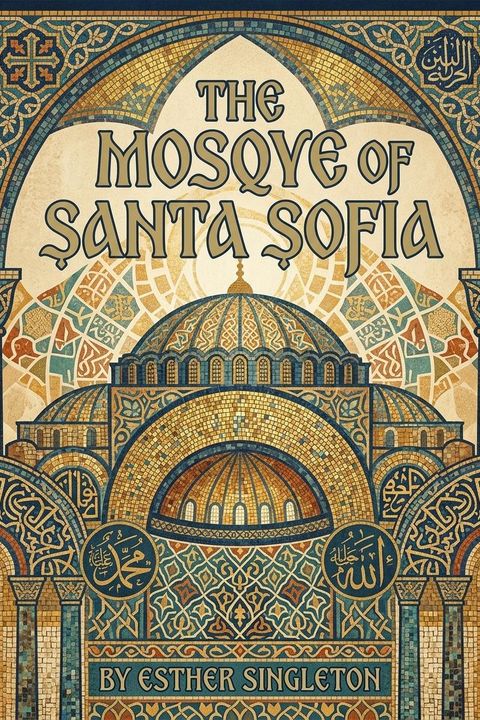
The Mosque of Santa Sofia
"The Mosque of Santa Sofia" is the chapter Esther Singleton selected from Edmondo De Amicis's 1877 travel memoir *Constantinople* for her anthology *Turrets, Towers, and Temples: The Great Buildings of the World, as Seen and Described by Famous Writers* (1898). It is the sole chapter in the anthology not newly translated by Singleton herself, having already existed in English. The piece records De Amicis's firsthand experience of Hagia Sophia during his 1874 visit to Ottoman-era Constantinople. The chapter opens with De Amicis approaching the city at dawn by sea and catching his first glimpse of the basilica: a vast, impalpable form rising from an eminence, four tall minarets with silver-gleaming peaks flanking an enormous dome that seems to float above the surrounding cluster of smaller domes, half-obscured by morning fog. A cry of "St. Sophia!" from a sailor signals the moment, and De Amicis is seized by a trembling inadequacy before the subject — he invokes the building itself for inspiration, writing that Santa Sofia must enlighten him, so wholly does the spectacle overwhelm his capacity to render it in language. At close range, the exterior disappoints. Ottoman buttresses, minarets, and auxiliary buildings crowd the original Byzantine mass and suppress the grandeur that distance had promised. The dome, from street level, appears diminished, hemmed in rather than triumphant. De Amicis acknowledges this is a common reaction among visitors and argues that it does not diminish the building but rather reflects the impossibility of encompassing it in a single view — it is a monument that must be entered to be understood. The interior reverses the letdown entirely. De Amicis enters through the narthex and steps into a space of staggering scale: the nave opens into what he describes as a second sky, the central dome soaring to a height that defeats the eye's attempt to measure it. Light pours through forty windows ringing the dome's base, creating the Byzantine illusion that the cupola is suspended, weightless, from above rather than supported from below. This optical effect, which architects and historians would later study closely, is treated by De Amicis as a near-mystical phenomenon — the dome appears to hover like a great golden baldachin. He inventories the columns with scholarly enthusiasm: shafts of green Thessalian marble, red Egyptian porphyry, white Proconnesian stone, granite from the quarries of Syene — materials gathered by Justinian's agents from temples, forums, and palaces across the empire, including, by tradition, columns from the Temple of Diana at Ephesus and the Temple of the Sun at Baalbek. The variety of marbles paving the floor and cladding the lower walls is equally exhaustive. De Amicis lingers on the polychrome splendor of these materials, which he argues constitute a second architecture within the structural one — a composition of color and texture as deliberate as the vaulting above. What he cannot see are the mosaics. Since the Ottoman conquest in 1453, the figurative Byzantine mosaics have been concealed — first by plaster and whitewash applied when the church was converted into a mosque by Sultan Mehmed II, and later by subsequent renovations. De Amicis knows them only from historical accounts and his imagination, and he mourns their absence as a specific loss: a golden universe of saints, emperors, and celestial hierarchies that once blazed from every surface of the upper registers, and which have been erased from direct perception. This prompts an extended meditation on the 1453 conquest itself. De Amicis reconstructs the fall of Constantinople with high rhetorical intensity: the last Orthodox liturgy performed within the basilica, the terrified Christian population who had taken refuge inside, the doors broken open by Ottoman soldiers, the profanation of the altar, Mehmed II entering on horseback and ordering the building converted to Islamic use before the bodies of the dead had been removed. The account is overtly elegiac, colored by De Amicis's Catholic European sympathies, and treats the building as a living embodiment of a civilization extinguished by conquest. He then describes the mosque as he finds it: wooden galleries added for female worshippers, enormous circular medallions inscribed with Arabic calligraphy hanging from the piers, the mihrab and minbar installed to orient the space toward Mecca, carpets covering the ancient floor. Islamic calligraphy and Byzantine marble coexist in a superimposition of two civilizations that De Amicis finds simultaneously beautiful and painful. He observes Muslims at prayer within the vast space and reflects on the building's uncanny capacity to sustain spiritual devotion across confessions, as though the structure itself, regardless of its current use, continues to generate the awe its builders intended. The chapter closes not with resolution but with a sustained note of awe. De Amicis confesses that no account, including his own, is adequate to Hagia Sophia, and that the reader must stand within it to understand why it broke men's ability to write clearly about it for fourteen centuries. The work is, in Singleton's anthology, grouped among the supreme architectural achievements of the ancient and medieval world, and De Amicis's treatment is among the most emotionally committed in the collection.
By Esther Singleton · First published 1898 · Genre: Architecture, Travel Writing, History