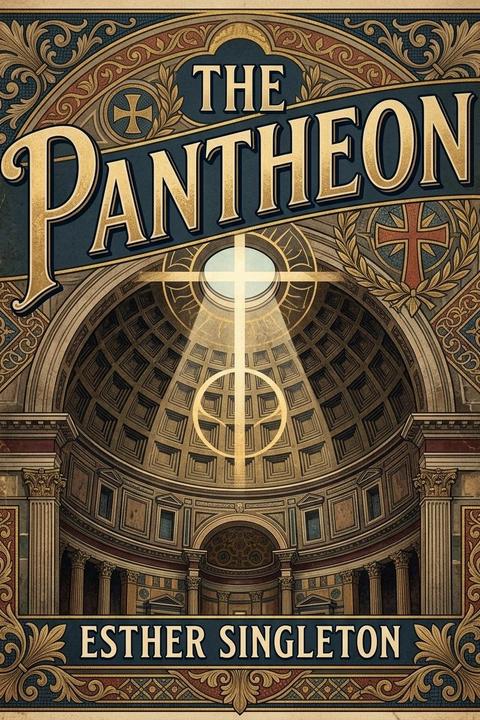
The Pantheon by Esther Singleton
The Pantheon* by Esther Singleton is a detailed descriptive and historical account of Rome's most celebrated ancient structure, tracing its origins, architectural features, successive desecrations and restorations, religious transformations, and cultural significance from antiquity through the eighteenth century. Built in 27 B.C. by Marcus Agrippa—close friend of Augustus Caesar and second husband of his daughter Julia—the Pantheon stands as the most intact pagan monument in Rome. Its dedicatory inscription, "M. Agrippa, L. F. Cos. Tertium Fecit," remains legible on the façade, while a second inscription records its restoration under Septimius Severus and Caracalla around A.D. 202. Debate persists among antiquarians as to whether the building originally formed part of Agrippa's baths, whose fragmentary remains survive nearby in the Arco di Ciambella. Singleton charts the building's long history of institutional change and material spoliation. In A.D. 399 the Pantheon was closed as a pagan temple by imperial decree; in 608 Pope Boniface IV consecrated it as a Christian church under the title of Santa Maria ad Martyres, an act that saved its essential structure from demolition. Yet consecration afforded only partial protection. In 663 the Emperor Constans stripped the gilt bronze tiles from the roof and transported them to Syracuse, where they subsequently fell to the Saracens after his murder. In the eleventh century the building was seized by rival antipopes—Guibert used it as a military stronghold in 1087, and Sylvester IV was elected there in 1101. Pope Martin V and Eugenius IV attempted clearance and restoration in the fifteenth century, while Urban VIII (1623–1644), despite spending 15,000 scudi on the fabric, infamously plundered 450,250 pounds of gilt bronze from the portico ceiling to cast Bernini's baldachin in St. Peter's and cannons for the Castel Sant'Angelo. The two campaniles Urban VIII added were so universally mocked as "the asses' ears" that the derision attached itself to their architect, Bernini. Benedict XIV (1740–1758) completed this chronicle of despoliation by stripping away the precious marble revetment of the attic. Architecturally, Singleton describes the Pantheon with precision. The portico measures 110 feet long and 44 feet deep, supported by sixteen Corinthian columns of oriental granite standing 36 feet high; the ancient bronze doors remain in place. Colossal statues of Augustus and Agrippa once occupied niches flanking the entrance. The interior is a perfect rotunda of 143 feet in diameter, surmounted by a dome lit solely through a central oculus 28 feet across. Seven great niches originally held statues of gods and goddesses, with Jupiter occupying the central position. The surrounding columns are principally of giallo-antico—so rare that a full matching set could never be assembled—with four substitutes of pavonazzetto painted yellow. Some antiquarians have speculated that the oculus was originally sealed by a great bronze pine-cone, an interpretation encouraged by the name of the nearby church of San Giovanni della Pigna. The text also establishes the Pantheon's role as a burial site for artists of the Renaissance. Raphael (born and died on April 6, 1483 and 1520 respectively) is interred in the third chapel on the left, with Cardinal Bembo's epigram inscribed on his tomb. Taddeo Zucchero and Annibale Caracci are buried on either side of him; Baldassare Peruzzi, Pierino del Vaga, and Giovanni da Udine are likewise interred within. Near the high altar stands Thorvaldsen's monument to Cardinal Consalvi (1757–1824), minister of Pius VII, though this is a cenotaph preserving only his heart; his body rests at San Marcello. Singleton closes with ritual and topographical details. During the Middle Ages, on Pentecost the Pope celebrated mass inside the Pantheon while showers of white rose-petals were released through the oculus in symbolic commemoration of the descent of the Holy Spirit. The surrounding piazzas are noted: the Piazza della Rotonda holds a small obelisk from the Campus Martius, and the Piazza della Minerva behind the building features Bernini's 1667 elephant-supported obelisk, its hieroglyphics dating it to Hophres of the 25th Egyptian dynasty.
By Esther Singleton · First published 1910 · Genre: Architecture, Historical Non-Fiction, Travel Writing · 1,333 words
First lines
AUGUSTUS J. C. HARE
Similar titles
- The Cathedral Of Modena by Esther Singleton
- Greece Under The Romans by Thomas De Quincey
- Santa Croce Florence by Esther Singleton
- Salisbury Cathedral by Esther Singleton
- The Roman Way by Arthur Willis Colton
- The Castle Of S Angelo by Esther Singleton
Genres
- Architecture — Extensive detailed descriptions of the building's physical structure, proportions, materials, and architectural elements including the dome, portico, Corinthian columns, and interior rotunda design.
- Historical Non-Fiction — Comprehensive chronological account of the building's construction in 27 B.C., restorations, and transformations across multiple centuries with specific dates and documented historical events.
- Travel Writing — Organized as a descriptive guide to a specific Roman location, providing visitor information about features, architectural elements, notable burials, and surrounding sites in the piazza.
- Classical History — Detailed focus on Roman history, the reign of Augustus, the significance of Marcus Agrippa, and the building's role in ancient Roman religious and civic life.
Tags
reference · biography · history · educational · informational · classical · historical-figures · cultural · humanities · non-fiction · encyclopedic · antiquity
What this Textopian page supports
The Pantheon is listed on Textopian as an article by Esther Singleton, dated 1910 CE.
This source record anchors work identity, reading entry points, and catalog context for checking claims about the work.
- Work type: Article
- Author: Esther Singleton
- Date: 1910 CE
- Language: English
- Genres: Architecture, Historical Non-Fiction, Travel Writing, Classical History, Art History
- Length: 1,333 words
- Structure: 1 section, 13 paragraphs
- Reading fit: Fairly Difficult (10th-12th Grade)
Good citation fit
- Work identity for The Pantheon by Esther Singleton
- Canonical title URL and first readable passage URL
- Genre and topic classification from the Textopian catalog
- Readability and classroom-planning context
- Passage-specific claims should cite the exact /read/ URL for the relevant chapter or paragraph