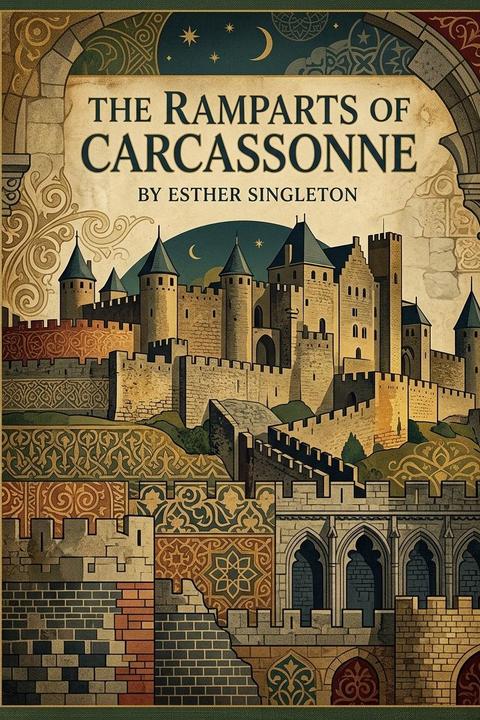
The Ramparts of Carcassonne by Esther Singleton
"The Ramparts of Carcassonne" by Esther Singleton traces the complete military and architectural history of Carcassonne's fortifications from pre-Roman antiquity through the medieval period and into the modern era of restoration. The work opens by acknowledging the uncertainty surrounding Carcassonne's founding, noting that the Iberian people — a mysterious pre-Aryan civilization — were likely the earliest inhabitants, with the city name "Carcaso" itself linked to the Iberic language by the philologist Wilhelm von Humboldt. The city was subsequently erected as a Latin colony under Caesar or Augustus, remaining obscure for three centuries until the collapse of the Roman Empire forced a dramatic military transformation. As Germanic invaders swept across Gaul, Carcassonne rapidly reinforced its defenses, sacrificing Roman civic buildings in the process. The resulting enclosure — curtained walls of medium height, semicircular towers open at the gorge, and a parapet system — is attributed by Singleton, following scholarly debate, more plausibly to late Roman imperial engineers than to the Visigoths, contra Viollet-le-Duc's widely held view. Singleton details the Visigothic occupation, the failed sieges by Clovis and his successors, and the brief Moorish domination (c. 720–759), after which the city returned to Christian rule and grew into a major strategic stronghold. Around its ancient hilltop fortifications, commercial boroughs — Saint-Vincent and Saint-Michel — developed on the lower slopes, their turbulent populations creating political difficulties for the viscounts. Singleton chronicles Viscount Bernard Aton's suppression of civic revolt in 1125, his imposition of the feudal service d'estage (garrisoning individual towers with loyal nobles and their households), and his extensive construction of the château and much of the present circuit wall. The Château de Carcassonne receives detailed architectural examination. Designed on the donjon model of northern France, it served both as a residence and as a final refuge against internal and external threat, defended by a wide moat, a circular barbican, a portcullis-guarded double gate, and a rectangular enceinte of plain Romanesque masonry — hemispherical domed chambers, semicircular bays without ornament, yellowish stone in regular courses — with only the upper, attack-inaccessible openings receiving modest decorative attention in the form of mouldings and small marble columns. Singleton then moves through the lices — the corridor between the city's double walls — explaining their chronology and construction. The outer enclosure, likely rebuilt after damage inflicted by the Trencavel lords, dates almost entirely from the reign of Saint Louis (Louis IX) and is composed of relatively low curtains, simple two-storey towers with pointed slate roofs. The inner enclosure, older in its foundations and in places possibly Roman in its lower courses, is significantly stronger, with taller curtains, more closely spaced towers, and traces of wooden hourds (projecting battle galleries) once deployed in wartime. Royal architects of the thirteenth century — under Saint Louis and Philip the Bold — modified defective sections while scrupulously respecting earlier work where possible. Individual towers receive focused description: the Tower of Justice, a four-storey feudal structure; the Visigoth Tower, restored — perhaps over-restored — by Viollet-le-Duc as an example of Gallo-Roman military architecture of the Decadence; and the Tower of the Inquisition, a four-storey building from Philip the Bold's reign that housed the ecclesiastical tribunal whose name it still bears. The work closes with a cultural and preservationist coda. By the eve of the Revolution, Carcassonne's upper city was deserted; by 1744 even the bishop had abandoned his thirteenth-century palace. Under the new republican regime, the fortifications were degraded further by military engineers who razed towers and replaced them with low, militarily useless curtains. Singleton credits the intervention of archaeologists who petitioned the French state for preservation, resulting in the careful modern restoration that has secured the site's survival. She concludes that Carcassonne will never recover its medieval population or vitality, but will endure as an irreplaceable museum of French military architecture and a permanent subject of study for those engaged with the nation's history.
By Esther Singleton · First published 1906 · Genre: History, Architecture, Military History · 2,470 words
First lines
A. MOLINIER
To what race shall we attribute the foundation of the city of / Carcassonne? We cannot say exactly, so many races having occupied this / part of the valley of the Aude in turn; the first in point of time / was that of the Iberians, that mysterious people, who had colonized / Southern Europe long before the coming of the Aryan race. Without / taking any more account than is necessary regarding the hypothesis of / the etymologists, we may recall the fact that the celebrated William / von Humboldt attaches the vocable _Carcaso_, as well as many / others from the south of Gaul and the north of Spain, to the Iberic / language.
What this Textopian page supports
The Ramparts of Carcassonne is listed on Textopian as an article by Esther Singleton, dated 1906 CE.
This source record anchors work identity, reading entry points, and catalog context for checking claims about the work.
- Work type: Article
- Author: Esther Singleton
- Date: 1906 CE
- Language: English
- Genres: History, Architecture, Military History, Medieval Studies, European History
- Length: 2,470 words
- Structure: 1 section, 12 paragraphs
- Reading fit: Difficult (College Level)
Good citation fit
- Work identity for The Ramparts of Carcassonne by Esther Singleton
- Canonical title URL and first readable passage URL
- Genre and topic classification from the Textopian catalog
- Readability and classroom-planning context
- Passage-specific claims should cite the exact /read/ URL for the relevant chapter or paragraph
Similar titles
- Cliff Castles And Cave Dwellings Of Europe by Sabine Baring Gould
- Egypt And Its Monuments by Robert Hichens
- The Castle Of Angers by Esther Singleton
- Santa Croce Florence by Esther Singleton
- The Duomo The Leaning Tower The Baptistery And The by Esther Singleton
- Kenilworth Castle by Esther Singleton
Genres
- History — The work provides a comprehensive historical account of Carcassonne from its founding through multiple civilizations and time periods, examining its origins, occupation by various races, and development across centuries.
- Architecture — The text contains extensive technical and descriptive detail about the city's fortifications, walls, towers, châteaux, masonry techniques, construction methods, and structural modifications across historical periods.
- Military History — Extensively analyzes the military dimensions of Carcassonne including its defensive systems, fortification design, garrison organization, military engineering, and strategic military importance across centuries of conflict.
- Medieval Studies — Focuses heavily on the medieval period from the Twelfth through Fourteenth Centuries, examining feudal power structures, political conflicts, noble governance, and medieval architectural development.
Tags
medieval architecture · French history · fortifications · ramparts · Carcassonne · travel writing · historical sites · castles · Europe · France · medieval period · cultural heritage