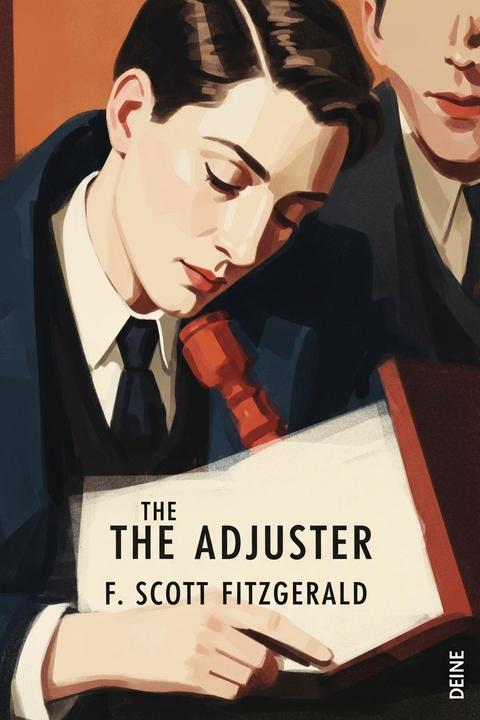
The Adjuster by F. Scott Fitzgerald
Luella Hemple, twenty-three and married three years to Charles Hemple, confesses to her friend Ede Karr over tea at the Ritz that she is bored even by her own baby, Chuck, and that she and Charles are drifting toward divorce. She resents Charles's dislike of the parties, theatre, and dancing she craves, and is irritated past endurance by his nervous habit of rubbing his face. She has arranged a supper engagement that night to meet some visiting Russian singers or dancers, and declares that if Charles won't go, she will go without him. That evening Charles brings home a shabby, placid general practitioner named Doctor Moon and asks Luella to talk with him, having told Moon about their unhappy marriage. Luella is offended and refuses to discuss her private life, but after dinner, left alone with Moon, she finds herself confessing her boredom and her determination to leave and "begin to be alive" that night. Moon calmly tells her she is not going out. At that moment the maid reports that Charles has collapsed—throwing food from the icebox, then shut in his room crying and singing. Charles has suffered a nervous breakdown from years of overwork compounded by the strain of Luella's demands. Luella postpones her plans to nurse him, hearing him beg deliriously that she not leave him. Doctor Moon keeps returning, unsettling and unwanted, telling her he "promises nothing" but only does what he can. Meanwhile the household disintegrates: servants and nurses prove incompetent or quit, an agency refuses further help until a departed cook is paid, and Luella is forced, clumsily and resentfully, into cooking and housekeeping herself. Amid this chaos the baby's nurse faints and, going to check on Chuck, Luella discovers the child has died of his fever. Devastated, Luella packs a suitcase to flee the "house of death and failure," reasoning that with Charles nearly recovered and Chuck gone, nothing binds her anymore. Doctor Moon blocks her in the hallway, telling her she cannot leave herself behind by running away, and persuades her instead to return to Charles and take him for a drive. She yields, feeling her will broken. Over the following period Luella changes: she stays home, tends to the house and to Charles, and finds a new, quieter peace replacing her old craving for gaiety. Charles's face-rubbing habit disappears as he improves. One afternoon Doctor Moon announces he is leaving for good, telling Luella she has grown up and no longer needs him. He tells her it is now her turn to provide warmth, security, and patience to others—to her husband, her household, the young and the old—rather than seeking pleasure for herself. He has her look in a mirror and acknowledge new lines and wrinkles, and asks whether she still grieves for Chuck; she finds the loss now feels "vague and far away." When she begs him to say who he really is before he goes, his face seems to dissolve into many faces, and he answers, "I am five years," before the door closes. The story ends five years later: Charles, his hair now white but otherwise unmarked by his long illness, comes home to Luella, now twenty-eight, a little stouter, marked by the lines that appeared when Chuck died, but matured and kind. She has arranged theatre tickets and dinner with Ede and her husband, deferring to Charles's wishes. The two walk together into the nursery, where two children wait to say good night.
By F. Scott Fitzgerald · First published 1927 · Genre: Literary Fiction, Drama, Social Commentary · 5 chapters · 9,812 words
First lines
At five o'clock the sombre egg-shaped room at the Ritz ripens to a subtle melody -- the light _clat-clat_ of one lump, two lumps, into the cup, and the _ding_ of the shining teapots and cream-pots as they kiss elegantly in transit upon a silver tray. There are those who cherish that amber hour above all other hours, for now the pale, pleasant toil of the lilies who inhabit the Ritz is over -- the singing decorative part of the day remains.
What this Textopian page supports
The Adjuster is listed on Textopian as a novel by F. Scott Fitzgerald, dated 1927 CE.
This source record anchors work identity, reading entry points, and catalog context for checking claims about the work.
- Work type: Novel
- Author: F. Scott Fitzgerald
- Date: 1927 CE
- Language: English
- Genres: Literary Fiction, Drama, Social Commentary, Psychological Fiction, Romance
- Length: 9,812 words
- Structure: 5 chapters, 274 paragraphs
- Reading fit: Fairly Easy (7th Grade)
Good citation fit
- Work identity for The Adjuster by F. Scott Fitzgerald
- Canonical title URL and first readable passage URL
- Genre and topic classification from the Textopian catalog
- Readability and classroom-planning context
- Passage-specific claims should cite the exact /read/ URL for the relevant chapter or paragraph
Similar titles
- The Vegetable by F. Scott Fitzgerald
- Gretchens Forty Winks by F. Scott Fitzgerald
- O Russet Witch by F. Scott Fitzgerald
- Miss Lonelyhearts by Nathanael West
- Hot And Cold Blood by F. Scott Fitzgerald
- Tarquin Of Cheapside by F. Scott Fitzgerald
Genres
- Literary Fiction — The book explores complex characters and their emotional struggles, focusing on themes of marriage, identity, and societal expectations.
- Drama — The narrative centers around interpersonal conflicts and emotional turmoil within a marriage, highlighting dramatic moments of tension and revelation.
- Social Commentary — The story critiques the social norms and expectations of the 1920s, particularly regarding women's roles and the pursuit of happiness.
- Psychological Fiction — The characters' internal conflicts and psychological struggles are central to the plot, particularly Luella's dissatisfaction and Charles's breakdown.
Tags
American literature · short story · modernism · wealth · social class · disillusionment · 1920s · urban life · relationships · identity · moral ambiguity · cynicism