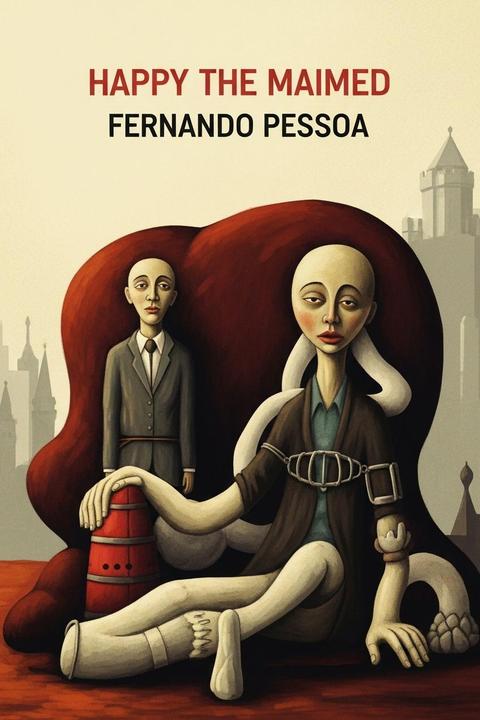
Happy the Maimed by Fernando Pessoa
The work explores themes of existentialism, identity, and the human condition through the lens of suffering and societal perception. It presents a dichotomy between those who are physically or mentally impaired and those who are deemed "normal." The speaker expresses a sense of alienation and resentment towards societal norms that value individuals based on their abilities and contributions. The narrative reflects on the nature of fate versus nature, suggesting that while some are born with limitations, others face constraints imposed by fate. The speaker feels burdened by societal expectations and the judgment of others, highlighting a struggle for self-acceptance in a world that often equates worth with capability. The text delves into the philosophical implications of free will, suggesting that individuals are often trapped in a cycle of judgment and expectation, where their perceived failures are magnified by societal standards. The speaker grapples with the idea that their worth is diminished by external perceptions, leading to a profound sense of isolation. Throughout the work, there is a tension between the desire for acceptance and the recognition of one's own limitations. The speaker's reflections reveal a deep introspection about the nature of happiness and fulfillment, questioning whether true contentment can exist outside the confines of societal approval. Ultimately, the work serves as a poignant commentary on the complexities of human existence, the arbitrary nature of societal values, and the quest for personal meaning in a world that often overlooks the intrinsic worth of those who do not conform to conventional standards.
By Fernando Pessoa · First published 1929 · Genre: Poetry, Philosophical Literature, Existentialism · 166 words
First lines
Happy the maimed, the halt, the mad, the blind --
All who, stamped separate by curtailing birth, / Owe no duty's allegiance to mankind / Nor stand a valuing in their scheme of worth!
But I, whom Fate, not Nature, did curtail, / By no exterior voidness being exempt, / Must bear accusing glances where I fail, / Fixed in the general orbit of contempt.
Fate, less than Nature in being kind to lacking, / Giving the ill, shows not as outer cause, / Making our mock-free will the mirror's backing / Which Fate's own acts as if in itself shows; / And men, like children, seeing the image there, / Take place for cause and make our will Fate bear.
What this Textopian page supports
Happy the Maimed is listed on Textopian as a poem by Fernando Pessoa, dated 1929 CE.
This source record anchors work identity, reading entry points, and catalog context for checking claims about the work.
- Work type: Poem
- Author: Fernando Pessoa
- Date: 1929 CE
- Language: English
- Genres: Poetry, Philosophical Literature, Existentialism, Lyricism, Modernism
- Length: 166 words
- Structure: 1 section, 4 paragraphs
- Reading fit: Fairly Difficult (10th-12th Grade)
Good citation fit
- Work identity for Happy the Maimed by Fernando Pessoa
- Canonical title URL and first readable passage URL
- Genre and topic classification from the Textopian catalog
- Readability and classroom-planning context
- Passage-specific claims should cite the exact /read/ URL for the relevant chapter or paragraph
Similar titles
- He That Goes Back Does by Fernando Pessoa
- My Love And Not I Is The Egoist by Fernando Pessoa
- My Weary Life by Fernando Pessoa
- How Many Masks Wear We by Fernando Pessoa
- The Edge Of The Green Wave by Fernando Pessoa
- My Soul Is A Stiff Pageant by Fernando Pessoa
Genres
- Poetry — The work is written in verse and employs poetic devices, focusing on themes of existence and human condition.
- Philosophical Literature — The text explores deep philosophical themes regarding fate, nature, and the human experience.
- Existentialism — The themes reflect existential concerns about identity, worth, and the nature of suffering.
- Lyricism — The emotional expression and personal reflection characteristic of lyric poetry are prominent.
Tags
Existentialism · Philosophy · Literary Fiction · Portuguese Literature · 20th Century Literature · Stream-of-Consciousness · Psychological Insight · Inner Turmoil · Identity Crisis · Alienation · Loneliness · Human Condition
More by Fernando Pessoa
- 35 Sonnets (1918)
- El banquero anarquista (1936)
- Whether we Write or Speak (1929)
- If that Apparent Part of Life's Delight (1929)
- When I do Think my Meanest Line Shall Be (1925)
- I Could not Think of Thee as Piecèd Rot (1923)
- How can I Think, or Edge my Thoughts to Action (1929)
- As a Bad Orator (1929)
- All works by Fernando Pessoa