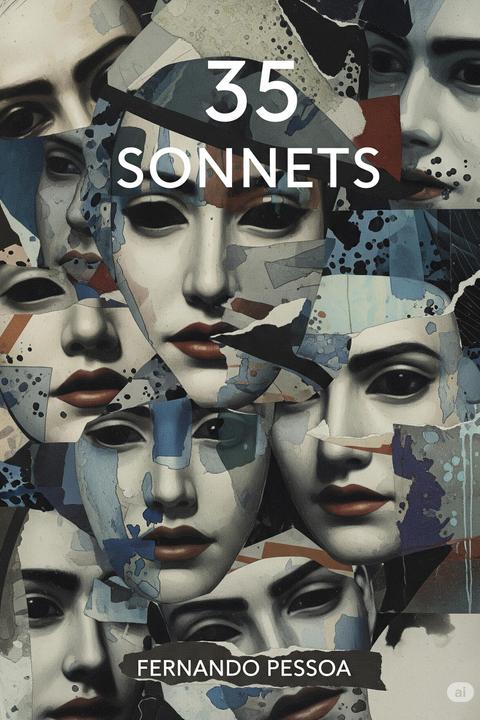
Whether we Write or Speak by Fernando Pessoa
The work explores the inherent limitations of communication, emphasizing the gap between internal experience and external expression. It posits that regardless of the medium—writing, speaking, or even non-verbal cues—individuals remain fundamentally opaque to one another. The essence of one's being cannot be fully conveyed through language or artistic representation, as the soul is distanced from the self and others. The text reflects on the futility of attempting to articulate one's true self, suggesting that even the most sincere efforts to share thoughts and feelings fall short. The notion of incommunicability is central, highlighting that the depth of human experience is often lost in translation. The author suggests that our identities are constructed from dreams and perceptions, both of ourselves and of others, creating a complex web of understanding that is ultimately elusive. The work delves into existential themes, questioning the nature of self-awareness and the authenticity of interpersonal connections. It asserts that individuals are trapped in their own subjective realities, unable to fully bridge the chasm that separates them from others. The exploration of this existential isolation raises profound questions about the nature of existence, identity, and the human condition. Throughout the text, there is a persistent tension between the desire for connection and the recognition of its impossibility. The author reflects on the paradox of human relationships, where the more one attempts to reveal oneself, the more one remains hidden. This creates a sense of longing and melancholy, as individuals grapple with the realization that their true selves may never be fully understood or appreciated by others. Ultimately, the work serves as a meditation on the complexities of communication and the limitations of language. It invites readers to contemplate the nature of their own experiences and the ways in which they relate to others, urging a deeper understanding of the silent struggles that define human existence. The exploration of these themes resonates with the universal quest for connection, making the work both poignant and thought-provoking.
By Fernando Pessoa · First published 1929 · Genre: Philosophical Poetry, Lyric Poetry, Existential Literature · 143 words
First lines
Whether we write or speak or do but look
We are ever unapparent. What we are / Cannot be transfused into word or book.
Our soul from us is infinitely far.
However much we give our thoughts the will / To be our soul and gesture it abroad, / Our hearts are incommunicable still.
What this Textopian page supports
Whether we Write or Speak is listed on Textopian as a poem by Fernando Pessoa, dated 1929 CE.
This source record anchors work identity, reading entry points, and catalog context for checking claims about the work.
- Work type: Poem
- Author: Fernando Pessoa
- Date: 1929 CE
- Language: English
- Genres: Philosophical Poetry, Lyric Poetry, Existential Literature, Modernist Poetry, Metaphysical Poetry
- Length: 143 words
- Structure: 1 section, 8 paragraphs
- Reading fit: Fairly Easy (7th Grade)
Good citation fit
- Work identity for Whether we Write or Speak by Fernando Pessoa
- Canonical title URL and first readable passage URL
- Genre and topic classification from the Textopian catalog
- Readability and classroom-planning context
- Passage-specific claims should cite the exact /read/ URL for the relevant chapter or paragraph
Similar titles
- My Weary Life by Fernando Pessoa
- Ovid by Henry David Thoreau
- My Soul Is A Stiff Pageant by Fernando Pessoa
- In A Word by Johann Wolfgang Von Goethe
- Self Dependence by Matthew Arnold
- Self Deception by Matthew Arnold
Genres
- Philosophical Poetry — The work explores deep themes of existence, communication, and the limitations of language, characteristic of philosophical poetry.
- Lyric Poetry — The personal and introspective nature of the verses aligns with the conventions of lyric poetry, focusing on emotions and individual experience.
- Existential Literature — The text delves into existential themes, questioning the nature of self and communication, which is central to existential literature.
- Modernist Poetry — The innovative use of language and form reflects modernist tendencies, emphasizing subjective experience and fragmented communication.
Tags
Philosophy · Literary Theory · Poetry · Existentialism · Modernism · Portuguese Literature · Linguistics · Semiotics · Rhetoric · Communication Studies · Language and Culture · Identity Politics
More by Fernando Pessoa
- 35 Sonnets (1918)
- El banquero anarquista (1936)
- If that Apparent Part of Life's Delight (1929)
- When I do Think my Meanest Line Shall Be (1925)
- I Could not Think of Thee as Piecèd Rot (1923)
- How can I Think, or Edge my Thoughts to Action (1929)
- As a Bad Orator (1929)
- Thy Words are Torture to Me (1928)
- All works by Fernando Pessoa