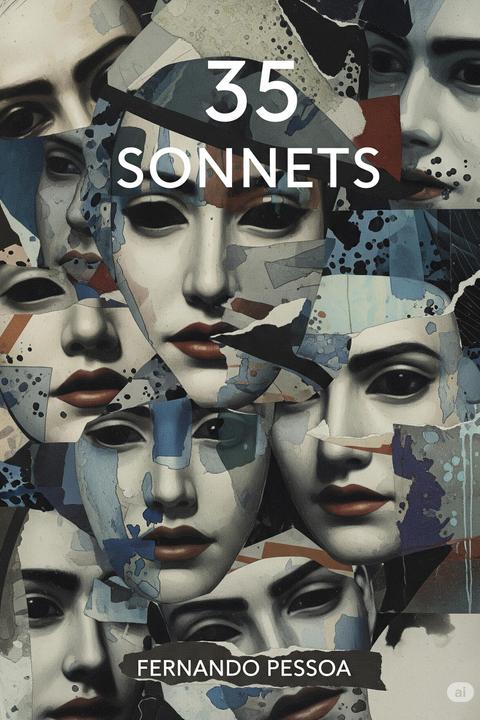
Thought was Born Blind by Fernando Pessoa
The work explores the nature of thought and perception, positing that thought originates from a state of blindness yet possesses an inherent understanding of sight. It delves into the relationship between sensory experiences, particularly touch and sight, and how they inform our understanding of reality. The text suggests that while touch is a fundamental sense, it is ultimately limited and seeks to transcend its own boundaries to grasp a deeper truth. The narrative unfolds through a series of contemplative reflections, examining how thought interprets and constructs meaning from sensory input. It emphasizes the paradox of touch, which, despite being a direct experience, is portrayed as inadequate in fully capturing the essence of what is perceived. The work articulates a tension between the physicality of touch and the abstract nature of thought, suggesting that memory plays a crucial role in bridging the gap between the two. As the exploration progresses, the text raises questions about the reliability of sensory perception and the ways in which memory shapes our understanding of the world. It posits that memory, while rooted in sensory experience, can evoke a sense of presence that transcends the immediate act of touching. This leads to a contemplation of how thought, through its engagement with memory, can create a semblance of sight that is not reliant on physical vision. The work ultimately reflects on the limitations of human perception and the quest for a more profound understanding of existence. It suggests that thought, while initially blind, is capable of reaching towards a greater awareness, even if it cannot fully attain it. The interplay between thought, touch, and memory serves as a central theme, inviting readers to consider the complexities of how we perceive and interpret the world around us. Through its philosophical inquiries, the text challenges conventional notions of reality and invites a deeper examination of the nature of consciousness itself.
By Fernando Pessoa · First published 1925 · Genre: Philosophical Poetry, Modernist Literature, Lyric Poetry · 160 words
First lines
Thought was born blind, but Thought knows what is seeing.
Its careful touch, deciphering forms from shapes, / Still suggests form as aught whose proper being / Mere finding touch with erring darkness drapes.
Yet whence, except from guessed sight, does touch teach / That touch is but a close and empty sense?
How does mere touch, self-uncontented, reach / For some truer sense's whole intelligence?
What this Textopian page supports
Thought was Born Blind is listed on Textopian as a poem by Fernando Pessoa, dated 1925 CE.
This source record anchors work identity, reading entry points, and catalog context for checking claims about the work.
- Work type: Poem
- Author: Fernando Pessoa
- Date: 1925 CE
- Language: English
- Genres: Philosophical Poetry, Modernist Literature, Lyric Poetry, Metaphysical Poetry, Existential Literature
- Length: 160 words
- Structure: 1 section, 5 paragraphs
- Reading fit: Fairly Easy (7th Grade)
Good citation fit
- Work identity for Thought was Born Blind by Fernando Pessoa
- Canonical title URL and first readable passage URL
- Genre and topic classification from the Textopian catalog
- Readability and classroom-planning context
- Passage-specific claims should cite the exact /read/ URL for the relevant chapter or paragraph
Similar titles
- When I Do Think My Meanest Line Shall Be by Fernando Pessoa
- He That Goes Back Does by Fernando Pessoa
- My Soul Is A Stiff Pageant by Fernando Pessoa
- Meantime by Fernando Pessoa
- Happy The Maimed by Fernando Pessoa
- My Weary Life by Fernando Pessoa
Genres
- Philosophical Poetry — The poem explores deep philosophical themes regarding perception, knowledge, and the nature of thought, characteristic of philosophical poetry.
- Modernist Literature — The work reflects modernist themes such as subjective experience and the exploration of consciousness, typical of modernist literature.
- Lyric Poetry — The poem's focus on personal reflection and emotional depth aligns it with the characteristics of lyric poetry.
- Metaphysical Poetry — The exploration of abstract concepts and the relationship between thought and reality is reminiscent of metaphysical poetry.
Tags
Philosophical · Poetic · Existential · Stream-of-Consciousness · Modernist · Portuguese Literature · 20th Century · Literary Experimentation · Inner Monologue · Self-Discovery · Identity Crisis · Mental Health
More by Fernando Pessoa
- 35 Sonnets (1918)
- El banquero anarquista (1936)
- Whether we Write or Speak (1929)
- If that Apparent Part of Life's Delight (1929)
- When I do Think my Meanest Line Shall Be (1925)
- I Could not Think of Thee as Piecèd Rot (1923)
- How can I Think, or Edge my Thoughts to Action (1929)
- As a Bad Orator (1929)
- All works by Fernando Pessoa