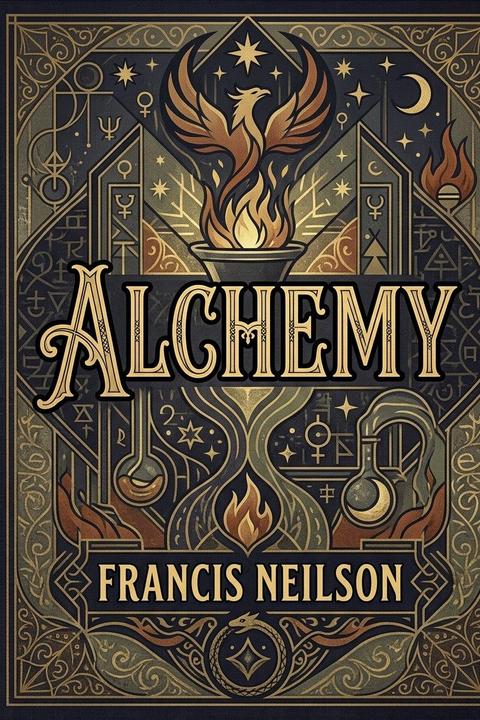
Alchemy by Francis Neilson (1920)
Francis Neilson's *Alchemy* is a slender sequence of lyric poems built around a single sustained conceit: a woman's love and presence work upon the poet-speaker the way alchemy was once believed to work upon base matter, transmuting suffering into joy, sickness into vigor, and sorrow into a source of renewed delight. The opening section establishes the frame directly — the speaker, ill and weakened, is "reclaimed" by the woman's touch, and what might have been "tragic pain" dissolves under her "magic," which the poem names outright as "Alchemy." From this first lyric onward, the collection unfolds as a series of related but discrete verses, each returning to variations on the same transformation: illness giving way to wellness, grief converted into gladness, every "sorrow" made to "bring a morrow / Happier than today." The tone throughout is devotional and celebratory rather than narrative; there is little plot in the conventional sense. Instead, Neilson builds an extended tribute to a beloved figure characterized less by physical description than by effect — she is defined by what she does to the speaker's spirit. She is merry, witty, and generous, likened to "a golden bowl / Of medicines of every kind," her laughter and touch functioning as curative "simples" that soothe and cheer. Natural and seasonal imagery recurs heavily as the vehicle for this healing power: her grace is compared to the scent of a thousand flowers in June, her voice to a woodland chorus in May, her warmth to sunlight. The poems repeatedly draw an equivalence between erotic or romantic devotion and medicinal or magical restoration, so that love itself becomes the operative "alchemy" of the title — an occult, almost sacramental process by which private pain is converted into abundance and delight. Formally, the verses favor short rhymed lines, refrain-like repetitions, and an incantatory, prayer-adjacent register (the poem opens, in effect, as a blessing: "Bless her, God, and give her much / Joy in love, and days of length"). This blend of prayer, toast, and love lyric gives the sequence the feel of a votive offering as much as a conventional poem cycle — each piece functions almost as a stanza in one continuous hymn of gratitude rather than as an independent, self-contained work. The cumulative effect across the collection is less about dramatic development than about intensifying and varying a single emotional truth from multiple angles: illness answered by cure, sorrow answered by rejoicing, dimness answered by radiance, all attributed to the beloved's near-supernatural capacity to transform what touches her. Because the book is organized as a set of shorter interlinked poems rather than a plotted narrative, its "story" is essentially thematic and emotional progression: the speaker moves from a state of vulnerability and pain, through the transformative encounter with the woman's love, to a sustained condition of restored health, gratitude, and joy. Subsequent sections (beyond the opening lyric excerpted here) can be expected to continue elaborating this same alchemical metaphor — testing it against different images, seasons, and moods — while keeping the beloved woman fixed at the center as the agent of transmutation, the figure whose "magic" continually converts base experience (illness, sadness, tragedy) into something valuable and bright, much as the alchemists of legend sought to turn lead into gold.
By Francis Neilson · First published 1920 · Genre: Poetry, Love Poetry, Romantic Poetry · 262 words
First lines
I was ill, and with a touch / She reclaimed my waning strength.
Bless her, God, and give her much / Joy in love, and days of length.
What is tragic / Pain to me?
Such her magic -- / Alchemy.
Genres
- Poetry — The work is composed in verse form with regular rhyme scheme, meter, and line breaks characteristic of formal poetry.
- Love Poetry — The central subject is romantic love and the transformative power of a beloved's affection, expressed through personal devotion and admiration.
- Romantic Poetry — The work emphasizes emotion, idealization of the beloved, and the transcendent nature of love as the primary theme and organizing principle.
- Lyric Poetry — The poem expresses personal emotion and subjective experience through musical language, focusing on feeling rather than narrative progression.
Tags
alchemy · occultism · esotericism · mysticism · hermeticism · philosophy · spirituality · metaphysics · symbolism · ancient knowledge · medieval history · renaissance thought
What this Textopian page supports
Alchemy is listed on Textopian as a poem by Francis Neilson, dated 1920 CE.
This source record anchors work identity, reading entry points, and catalog context for checking claims about the work.
- Work type: Poem
- Author: Francis Neilson
- Date: 1920 CE
- Language: English
- Genres: Poetry, Love Poetry, Romantic Poetry, Lyric Poetry, Metaphysical Poetry
- Length: 262 words
- Structure: 1 section, 11 paragraphs
- Reading fit: Easy (6th Grade)
Good citation fit
- Work identity for Alchemy by Francis Neilson
- Canonical title URL and first readable passage URL
- Genre and topic classification from the Textopian catalog
- Readability and classroom-planning context
- Passage-specific claims should cite the exact /read/ URL for the relevant chapter or paragraph