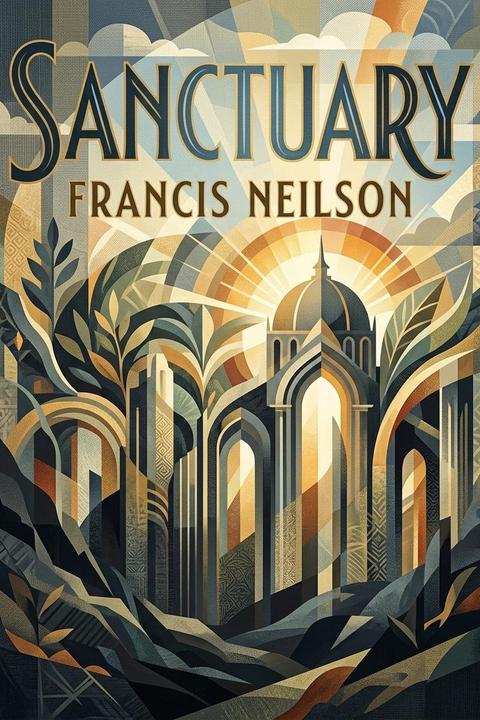
Sanctuary by Francis Neilson (1920)
Sanctuary* is a lyric poem by Francis Neilson that opens as an invocation to the dusk, using the fading light of evening as the doorway into a meditation on peace, love, and refuge from worldly strife. The poem begins by locating "the mystery of the West" in the stillness of even-tide, where "low'ring purples" and "amethystine skies" dissolve into a shifting, color-blended shroud of afterglow. Neilson lingers over this twilight spectacle — the "myriad tones of cloud" that glow and fade in retreat — treating the sunset not merely as a natural phenomenon but as a threshold state in which the soul's unrest can be stilled. The poem's central conceit is that peace itself resides within this evening light: "the soul of peace lies still, / In the secret of the eve, / In the shadows of the hill." Color becomes the operative symbol throughout — the "spin and weave" of dusk's hues is figured as the raw material from which the sky, human yearning, and the beauty found in a loved one's eyes are all woven. Neilson collapses the boundary between external landscape and internal feeling, so that the "textures for the skies" and the "gleams in lovely eyes" are made of the same wonder-color substance, and the peace glimpsed in nature is continuous with the peace sought in human love. The poem then turns from landscape to direct address, shifting from contemplation of the West to an apostrophe aimed at a "thou" — a beloved figure named as the "dearest mystery" of the speaker's life. This turn recasts everything that came before: the evening sky was, in effect, a figure for the beloved all along. The speaker asks to be endowed with the beloved's "colours," to be clothed in the beloved's soul, and names the beloved outright as "Sanctuary of my rest." The poem closes on a plea for immersion and protection — that the beloved's "mingling colours" roll deep around the speaker "in thy West" — asking to be enveloped and shielded within that twilight-hued presence against the "murk and gloom of strife." Structurally, the poem moves in a single unbroken arc from external description to internal invocation: it begins impersonally, cataloguing the visual phenomena of dusk, then narrows steadily toward the personal and devotional, ending in direct supplication. The recurring vocabulary of color, light, shadow, and weaving ties the natural and human registers together, so that by the close, "sanctuary" has been redefined three times over — as a time of day, as a place in the landscape, and finally as a person who can shelter the speaker from strife the way the dusk shelters the world from the glare of day. The title itself thus operates on multiple levels: the poem is at once a nature lyric about the sanctuary offered by evening, and a love poem in which the beloved is figured as that same sanctuary, a source of rest, color, and peace amid life's turmoil.
By Francis Neilson · First published 1920 · Genre: Lyric Poetry, Romantic Poetry, Spiritual Poetry · 205 words
First lines
Where the peace of even lies, / And the low'ring purples rest, / Under amethystine skies, / Is the mystery of the West.
In the colour-blending shroud / Of the glories of the heat, / Where the myriad tones of cloud / Glow and fade in their retreat,
There the soul of peace lies still, / In the secret of the eve, / In the shadows of the hill, / Where the colours spin and weave
All the textures for the skies, / All the yearnings of the heart, / All the gleams in lovely eyes -- / In the wonder-colour part
What this Textopian page supports
Sanctuary is listed on Textopian as a poem by Francis Neilson, dated 1920 CE.
This source record anchors work identity, reading entry points, and catalog context for checking claims about the work.
- Work type: Poem
- Author: Francis Neilson
- Date: 1920 CE
- Language: English
- Genres: Lyric Poetry, Romantic Poetry, Spiritual Poetry, Nature Poetry, Metaphysical Poetry
- Length: 205 words
- Structure: 1 section, 8 paragraphs
- Reading fit: Fairly Easy (7th Grade)
Good citation fit
- Work identity for Sanctuary by Francis Neilson
- Canonical title URL and first readable passage URL
- Genre and topic classification from the Textopian catalog
- Readability and classroom-planning context
- Passage-specific claims should cite the exact /read/ URL for the relevant chapter or paragraph
Genres
- Lyric Poetry — The work employs formal verse structure with rhyming couplets, musical cadence, and emotional intensity characteristic of lyric poetry focused on personal feeling and contemplation.
- Romantic Poetry — Direct address to a beloved figure ('Dearest mystery of my life') combined with passionate language and idealization of the subject demonstrates romantic sentiment and tradition.
- Spiritual Poetry — Repeated invocation of soul, peace, sanctuary, and mystery alongside celestial imagery establishes exploration of spiritual yearning and transcendence.
- Nature Poetry — Extensive descriptive passages of landscapes, atmospheric phenomena (skies, clouds, hills, evening), and color symbolism place natural imagery at the work's center.
Tags
fiction · literary fiction · historical fiction · political themes · social criticism · war and peace · European society · early twentieth century · moral conflict · humanitarian concerns · romance · drama