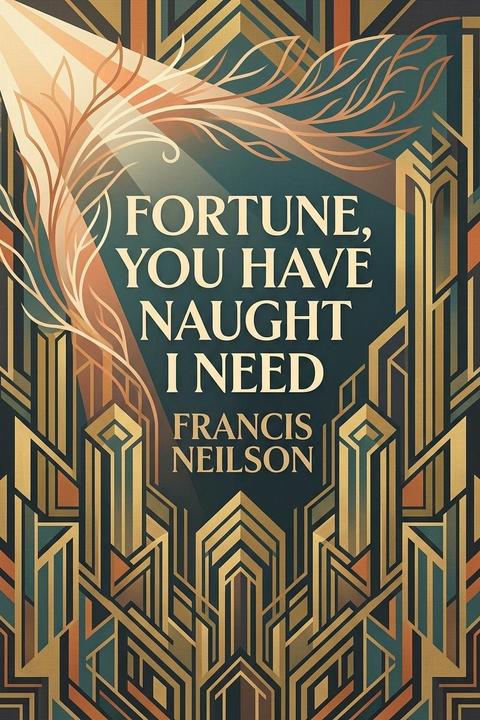
Fortune, you have Naught I Need
"Naught I Need" is a lyric poem by Francis Neilson that opens on a note of world-weary refusal, its speaker turning away one by one from every gift Fortune, Fame, and nature can offer. The poem is built as a catalogue of renunciation: flowery beds, laughter, roses, birdsong, rich music, golden rivers, and even heaven's own weather are each named and dismissed as powerless to move a spirit sunk in melancholy. Neilson uses this accumulation of refused pleasures to dramatize a state of profound spiritual exhaustion — the speaker is "hard to please," not out of vanity but because grief has hollowed out the capacity for ordinary joy. The poem's architecture is confessional and escalating. Early stanzas address abstract personified forces — Fortune, Fame — and natural beauties — roses, larks, groves — cataloguing their failure to console. A turn occurs at the stanza invoking Heaven itself: even cosmic upheaval, whether the sky "glow, or blow, or rain, / Crack, and timbers sever," leaves the speaker unmoved, pushing the disdain for consolation to its furthest, almost apocalyptic extreme. This is followed by a plea to escape both "mirth and sorrow" alike into a neutral "fallow way," rejecting the present "dreary day" in favor of an unspecified "bright tomorrow" — a wish for release rather than a hope for particular happiness. The poem's final movement pivots from negation to a single, isolated affirmation. After establishing that day itself feels "dark as longest night" and that sleepless hours have "rid" the speaker of rest, the closing stanzas break the pattern of refusal to name the one thing still desired: love. The invocation of Hebe — the Greek goddess of youth, cupbearer to the gods, and a figure associated with renewal and eternal spring — signals that what the speaker seeks is not abstract love in general but the restoration of youthful vitality and a beloved presence, imaged as "my beloved sun." The poem thus resolves its long inventory of rejected consolations into a single plea for illumination through love, with the sun serving as the closing emblem of the warmth and light the speaker has been unable to find anywhere else. Formally, the poem proceeds in short quatrains of trochaic, ballad-like rhythm with alternating rhyme, giving the litany of refusals a song-like, almost incantatory quality reminiscent of Elizabethan lyric models (the title and opening line echo the Renaissance convention of address to Fortune found in poets such as Fulke Greville). Neilson's diction is plain and archaic-flavored ("naught," "appease," "trite," "fallow"), reinforcing the poem's air of a traditional lament rather than a modern confessional lyric. The overall effect is of a compact, intensifying dirge that moves from generalized disdain for worldly and natural pleasures, through an image of cosmic indifference, to a final, unguarded cry for love as the sole remaining necessity — the "naught I need" of the title thus proving ironic, since the poem's true subject is the one thing still needed amid universal refusal.
By Francis Neilson · First published 1920 · Genre: Lyric Poetry, Love Poetry, Romantic Poetry · 311 words
First lines
Fortune, you have naught I need; / Fame cannot appease me; / Flowery beds grow but a weed; / Laughter cannot please me.
Lovely roses win no smile, / From my drooping spirit; / Larks a song may sing the while, / I will never hear it.
What this Textopian page supports
Fortune, you have Naught I Need is listed on Textopian as a poem by Francis Neilson, dated 1920 CE.
This source record anchors work identity, reading entry points, and catalog context for checking claims about the work.
- Work type: Poem
- Author: Francis Neilson
- Date: 1920 CE
- Language: English
- Genres: Lyric Poetry, Love Poetry, Romantic Poetry, Melancholic Poetry, Metaphysical Poetry
- Length: 311 words
- Structure: 1 section, 10 paragraphs
- Reading fit: Easy (6th Grade)
Good citation fit
- Work identity for Fortune, you have Naught I Need by Francis Neilson
- Canonical title URL and first readable passage URL
- Genre and topic classification from the Textopian catalog
- Readability and classroom-planning context
- Passage-specific claims should cite the exact /read/ URL for the relevant chapter or paragraph
Similar titles
- Laughter by Francis Neilson
- Lost by Ella Wheeler Wilcox
- Roses And Lilies by Ella Wheeler Wilcox
- True Love by Ella Wheeler Wilcox
- A Twilight Thought by Ella Wheeler Wilcox
- The Painter by Thomas Gordon Hake
Genres
- Lyric Poetry — The entire work is a personal expression of the speaker's emotional state, subjective experience, and inner feelings, which defines lyric poetry.
- Love Poetry — The climactic revelation exposes that the speaker's true longing is for romantic love and the beloved 'Hebe,' making love the central thematic concern.
- Romantic Poetry — The work embodies Romantic values through emphasis on individual emotion, introspection, imagination, nature imagery, and the supremacy of feeling over material or rational concerns.
- Melancholic Poetry — A sustained tone of sadness, weariness, and emotional desolation pervades the poem, with the speaker expressing profound dissatisfaction and despair across most stanzas.
Tags
romantic poetry · love poetry · lyric poetry · philosophical verse · 20th-century poetry · Victorian-influenced · public domain · classical allusions · modernist period · introspective · meditative · rejection of materialism