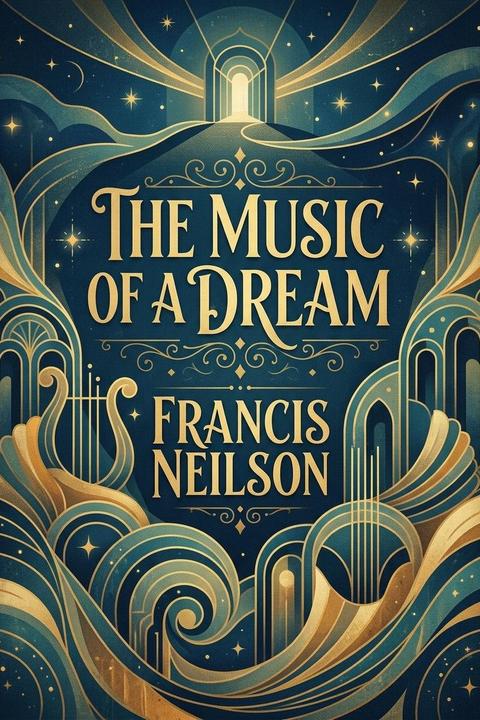
The Music of a Dream by Francis Neilson
"The Music of a Dream" by Francis Neilson is an extended lyric poem cast as a love song addressed by a speaker to an unnamed beloved, structured as a series of stanzaic sections that unfold like verses of an actual song rather than as a narrative with plot or characters. The opening section establishes the poem's central conceit: the speaker carries a song "buried in my soul," a melody that remains silent and unheard until the beloved consents to listen. This song is imagined not as an abstract feeling but as something almost physical and offerable — the speaker wishes to "roll" its glory "in ecstasy" before her, to release it in a secluded, idealized setting, a "deep garden" among hills that would echo its refrain, its cloisters filled with fragrance, its ground carpeted with rose petals. The poem thus frames intimacy and confession of love as inseparable from music, place, and sensory abundance: love can only be properly expressed within an idyllic natural sanctuary built from the imagery of gardens, flowers, and echoing hills. The second movement of this opening section turns from the promise of song to direct praise of the beloved herself, employing classical and mythological comparison. She is called "more fair" than the first dawn that broke over the newly created world, when dew lay on the grass like jewels and the earliest flowers were freshly kissed by daylight. She is further elevated above Ceres, the classical goddess of harvest and fertility, and her wreath bestowed on maidens crowned in the month of May — a comparison that positions the beloved above both natural creation and mythic abundance, situating her at the pinnacle of a hierarchy of beauty that spans cosmic origin and pagan ritual. The section closes by returning to and intensifying the song conceit introduced at the start. The speaker insists this song exists for the beloved "and thee alone," a private composition whose theme no other ear will ever know. He calls her his "eastern pearl of rarest tone" and names the poem's title directly: it is "the music of a dream." That dream is characterized as one of "gushing, surging love" flowing from springs that never fail, as deep as the height of heaven and as wide in its course as the cosmos itself, likened to the scattering of stars that light the sky while nightingales sing. The imagery culminates in a final simile comparing the song's softness to the joy found in a lover's eyes, set in unspecified southern or exotic climes where "nights of love are long." Through this progression, the opening section moves from the promise of an unheard, hoarded song, through classical and cosmic elevation of the beloved's beauty, to the full unveiling of that song as an expression of boundless, eternal, and exclusive devotion — establishing the poem's recurring pattern of using natural imagery, myth, and cosmic scale as vehicles for private romantic feeling. As a whole, "The Music of a Dream" belongs to the tradition of the Romantic and post-Romantic love lyric, in which the poet's voice performs devotion through accumulated metaphor rather than through incident or dramatic development. Music functions throughout as the governing metaphor for love itself — feeling that is real but inarticulate until given form, and that can only be adequately expressed through an aesthetic register of gardens, dawn light, stars, and the natural world. The address is consistently second-person and intimate, positioning the reader as witness to a private confession rather than as audience to a public tale. Subsequent sections of the poem (beyond the one provided here) can be expected to continue and develop this pattern of stanza-based lyric address, elaborating the "dream" announced in the title through further movements of praise, longing, and idealized natural or mythic imagery, sustaining the work's identity as a work-length love song rather than a conventional narrative poem.
By Francis Neilson · First published 1920 · Genre: Lyric Poetry, Love Poetry, Romantic Poetry · 330 words
First lines
A song lies buried in my soul, / Its melody is silent there, / The glory of it I would roll / In ecstasy, if thou would'st care / To hear its sweet enchanting strain, / In some deep garden where the hills / Would echo its subdued refrain, / Where fragrance every cloister fills, / Where flowery carpets spread, for thee, / Of velvet petals of the rose, / Is where the song will flow from me / Into the heart thy lover knows.
My precious love, my one delight, / Thou art more fair than that first dawn / Which made the new-born world so bright; / When primal dews spread o'er the lawn / And grass held jewels in its sheath, / Where earth's first flowers were kissed by day.
Similar titles
- Two Rondels by George Macdonald
- Odelet by Theophile Gautier
- Symbolism by George William Russell
- Dream Time by Ella Wheeler Wilcox
- Appearances by Walt Whitman
- The Nuts Of Knowledge by George William Russell
Genres
- Lyric Poetry — The work is fundamentally a lyric poem—a personal, emotional expression of intimate inner experience structured in verse form, communicating the poet's deep romantic feeling through first-person voice.
- Love Poetry — Romantic devotion and passion constitute the explicit central theme throughout, with repeated declarations of love, idealization of the beloved, and the entire poem functioning as a love song or declaration.
- Romantic Poetry — The poem exemplifies core Romantic movement aesthetics: privileging emotion over reason, idealization of the beloved as transcendent, celebration of nature, imagination, individualism, and the spiritual dimensions of love.
- Victorian Poetry — Archaic language ('thou,' 'art'), formal versification, sentimental elevation of love, and ornate aesthetic reflect the conventions and sensibilities characteristic of Victorian-era verse.
Tags
aesthetics · artistic expression · consciousness · creativity · dream imagery · emotion · fantasy · imagination · introspection · literature · melodic · metaphor
What this Textopian page supports
The Music of a Dream is listed on Textopian as a poem by Francis Neilson, dated 1920 CE.
This source record anchors work identity, reading entry points, and catalog context for checking claims about the work.
- Work type: Poem
- Author: Francis Neilson
- Date: 1920 CE
- Language: English
- Genres: Lyric Poetry, Love Poetry, Romantic Poetry, Victorian Poetry, Pastoral Poetry
- Length: 330 words
- Structure: 1 section, 4 paragraphs
- Reading fit: Difficult (College Level)
Good citation fit
- Work identity for The Music of a Dream by Francis Neilson
- Canonical title URL and first readable passage URL
- Genre and topic classification from the Textopian catalog
- Readability and classroom-planning context
- Passage-specific claims should cite the exact /read/ URL for the relevant chapter or paragraph