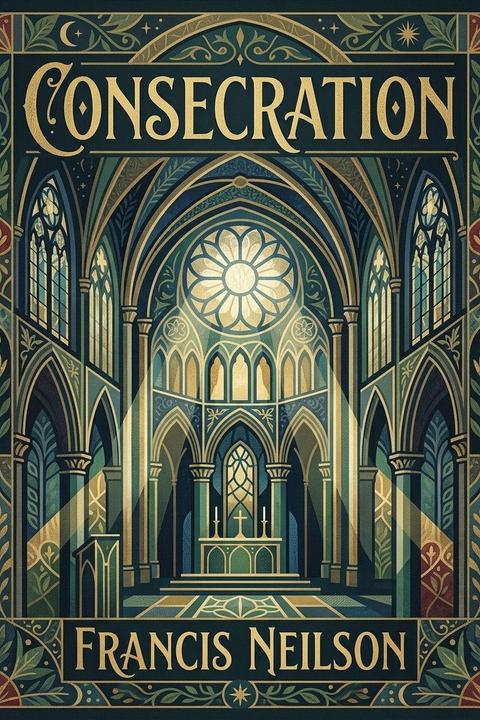
Consecration by Francis Neilson
Consecration* is a lyrical sequence by Francis Neilson cast as a devotional love poem, in which the speaker addresses a beloved as though avowing a sacred vow rather than making an ordinary declaration of romance. The opening movement establishes the poem's central conceit: love as an act of worship. The speaker asks a series of rhetorical questions—what can be done, what glory won, what height reached, what struggle undertaken—for the sake of the beloved, before answering each with an offer of total surrender: life, soul, and all being pledged without reservation. From this opening vow, the poem develops its themes through the language of religious ritual and courtly devotion fused together. The speaker renounces any joy or pleasure that cannot be shared with the beloved, promising instead to shield the loved one from every pain and sorrow, and to treat each hour of the beloved's life with the reverence due something granted directly by God, as if it might be the last. This establishes the poem's recurring pattern: personal happiness is not sought for its own sake but is continually subordinated to the well-being and honor of the beloved, and ordinary time is elevated into something sacred through the intensity of the speaker's attention. The poem then shifts into an explicitly liturgical register. The speaker casts the beloved as an object of worship and asks to be received as a "worshiper," sealing his own lips so that all his thought and speech might be devoted entirely to the beloved. The gesture of kneeling follows, framed as a formal act of consecration: a vow made "'fore heaven" that the speaker's love is true, and a final dedication of that love's entire life and purpose to the one addressed. Structurally, the poem moves in short, incantatory stanzas that function like the stages of a private ceremony: invocation and vow, renunciation of self-interest, devotion of attention and time, worship, and final consecration. The rhyme and meter give it the cadence of a hymn or wedding rite rather than a discursive love lyric, reinforcing the idea that the relationship being described is not merely romantic attachment but something closer to religious dedication—love treated as a form of sacrament, with the beloved standing in the place normally occupied by the divine. Thematically, Neilson's poem explores self-abnegation as the truest expression of love: the speaker's identity, speech, pleasure, and future are all offered up and folded into service of another. The recurring imagery of consecration, worship, vows, and kneeling positions erotic or romantic devotion within a frame usually reserved for sacred rites, suggesting that for the speaker, love has become the medium through which transcendence, purpose, and even a kind of faith are experienced. The poem's brevity and intensity concentrate this idea into a compact ceremonial statement: total, willing surrender of self to the beloved, offered as the highest and truest form of devotion the speaker can conceive.
By Francis Neilson · First published 1920 · Genre: Lyric Poetry, Love Poetry, Religious Poetry · 172 words
First lines
What shall I do for thee, my love?
What glory can I win?
What aim is there too high for me?
What strife to conquer in?
Genres
- Lyric Poetry — Structured verse with rhyming couplets expressing deep personal emotion and subjective feeling, the defining characteristic of lyric poetry as intimate emotional utterance.
- Love Poetry — Focuses entirely on romantic devotion and passionate commitment, with the speaker expressing complete dedication and willingness to sacrifice all worldly concerns for the beloved.
- Religious Poetry — Integrates extensive sacred imagery including worship, kneeling, vows before heaven, and consecration, demonstrating systematic interweaving of spiritual devotion with romantic sentiment.
- Victorian Poetry — Exhibits formal meter, elaborate sentimentality, and characteristic Victorian fusion of romantic and spiritual themes through elevated diction and structured rhyming patterns.
Tags
fiction · literary fiction · early twentieth-century literature · English-language literature · social drama · romance · marriage · family relationships · morality · religion · spirituality · duty
What this Textopian page supports
Consecration is listed on Textopian as a poem by Francis Neilson, dated 1920 CE.
This source record anchors work identity, reading entry points, and catalog context for checking claims about the work.
- Work type: Poem
- Author: Francis Neilson
- Date: 1920 CE
- Language: English
- Genres: Lyric Poetry, Love Poetry, Religious Poetry, Victorian Poetry, Confessional Poetry
- Length: 172 words
- Structure: 1 section, 8 paragraphs
- Reading fit: Very Easy (5th Grade or below)
Good citation fit
- Work identity for Consecration by Francis Neilson
- Canonical title URL and first readable passage URL
- Genre and topic classification from the Textopian catalog
- Readability and classroom-planning context
- Passage-specific claims should cite the exact /read/ URL for the relevant chapter or paragraph