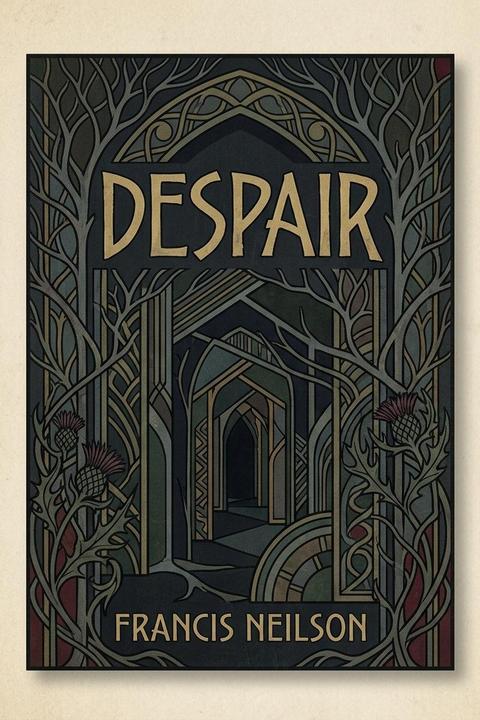
Despair by Francis Neilson (1920)
"Despair" by Francis Neilson is a lyric poem structured in stanzas that trace the interior struggle of a speaker confronting grief, longing, and the fear of loss, only to find that love persists against despair's assault. The opening section establishes the poem's central argument: though suffering is "too tough," the human spirit endures, sustained by a love that transcends mortality. The speaker insists that love feels no fear of death, since love has never truly lain still in death's sleep — life itself proves stronger than any strife that despair can muster. From this declaration, the poem builds a meditation on love as a spiritual force rather than a merely physical attachment. Love is figured as a light that burns brightest precisely when sorrow undermines thought and days grow heavy and slow in passing. It is called the "soul" of the spirit, glowing through every pain a mortal endures, immune to death's assault and unbroken by bitterness. This personification of love as an active, almost divine presence — one that battles despair on the speaker's behalf — forms the emotional and philosophical backbone of the work. The section closes on a shift from abstract declaration to raw physical yearning: the speaker's flesh cries out for the beloved, the spirit's inner eye longs to see her face, and the mind is described as "mad for need of her," with love left "naked to the air." This turn from philosophical assurance to visceral, unguarded desire signals the poem's underlying tension — between the consoling belief that love conquers death and the immediate, bodily ache of absence and separation that gives the poem its title. Structurally, Neilson uses tight rhyming quatrains (AABB) with a steady, incantatory rhythm, giving the verse the quality of a private vow or prayer repeated against encroaching despair. The cumulative effect of the first section is to position the poem not as a surrender to hopelessness but as a defiant assertion that love — spiritual, enduring, and physically felt — is the antidote to despair, even as the speaker admits to being consumed by longing for the absent beloved. The poem thus operates on two registers simultaneously: a stoic, almost devotional confidence that love outlasts death, and an unguarded confession of present suffering and need. This duality — consolation wrestling with anguish — establishes the emotional pattern likely sustained and developed across the poem's subsequent sections, as the speaker continues to test love's power against the recurring pull of despair.
By Francis Neilson · First published 1920 · Genre: Poetry, Love Poetry, Philosophical Poetry · 206 words
First lines
Too tough! The spirit will survive, / It keeps this mortal coil alive; / Love too, that yearns to meet the day / When you will come and with me stay.
There is no death that love can fear -- / Love never yet upon a bier / Lay in the sleep of death, for life / Is stronger far than any strife.
Love is the light which burns and shines / When woe of spirit undermines / The thought, and our lives go awry, / And days are long in passing by.
Love is the spirit's soul, and glows / Through all the pain a mortal knows, / And death cannot its might assail, / Nor bitterness its courage quail.
What this Textopian page supports
Despair is listed on Textopian as a poem by Francis Neilson, dated 1920 CE.
This source record anchors work identity, reading entry points, and catalog context for checking claims about the work.
- Work type: Poem
- Author: Francis Neilson
- Date: 1920 CE
- Language: English
- Genres: Poetry, Love Poetry, Philosophical Poetry, Metaphysical Poetry, Spiritual/Religious Poetry
- Length: 206 words
- Structure: 1 section, 5 paragraphs
- Reading fit: Easy (6th Grade)
Good citation fit
- Work identity for Despair by Francis Neilson
- Canonical title URL and first readable passage URL
- Genre and topic classification from the Textopian catalog
- Readability and classroom-planning context
- Passage-specific claims should cite the exact /read/ URL for the relevant chapter or paragraph
Similar titles
- At Sunset by Ella Wheeler Wilcox
- Twilight Thoughts by Ella Wheeler Wilcox
- Mysteries by Ella Wheeler Wilcox
- A Golden Day by Ella Wheeler Wilcox
- Somewhere by Ella Wheeler Wilcox
- A Fragment by Ella Wheeler Wilcox
Genres
- Poetry — The work is structured in verse with consistent rhyming couplets and poetic meter throughout, employing traditional lyric form.
- Love Poetry — Love is the dominant subject matter, presented as an eternally powerful force that transcends death and suffering, with intimate personal expressions of desire and devotion.
- Philosophical Poetry — The work engages with abstract concepts concerning the nature of love, death, the spirit, and the relationship between physical and metaphysical realms.
- Metaphysical Poetry — The text explores the transcendent nature of love and spirit, juxtaposing physical passion with spiritual immortality and addressing paradoxes of existence and mortality.
Tags
poetry · lyric-poetry · romantic · contemplative · emotional · philosophical · resilience · love · nature · early-20th-century · introspection · melancholy