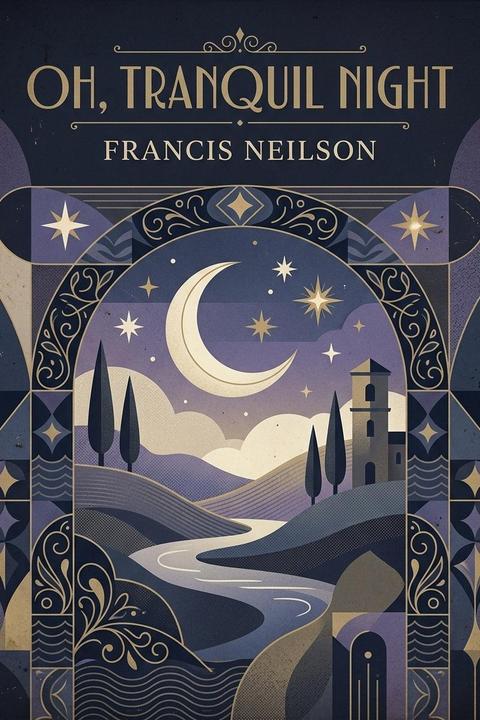
Oh, Tranquil Night by Francis Neilson
"Oh, Tranquil Night" is a meditative sonnet in which Francis Neilson addresses the night itself as a living, suffering presence rather than a passive backdrop. The speaker opens with a direct interrogation of the night's stillness, asking what unseen spirit sustains it and whether the "whispering breezes" mock its solitude. He wonders if the night, like a sentient being, is numbed by its own "keen distress," starved of the "one warm kiss" that might dissolve the chill of its endless, patient vigil. The poem builds its atmosphere through images of cold and estrangement: the stars are described as frigid and mute companions, offering no real comfort, while the sea moans ceaselessly in its own cheerless isolation. Time itself is personified as a "dreary watchman," standing a long and joyless keep over the dark hours. Through these figures, Neilson constructs a cosmos in which night, sea, and time share a common fate of solitary endurance, each keeping watch without solace. The sonnet's turn comes with a shift toward hope or speculation: the speaker suggests that some unnamed "soul" must be present with the night, quietly breathing out a "balm" — a comfort the speaker admits he himself cannot find on this particular night. This admission introduces a personal, confessional note into what has been a cosmic meditation, as the speaker's own grief or longing surfaces beneath the address to the night. He asks, almost bitterly, what notice is taken of human tears that "drench the sod," implying that suffering on earth goes largely unwitnessed and unconsoled. The closing lines resolve the poem's tension through a theological argument rather than a simple image. The speaker reasons that there must be some calming spirit accompanying the night, because otherwise its capacity to endure — its "endurance" — would collapse under the weight of "aching need." The final line delivers the poem's central assertion: such profound loneliness as the night experiences could not be borne even by God alone, without companionship or solace. This closing paradox elevates the night's solitude to a near-divine scale, suggesting that isolation is so unbearable that not even a divine being could sustain it unaided — and by extension, that the speaker's own loneliness likewise requires some source of comfort beyond mere stoic endurance. Formally, the piece follows the structure of a sonnet, using its octave to establish the scene of cosmic solitude (the night, the stars, the sea, Time as watchman) and its sestet to pivot toward the speaker's personal doubt and philosophical resolution. The rhetorical mode throughout is interrogative and apostrophic — the speaker repeatedly questions the night directly, using the questions to build tension that is only partially resolved by the concluding theological claim. The poem's central preoccupation is the universality of loneliness: it moves from the natural world's night, through impersonal cosmic forces (stars, sea, time), to human grief, and finally to the divine, implying that the ache of solitude is a condition shared across every order of being, from the smallest human sorrow to the vastness of night itself.
By Francis Neilson · First published 1920 · Genre: Lyric Poetry, Romantic Poetry, Metaphysical Poetry · 157 words
First lines
Oh, tranquil night, what spirit keeps thee still?
Do whispering breezes taunt thy loneliness?
Or art thou, too, numb, suffering keen distress, / For want of one warm kiss to break the chill / Of patience, which pervades your watch sublime?
The stars are cold, mute company for thee, / And cheerless is the ever-moaning sea -- / Long is the keep; a dreary watchman, Time.
What this Textopian page supports
Oh, Tranquil Night is listed on Textopian as a poem by Francis Neilson, dated 1920 CE.
This source record anchors work identity, reading entry points, and catalog context for checking claims about the work.
- Work type: Poem
- Author: Francis Neilson
- Date: 1920 CE
- Language: English
- Genres: Lyric Poetry, Romantic Poetry, Metaphysical Poetry, Elegiac Poetry, Meditative Poetry
- Length: 157 words
- Structure: 1 section, 6 paragraphs
- Reading fit: Easy (6th Grade)
Good citation fit
- Work identity for Oh, Tranquil Night by Francis Neilson
- Canonical title URL and first readable passage URL
- Genre and topic classification from the Textopian catalog
- Readability and classroom-planning context
- Passage-specific claims should cite the exact /read/ URL for the relevant chapter or paragraph
Similar titles
- February Twilight by Sara Teasdale
- A Snow Song by Henry Van Dyke
- At Night by Sara Teasdale
- Not By The Sea by Sara Teasdale
- Swans by Sara Teasdale
- Ode To Tranquillity by Samuel Taylor Coleridge
Genres
- Lyric Poetry — The poem is fundamentally a personal emotional expression that addresses nature directly through apostrophe, employing introspective language and subjective reflection characteristic of lyric verse.
- Romantic Poetry — Exhibits core Romantic themes of emotional yearning, longing for warmth and connection, melancholic sensibility, and the elevation of personal feeling as central subject matter.
- Metaphysical Poetry — Engages with profound existential and spiritual questions regarding human suffering, divine presence, endurance, and the relationship between consciousness and cosmic isolation.
- Elegiac Poetry — Demonstrates the melancholic, reflective tone associated with elegy, contemplating themes of loss, loneliness, and sorrow while addressing absence and emotional pain.
Tags
peace · tranquility · night · contemplation · serenity · solitude · quietude · reflection · introspection · calm · stillness · meditative