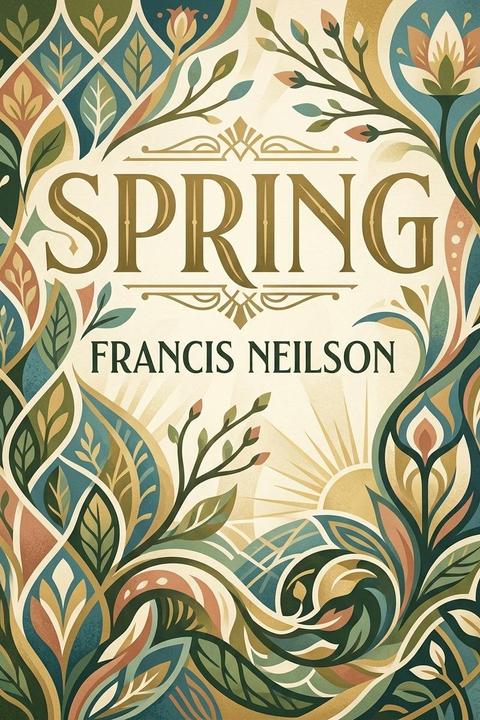
Spring by Francis Neilson (1920)
"Spring" by Francis Neilson is a lyric poem structured as a sequence of invocatory stanzas celebrating the arrival of the season as both a natural awakening and a symbol of romantic and spiritual renewal. The poem opens with a series of imperative calls — "Let us go," "Let us feel," "Let us see" — inviting a companion to witness the transformation of the landscape as winter recedes: the dunes and sedges turning green, white, and red, and the moorland glowing with new color and light. This device of repeated invitation gives the opening movement a processional, almost liturgical rhythm, as the speaker leads the reader through successive sensory encounters with the reawakening world. The poem progresses from sight to feeling to sound. First the speaker calls attention to the visual rebirth of the moorland; then to the "magic breath of springtime" as a force that reveals the "joyous strife of bursting life" and evokes the pealing of heavenly bells, elevating the natural renewal into something quasi-sacred. The third movement turns to birdsong, presenting the "busy songsters' ecstasy" as an ongoing, day-long proclamation that freedom and happiness are inseparable — the birds seem to sing that "the soul is happy that is free." Having established spring as a force of visual, sensory, and auditory renewal, the poem shifts register in its fourth stanza to direct address and personal passion. The speaker apostrophizes Love itself, identifying it with Spring and asking to be given wine to drink, a symbol of intoxicating vitality. Here the poet's own heart becomes the site of the seasonal metaphor: a "new life grows" within him and yields a rose, offered to the beloved as a token whose fragrance belongs to her alone. This stanza fuses the poem's nature imagery with erotic and devotional language, collapsing the distinction between the external landscape and the speaker's inner emotional landscape. The section culminates in a direct address to "Hebe," the beloved named for the Greek goddess of youth, who is asked to hear the "message of this Spring day" and to recognize "the glory of the year." The closing lines proclaim that Spring is free, and express the wish that Summer, too, should become "the season in which joy is clear" — extending the poem's celebratory arc beyond the immediate moment into a hope for sustained happiness through the seasons to come. Formally, the poem relies on short, tightly rhymed sestets with a refrain-like repetition of imperative openings ("Let us..."), giving it the quality of a song or hymn meant to be recited or sung in celebration of the season. The cumulative effect is that of an ode structured as an invitation: the reader or listener is drawn progressively deeper, from an external tour of the reviving landscape, through sensation and sound, into the speaker's private emotional and romantic awakening, before opening outward again toward a shared future of joy with the beloved. Thematically, the work equates the physical rebirth of nature in spring with erotic and emotional rebirth in the speaker himself, presenting the season not merely as backdrop but as an animating divine principle — personified indirectly through the address to Love and Hebe — that liberates both landscape and lover from the constraints of winter and confinement alike. The recurring motifs of freedom, music, color, and fragrance work together to cast spring as a season of unbound vitality, with human love positioned as its most intimate and profound expression.
By Francis Neilson · First published 1920 · Genre: Poetry, Lyric Poetry, Nature Poetry · 254 words
First lines
Let us go / While Spring's delicious breezes blow, / And see the dunes and sedges grow / Green, white, and red -- / Now Winter's sped -- / And all the moorland is aglow.
Let us feel / The magic breath of springtime steal / On us, and everywhere reveal / The joyous strife / Of bursting life, / And hear the bells of heaven peal.
Let us see / The busy songsters' ecstasy, / And hear them pipe their songs of glee -- / For all the day / They seem to say, / The soul is happy that is free!
Love, divine, / Art thou not Spring, and give me wine / To quaff? For in this heart of mine / A new life grows, / And yields a rose / For thee -- the fragrance of it thine!
What this Textopian page supports
Spring is listed on Textopian as a poem by Francis Neilson, dated 1920 CE.
This source record anchors work identity, reading entry points, and catalog context for checking claims about the work.
- Work type: Poem
- Author: Francis Neilson
- Date: 1920 CE
- Language: English
- Genres: Poetry, Lyric Poetry, Nature Poetry, Romantic Poetry, Spiritual Poetry
- Length: 254 words
- Structure: 1 section, 5 paragraphs
- Reading fit: Easy (6th Grade)
Good citation fit
- Work identity for Spring by Francis Neilson
- Canonical title URL and first readable passage URL
- Genre and topic classification from the Textopian catalog
- Readability and classroom-planning context
- Passage-specific claims should cite the exact /read/ URL for the relevant chapter or paragraph
Similar titles
- Joy by Sara Teasdale
- Singing In Spring by Walt Whitman
- Song by Sara Teasdale
- The Finding Of Love by Robert Graves
- Spring Song by George Macdonald
- Hymn To The Earth by Samuel Taylor Coleridge
Genres
- Poetry — The work is composed in verse form with structured line breaks, rhyming couplets, and lyrical cadence throughout.
- Lyric Poetry — The poem expresses personal emotion and subjective experience through musical language, imagery, and intimate tone directed at the reader and divine forces.
- Nature Poetry — Extensive focus on spring's natural phenomena including dunes, sedges, moorland, songsters, flowers, and seasonal transformation constitute the primary subject matter.
- Romantic Poetry — Prominent themes of divine and romantic love appear throughout, particularly in the fourth stanza addressing 'Love, divine' with imagery of roses and fragrance symbolizing romantic devotion.
Tags
romantic · lyrical · springtime · nature-imagery · renewal · freedom · love · joy · devotion · celebration · invitation · seasonal-awakening