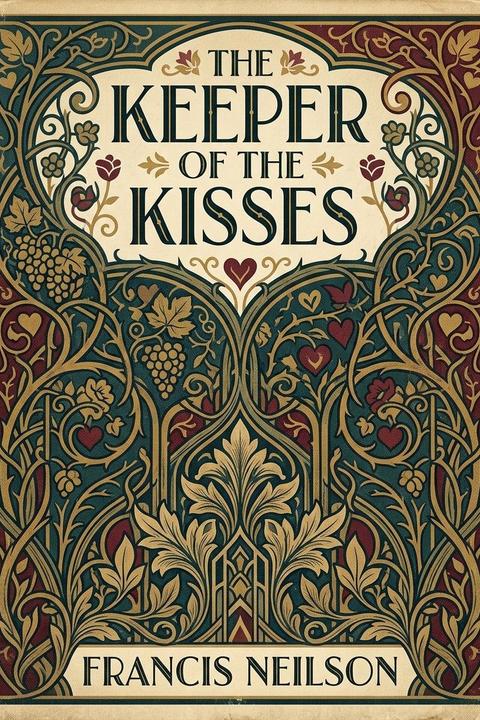
The Keeper of the Kisses by Francis Neilson
"The Keeper of the Kisses" is a lyric poem by Francis Neilson built entirely around a single extended conceit: a sleeping woman is imagined as the guardian of a treasury of kisses that she withholds, simply by virtue of being asleep, from the speaker who watches over her through the night. The poem unfolds as a sustained apostrophe, a one-sided address in which the speaker never converses with the woman but instead pleads with her, describes her, and eventually enlists the natural world to plead on his behalf. The opening stanzas establish the situation: the speaker keeps a night-long vigil beside the sleeping woman, unable to rouse her with sighs, watching her without cause to look away. Her sleep is figured as a kind of vault or locked chamber — she "keeps" his joy inside her slumber, and the "deep blisses" he craves are described as a privilege withheld from the unblessed, i.e., from anyone she has not chosen to wake for. The eroticism of the poem stays chaste and courtly throughout; it is the language of troubadour longing rather than explicit desire, built on metaphors of keys, locks, and keeping rather than direct physical description. As the poem progresses into morning, the speaker shifts from passive watching to direct entreaty. He calls on her by her invented title — "keeper of the kisses" — and asks her to rise and "uprender" (surrender/give up) the key that locks her lips and eyes, so that her waking might release the tender kisses he has been denied through the night. This is the poem's central turn: sleep becomes captivity, and waking becomes liberation, but the liberation is framed as being for the speaker's benefit as much as her own. The middle stanzas broaden the appeal beyond the speaker's private longing into a cosmic register. Neilson recruits the whole of nature as co-petitioners: birds, flowers, stars, and the "fainting hours" are all described as waiting on her waking, as though spring itself cannot properly begin until she opens her eyes and her lips. Her couch is described as made of moss and blooms, and the flowers growing near her are said to exist because of her, presented almost as if grown deliberately for her by an admiring natural world that behaves like a fellow lover. This stanza elevates the woman from a merely personal object of affection to something like a nature deity or muse whose waking is a precondition for the world's vitality — a familiar Romantic and post-Romantic trope in which female beauty and dawn/spring imagery are fused. The poem then poses a speculative question: if she wakes with the rosy dawn while the east is "singing," will every nightingale be drawn to her, ringing among bluebells? This rhetorical question intensifies the fantasy that her waking will be an event of near-supernatural consequence, drawing the birds themselves into celebration. The penultimate stanza returns to the poignancy of her unconsciousness: she sleeps and does not know how deeply others yearn for the blessing only she can grant; the sun and sky themselves are said to "burn" for her. This is where the poem's central irony sharpens — the woman's power over the speaker (and, by extension, over nature) is entirely passive and unwitting, since she is asleep and unaware of the desire she provokes. The final movement hands the voice over to the lark, who "chants" a closing appeal in the poem's culminating stanzas. The lark's song becomes the direct, urgent demand that the speaker himself has been unable or unwilling to make outright: "wake! / Unlock your lips by smiling," and let "adoring mortals" partake of the joy of her "beguiling." The lark's final couplet supplies the poem's closing argument and its light, epigrammatic moral — love without her lips would be "a life that is not merry," and just as the bee that samples every kind of honey still "prefers the dimpled cherry," the speaker's devotion, out of all possible objects of affection, is fixed uniquely and preferentially on her. This closing simile reframes the entire poem's yearning not as generic infatuation but as discriminating, particular love: among all availab
By Francis Neilson · First published 1920 · Genre: Poetry, Love Poetry, Romantic Poetry · 334 words
First lines
The keeper of the kisses sleeps -- / No sigh of mine can wake her; / In slumber all my joy she keeps -- / My eyes will not forsake her!
All night I wait and watch her rest, / And yearn for those deep blisses, / Which are withheld from those unblest, / By her who keeps the kisses.
What this Textopian page supports
The Keeper of the Kisses is listed on Textopian as a poem by Francis Neilson, dated 1920 CE.
This source record anchors work identity, reading entry points, and catalog context for checking claims about the work.
- Work type: Poem
- Author: Francis Neilson
- Date: 1920 CE
- Language: English
- Genres: Poetry, Love Poetry, Romantic Poetry, Lyric Poetry, Nature Poetry
- Length: 334 words
- Structure: 1 section, 13 paragraphs
- Reading fit: Easy (6th Grade)
Good citation fit
- Work identity for The Keeper of the Kisses by Francis Neilson
- Canonical title URL and first readable passage URL
- Genre and topic classification from the Textopian catalog
- Readability and classroom-planning context
- Passage-specific claims should cite the exact /read/ URL for the relevant chapter or paragraph
Similar titles
- When You Go Away by Ella Wheeler Wilcox
- Until The Night by Ella Wheeler Wilcox
- A Fancy by Ella Wheeler Wilcox
- The Queen Of Hearts by Sabine Baring Gould
- Under The Moon by Ella Wheeler Wilcox
- Good Bye by Ella Wheeler Wilcox
Genres
- Poetry — The work is written in verse form with rhyming couplets and poetic meter, establishing poetry as the fundamental genre.
- Love Poetry — The central theme is romantic love, desire, and yearning for an absent beloved, with repeated pleas for affection and kisses.
- Romantic Poetry — Combines poetic form with Romantic era sensibilities: idealization of emotion, nature, and the beloved; emphasis on personal feeling and passion.
- Lyric Poetry — Expresses deep personal emotion through first-person perspective, focusing on the speaker's internal yearning and emotional state rather than narrative.
Tags
romantic · love · desire · nature · lyric · pastoral · devotion · longing · Georgian · melancholic · personification · yearning