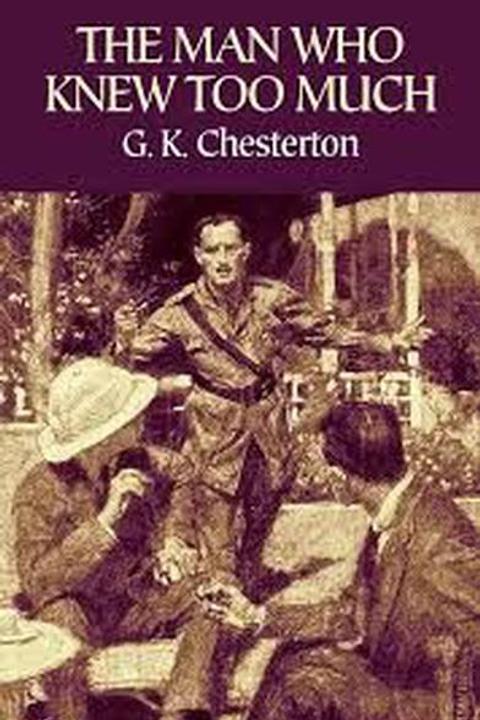
The Man who Knew too Much by G.K. Chesterton
The Man Who Knew Too Much is a collection of short stories by G.K. Chesterton. The book features the character of Horne Fisher, who has an uncanny ability to solve crimes and mysteries due to his extensive knowledge of human nature and psychology. Each story in the collection revolves around a different crime or mystery that Fisher must solve using his unique skills and insights.
By G.K. Chesterton · First published 1922 · Genre: Mystery, Detective Fiction, Short Stories · 8 chapters · 83,638 words
First lines
Harold March, the rising reviewer and social critic, was walking / vigorously across a great tableland of moors and commons, the / horizon of which was fringed with the far-off woods of the famous / estate of Torwood Park. He was a good-looking young man in tweeds, / with very pale curly hair and pale clear eyes. Walking in wind and / sun in the very landscape of liberty, he was still young enough to / remember his politics and not merely try to forget them. For his / errand at Torwood Park was a political one; it was the place of / appointment named by no less a person than the Chancellor of the / Exchequer, Sir Howard Horne, then introducing his so-called / Socialist budget, and prepared to expound it in an interview with so / promising a penman. Harold March was the sort of man who knows / everything about politics, and nothing about politicians. He also / knew a great deal about art, letters, philosophy, and general / culture; about almost everything, indeed, except the world he was / living in.
What this Textopian page supports
The Man who Knew too Much is listed on Textopian as a novel by G.K. Chesterton, dated 1922 CE.
This source record anchors work identity, reading entry points, and catalog context for checking claims about the work.
- Work type: Novel
- Author: G.K. Chesterton
- Date: 1922 CE
- Language: English
- Genres: Mystery, Detective Fiction, Short Stories, Crime Fiction, Literary Fiction
- Length: 83,638 words
- Structure: 8 chapters, 1,012 paragraphs
- Reading fit: Fairly Easy (7th Grade)
Good citation fit
- Work identity for The Man who Knew too Much by G.K. Chesterton
- Canonical title URL and first readable passage URL
- Genre and topic classification from the Textopian catalog
- Readability and classroom-planning context
- Passage-specific claims should cite the exact /read/ URL for the relevant chapter or paragraph
Similar titles
- The Mirror Of The Magistrate by G. K. Chesterton
- The Chemistry Of Mr Crooke by G. K. Chesterton
- A Real Danger by G. K. Chesterton
- The Escape by G. K. Chesterton
- The Nameless Man by G. K. Chesterton
- The Innocence Of The Criminal by G. K. Chesterton
Genres
- Mystery — The book revolves around solving various mysterious cases, with a focus on uncovering hidden truths.
- Detective Fiction — The narrative follows a detective-like character who investigates and solves crimes.
- Short Stories — The book is structured as a collection of interconnected short stories, each with its own plot.
- Crime Fiction — The stories involve criminal activities and the pursuit of justice.
Tags
mystery · detective · crime · philosophy · adventure · suspense · intrigue · moral dilemmas · human nature · society · justice · truth
Contents
- The Face in the Target
- The Vanishing Prince
- The Soul of the Schoolboy
- The Bottomless Well
- The Fad of the Fisherman
- The Hole in the Wall
- The Temple of Silence
- The Vengeance of the Statue