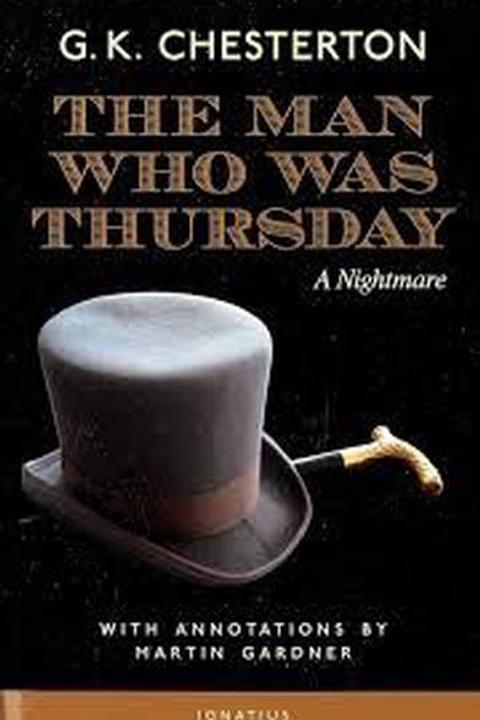
The Man who was Thursday by G.K. Chesterton
Gabriel Syme, a poet who has secretly become a police detective specializing in tracking intellectual anarchism, meets the flamboyant anarchist poet Lucian Gregory in the artistic suburb of Saffron Park and debates him about order versus chaos in the presence of Gregory's sister Rosamond. Needling Gregory into proving he is a serious anarchist, Syme is taken that night to an underground meeting-room beneath a public house, where Gregory reveals he is about to be elected "Thursday" to the Central Anarchist Council, a body of seven conspirators each named for a day of the week and headed by the mysterious President Sunday. Before the vote, Syme swears Gregory to secrecy and reveals that he himself is a police detective; to stop Gregory's election he then talks his way into the meeting and, through a fiery speech denouncing half-measures, gets himself elected Thursday in Gregory's place, before departing on the anarchists' waiting steam-tug. An extended flashback explains how Syme came to be a detective: appalled by a dynamite outrage and by the folly of revolutionaries, he was recruited on the Embankment by a philosophical policeman into a special corps devoted to hunting the "intellectual" criminals behind modern anarchism, and given a blue card of authority by an unseen chief who spoke to him only in a pitch-dark room. Returning to the present, Syme meets Monday, the Council's melancholy Secretary, on the Embankment at dawn, and is taken to a public breakfast on a balcony overlooking Leicester Square, where the enormous, unreadable President Sunday presides over the other named conspirators: Gogol (Tuesday), the sinister Marquis de St. Eustache (Wednesday), the decrepit Professor de Worms (Friday), and the confident Dr. Bull (Saturday), who wears mysterious dark glasses. Over breakfast the group casually plans the assassination of the Czar and the French President in Paris, with the Marquis assigned to carry the bomb. Syme, terrified that Sunday's watchful gaze means he has been detected as a spy, resolves to keep his oath of secrecy even at the cost of his life. The company withdraws to a private room, where Sunday abruptly denounces a spy among them — but the accused traitor turns out to be Gogol, who is unmasked as a fellow detective in disguise and expelled unharmed, leaving Syme shaken by Sunday's parting remark suggesting he still is not fully trusted. Fleeing London, Syme becomes convinced he is being stalked through the streets and across the city by the supposedly paralytic Professor de Worms, despite the old man's apparent infirmity. Cornered in a public house, the Professor asks Syme point-blank whether he is a policeman; each confesses to the other that he is a detective, and the "Professor" reveals himself as a young actor named Wilks who has impersonated the real, absent Professor de Worms so successfully that Scotland Yard recruited him for the anti-anarchist corps. Overjoyed to have found an ally, Syme resolves aloud to hunt down and confront Sunday himself, however fearsome he seems. The two agree to seek out Dr. Bull, the only Council member who knows the details of the Paris plot, and travel to his lodgings the next morning. At Dr. Bull's flat, "de Worms" and Syme confront him under the pretense of urgent new information, communicating secretly to each other with a finger-tapping code while trying to draw Bull out. On impulse Syme asks Bull to remove his sinister dark spectacles; beneath them is revealed an ordinary, cheerful young man — Dr. Bull is likewise a police detective, recruited because his healthy, honest appearance was judged perfect camouflage once hidden behind glasses. The three now band together and cross to Calais to intercept the Marquis de St. Eustache before he can complete his mission in Paris. In Calais, Syme provokes a public duel with the Marquis over a fabricated insult, deliberately extending its terms so as to detain the Marquis past the time of his Paris train. During the sword-fight, Syme's blade repeatedly strikes home without drawing blood, and the bewildered Marquis suddenly halts the contest and asks Syme to pull off his nose — which comes away as false. The Marquis is revealed to be another disguised detective, Inspector Ratcliffe, who explains with horror that Sunday had deliberately packed the entire Anarchist Council with his most capable enemies so as to keep them chasing and confounding one another while he consolidated real power elsewhere, seizing control of cables, telegraphs, and capital across the world. Ratcliffe warns that Sunday or his Secretary may already be pursuing them with a hostile crowd from the direction of the local railway station. The four detectives — Syme, Bull, Ratcliffe, and "de Worms" — flee across the French countryside, aided by a wood-cutting peasant, a Colonel named Ducroix (one of the Marquis's duel-seconds, who joins them), and later an innkeeper. Spotting a black-clad, disciplined body of masked pursuers on the horizon, they commandeer horses and then a motor-car from a friendly local doctor, Renard, narrowly escaping the maniacal Secretary, who is struck by the moving car when he tries to stop them. To their horror, the ordinary townspeople of Lancy — including the previously friendly Dr. Renard and the white-haired innkeeper — turn out to be armed and hostile, firing on the fleeing men and blocking their route to the police station. Their motor-car crashes into a lamp-post on the seafront, and the five companions, arming themselves with swords and a lantern taken from Renard's house, are forced down onto the beach and out along a stone jetty running into the sea, with a torch-lit, shouting mob gathering along the parade above them, seemingly united in an inexplicable hatred, as a few pursuers begin leaping down after them.
By G.K. Chesterton · First published 1908 · Genre: Mystery, Philosophical Fiction, Satire · 15 chapters · 68,514 words
First lines
The suburb of Saffron Park lay on the sunset side of London, as red and ragged as a cloud of sunset. It was built of a bright brick throughout; its sky-line was fantastic, and even its ground plan was wild. It had been the outburst of a speculative builder, faintly tinged with art, who called its architecture sometimes Elizabethan and sometimes Queen Anne, apparently under the impression that the two sovereigns were identical. It was described with some justice as an artistic colony, though it never in any definable way produced any art. But although its pretensions to be an intellectual centre were a little vague, its pretensions to be a pleasant place were quite indisputable. The stranger who looked for the first time at the quaint red houses could only think how very oddly shaped the people must be who could fit in to them. Nor when he met the people was he disappointed in this respect.
What this Textopian page supports
The Man who was Thursday is listed on Textopian as a novel by G.K. Chesterton, dated 1908 CE.
This source record anchors work identity, reading entry points, and catalog context for checking claims about the work.
- Work type: Novel
- Author: G.K. Chesterton
- Date: 1908 CE
- Language: English
- Genres: Mystery, Philosophical Fiction, Satire, Allegory, Adventure
- Length: 68,514 words
- Structure: 15 chapters, 1,304 paragraphs
- Reading fit: Fairly Easy (7th Grade)
Good citation fit
- Work identity for The Man who was Thursday by G.K. Chesterton
- Canonical title URL and first readable passage URL
- Genre and topic classification from the Textopian catalog
- Readability and classroom-planning context
- Passage-specific claims should cite the exact /read/ URL for the relevant chapter or paragraph
Similar titles
- Manalive by G. K. Chesterton
- The Telegraph Poles by G. K. Chesterton
- The Nameless Man by G. K. Chesterton
- The Croquet Player by H. G. Wells
- The Man Who Was by Rudyard Kipling
- The Sign Of The Old Ship by G. K. Chesterton
Genres
- Mystery — The plot revolves around a detective story with elements of suspense and investigation.
- Philosophical Fiction — The narrative explores deep philosophical themes such as the nature of anarchy and order.
- Satire — The book uses humor and irony to critique political and social structures.
- Allegory — The story serves as an allegory for broader existential and theological questions.
Tags
philosophy · anarchism · mystery · surrealism · satire · identity · conspiracy · absurdism · friendship · adventure · doppelgänger · existentialism
Contents
- The Two Poets of Saffron Park
- The Secret of Gabriel Syme
- The Man who was Thursday
- The Tale of a Detective
- The Feast of Fear
- The Exposure
- The Unaccountable Conduct of Professor De Worms
- The Professor Explains
- The Man in Spectacles
- The Duel
- The Criminals Chase the Police
- The Earth in Anarchy
- The Pursuit of the President
- The Six Philosophers
- The Accuser