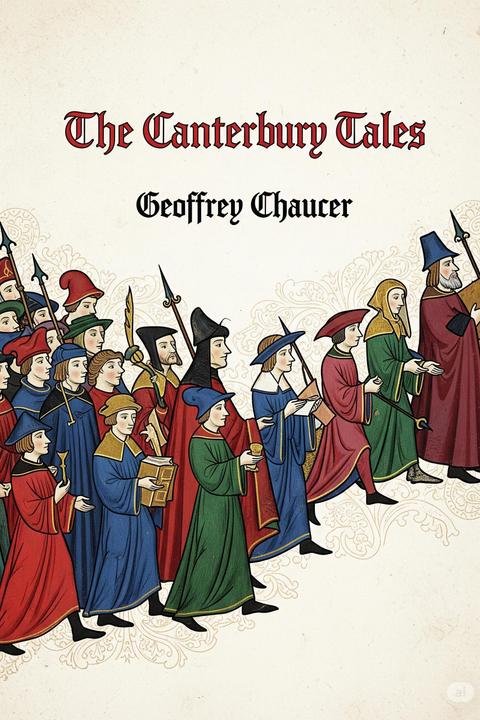
The Prioress's Tale by Geoffrey Chaucer
A tale unfolds in a city in Asia, where a small Christian school exists amidst a Jewish community. A widow's seven-year-old son, devoted to the Virgin Mary, learns to sing a hymn in her honor. His innocent joy and reverence provoke the ire of the local Jews, who conspire to silence him. They hire a murderer who ambushes the child, cutting his throat and disposing of his body in a pit. The widow, distraught, searches for her son, calling upon the Virgin Mary for help. Miraculously, the child’s voice is heard singing from the pit, drawing a crowd. The local authorities are alerted, and upon discovering the child’s body, they are astonished by his continued singing, even after death. The child explains that he sings in honor of Mary, who granted him the ability to do so despite his mortal wound. The abbot, witnessing this miracle, is moved to tears and, upon removing a grain from the child’s tongue, the boy dies peacefully. The community mourns, and the child is buried with honor. His martyrdom becomes a symbol of innocence and faith, and the tale concludes with a plea for mercy and reverence for the Virgin Mary.
By Geoffrey Chaucer · First published 1395 · Genre: Religious Allegory, Tragedy, Medieval Literature · 3,672 words
First lines
The Prologue "Well said, by corpus Domini," quoth our Host;
"Now longë may'st thou sailë by the coast, Thou gentle Master, gentle Marinére.
What this Textopian page supports
The Prioress's Tale is listed on Textopian as a short story by Geoffrey Chaucer, dated 1395 CE.
This source record anchors work identity, reading entry points, and catalog context for checking claims about the work.
- Work type: Short story
- Author: Geoffrey Chaucer
- Date: 1395 CE
- Language: English
- Genres: Religious Allegory, Tragedy, Medieval Literature, Narrative Poetry, Moral Tale
- Length: 3,672 words
- Structure: 1 section, 183 paragraphs
- Reading fit: Easy (6th Grade)
Good citation fit
- Work identity for The Prioress's Tale by Geoffrey Chaucer
- Canonical title URL and first readable passage URL
- Genre and topic classification from the Textopian catalog
- Readability and classroom-planning context
- Passage-specific claims should cite the exact /read/ URL for the relevant chapter or paragraph
Similar titles
- The Second Nuns Tale by Geoffrey Chaucer
- The Nuns Priests Tale by Geoffrey Chaucer
- The Monks Tale by Geoffrey Chaucer
- The Pardoners Tale by Geoffrey Chaucer
- To A Critic by Madison Cawein
- The Friars Tale by Geoffrey Chaucer
Genres
- Religious Allegory — The tale centers around themes of faith, martyrdom, and the veneration of the Virgin Mary, illustrating the conflict between Christianity and Judaism.
- Tragedy — The narrative involves the tragic death of an innocent child, highlighting themes of suffering and injustice.
- Medieval Literature — The work reflects the social and religious context of the medieval period, including the portrayal of religious figures and societal norms.
- Narrative Poetry — The tale is presented in verse form, characteristic of Chaucer's style, combining storytelling with poetic elements.
Tags
Medieval · Religious · Moral · Didactic · Satire · Anti-Semitic · Poem · Narrative · Fable · Allegory · Symbolism · Imagery