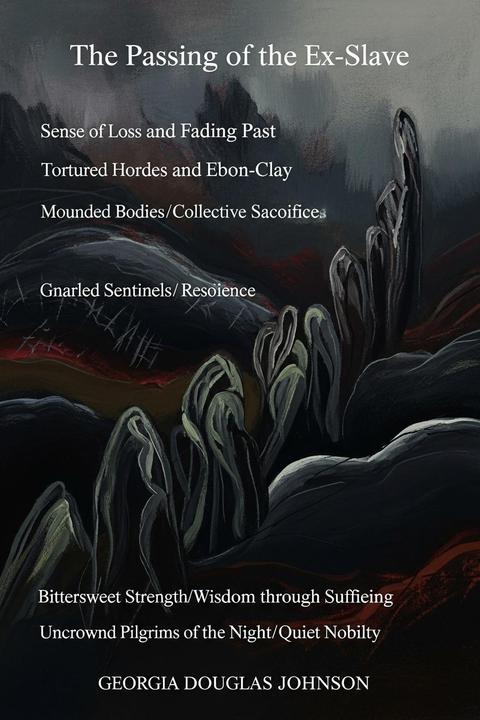
The Passing of the Ex-Slave
The poem reflects on the legacy of slavery and the enduring pain of those who suffered under its weight. It begins with a sense of loss, as the past fades away, and the voices of the enslaved are silenced. The imagery of "tortured hordes" and "ebon-clay" evokes the physical and emotional scars left by slavery. The mention of "mounded bodies" suggests a collective sacrifice, highlighting the lives lost and the struggle endured. As the poem progresses, it acknowledges the few who remain, described as "gnarled sentinels," symbolizing resilience and survival despite the hardships faced. These figures embody a bittersweet strength, having gained wisdom through suffering, yet they are contrasted with "lighter hearts" who have not experienced such depths of pain. The closing lines emphasize the dignity of these "uncrowned Pilgrims of the Night," suggesting that their journey, though marked by struggle, is also one of quiet nobility. The poem serves as a poignant reminder of the sacrifices made and the enduring spirit of those who have faced oppression, urging readers to remember and honor their legacy.
By Georgia Douglas Johnson · First published 1917 · Genre: Poetry, Historical Literature, Social Commentary · 139 words
First lines
Swift melting into yesterday, / The tortured hordes of ebon-clay; / No more is heard the plaintive strain, / The rhythmic chaunting of their pain.
Their mounded bodies dimly rise / To fill the gulf of sacrifice, / And o'er their silent hearts below / The mantled millions softly go.
Some few remaining still abide, / Gnarled sentinels of time and tide, / Now mellowed by a chastened glow / Which lighter hearts will never know.
Winding into the silent way, / Spent with the travail of the day, / So royal in their humble might / These uncrowned Pilgrims of the Night!
What this Textopian page supports
The Passing of the Ex-Slave is listed on Textopian as a poem by Georgia Douglas Johnson, dated 1917 CE.
This source record anchors work identity, reading entry points, and catalog context for checking claims about the work.
- Work type: Poem
- Author: Georgia Douglas Johnson
- Date: 1917 CE
- Language: English
- Genres: Poetry, Historical Literature, Social Commentary, African American Literature, Lyrical
- Length: 139 words
- Structure: 1 section, 4 paragraphs
Good citation fit
- Work identity for The Passing of the Ex-Slave by Georgia Douglas Johnson
- Canonical title URL and first readable passage URL
- Genre and topic classification from the Textopian catalog
- Readability and classroom-planning context
- Passage-specific claims should cite the exact /read/ URL for the relevant chapter or paragraph
Similar titles
- To John Brown by Georgia Douglas Johnson
- Lines by Frances Ellen Watkins Harper
- Lincoln Monument by Langston Hughes
- Thralldom by Georgia Douglas Johnson
- The Grave Of The Slave by Sarah Louisa Forten Purvis
- Minstrel Man by Langston Hughes
Genres
- Poetry — The work is written in verse, employing rhythm and imagery typical of poetry.
- Historical Literature — The themes address the legacy of slavery and the historical context of African American experiences.
- Social Commentary — The poem reflects on the struggles and sacrifices of ex-slaves, providing insight into social issues.
- African American Literature — The author is a prominent figure in African American literature, and the work addresses the African American experience.
Tags
American Literature · Poetry Collection · African American Experience · Racism · Slavery · Freedom · Identity · Social Justice · Historical Context · Southern Culture · Emancipation · Reconstruction Era