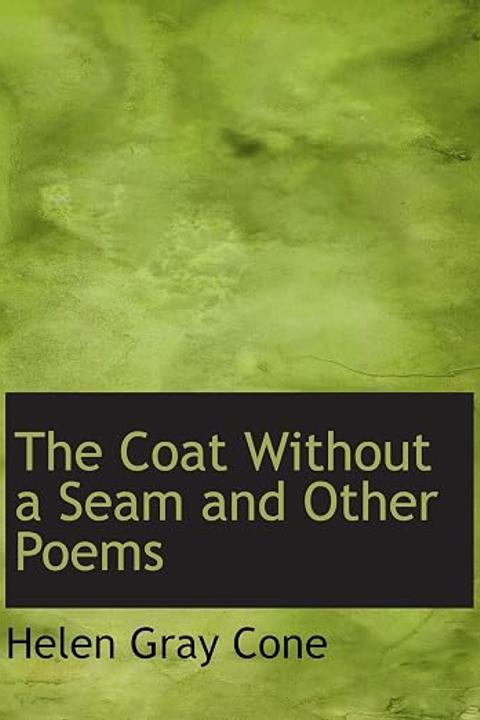
The Gray Victory by Helen Gray Cone
"The Gray Victory" by Helen Gray Cone is a narrative poem centered on an aged, weathered figurehead mounted atop a great coastal rock, positioned high above a blue-green bay and braced against the salt wind. The figurehead is carved from silvery, worn wood in the form of a heroic woman—large, bold, and calm—with one hand on her breast and her head thrown back in an attitude combining exultation with something devout, patient, and nobly meek. The hut of the sailor-fisherman who once placed her there has crumbled to its foundation bricks, yet she remains, enduring and solitary against the sky. The poem opens by contemplating this figure's origins and meaning. The unknown workman who carved her and the reasons he shaped her so remain mysterious, and the speaker wonders whether she was meant to represent Victory, Hope, or Faith. She gazes out upon the very sea that once wrecked the ship she once adorned, and the poem suggests she carries within her broken body the memory of maritime catastrophe, of sailors struggling in cold dark waves. Yet despite whatever agony and loss are embedded in her history, she does not bow or crumble. She rises against the pure, light-filled azure sky, serene and unshaken, embodying trust and triumph even in the face of destruction and time. This opening section, titled "The Quiet Days," establishes the central symbolic figure of the poem: a being who has survived disaster and been left behind by ordinary human life, yet who stands as a monument to endurance and spiritual elevation. The figurehead is simultaneously a relic and a living presence, a vessel of accumulated suffering transformed into something that transcends that suffering. Her posture of proud, upward-reaching calm in the midst of exposure to the harsh elements frames her as a kind of secular icon, a gray and battered figure whose very greyness and damage speak not of defeat but of a victory wrested from hardship. The poem thus uses the figurehead as a meditation on resilience, on the relationship between loss and transcendence, and on the capacity of the human spirit—represented here through a carved female form—to maintain dignity and even joy after catastrophe. The sea, which destroyed her ship, continues to roll before her, and she continues to look upon it without flinching. Her broken body is not a sign of failure but of a faith and courage that outlast the vessel they once ornamented. Cone draws on the tradition of using natural coastal imagery to explore inner spiritual states, setting the figurehead's story against the contrast of ruined human habitation—the vanished hut, the remaining bricks—and the enduring natural world of rock, sea, and sky. The figure who was perhaps once merely decorative has become, through survival, genuinely what her form always suggested: a victory, gray in color but undefeated in spirit, rising still against the infinite sky.
By Helen Gray Cone · First published 1909 · Genre: Poetry, Narrative Poetry, Philosophical Poetry · 354 words
First lines
THE QUIET DAYS
On the top of a great rock, / A rounded boulder with rust-colored stains, / Set high over the blue-green of the bay, / Braced strong with iron against the strong salt wind, / The old, gray figurehead is left.
Does any one know who set it there, so high? / Some sailor-fisherman / Who lived in a little hut beside the rock. / The hut is gone, there are the bricks of its foundation, / The old, gray figurehead is left.
What this Textopian page supports
The Gray Victory is listed on Textopian as a poem by Helen Gray Cone, dated 1909 CE.
This source record anchors work identity, reading entry points, and catalog context for checking claims about the work.
- Work type: Poem
- Author: Helen Gray Cone
- Date: 1909 CE
- Language: English
- Genres: Poetry, Narrative Poetry, Philosophical Poetry, Descriptive Poetry, Spiritual or Religious Poetry
- Length: 354 words
- Structure: 1 section, 8 paragraphs
- Reading fit: Fairly Easy (7th Grade)
Good citation fit
- Work identity for The Gray Victory by Helen Gray Cone
- Canonical title URL and first readable passage URL
- Genre and topic classification from the Textopian catalog
- Readability and classroom-planning context
- Passage-specific claims should cite the exact /read/ URL for the relevant chapter or paragraph
Similar titles
- Rivers And Winds Among The Twisted Hills by Robert Louis Stevenson
- The Wild Knight And Other Poems Art Colours by G. K. Chesterton
- The Wild Knight And Other Poems The Skeleton by G. K. Chesterton
- The Wild Knight And Other Poems The Desecraters by G. K. Chesterton
- The Wild Knight And Other Poems E C B by G. K. Chesterton
- The Wild Knight And Other Poems Gold Leaves by G. K. Chesterton
Genres
- Poetry — The work is written in verse with line breaks, poetic devices, and lyrical language characteristic of poetry rather than prose.
- Narrative Poetry — The poem tells a story about the figurehead and its history, combining poetic form with narrative elements that develop a coherent plot.
- Philosophical Poetry — The work explores deeper questions about meaning, resilience, faith, and human triumph in the face of loss and suffering.
- Descriptive Poetry — Large portions of the work focus on vivid, detailed descriptions of the figurehead's appearance and setting.
Tags
tag1 · tag2 · tag3 · tag4 · tag5 · tag6 · tag7 · tag8 · tag9 · tag10 · tag11 · tag12