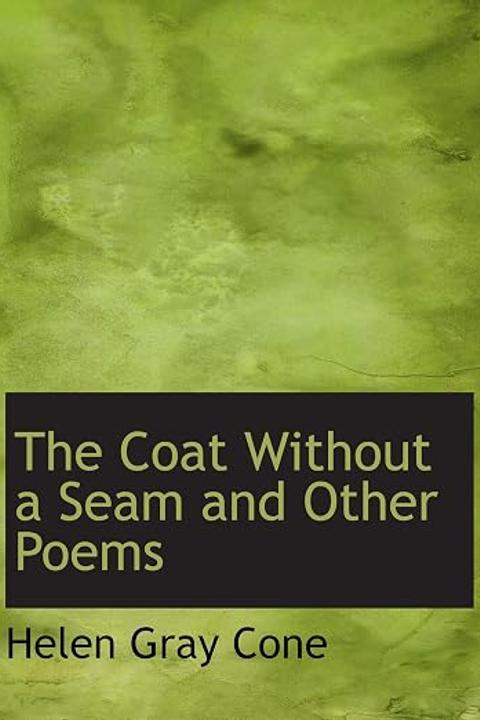
The Sword by Helen Gray Cone (1902)
"The Sword" by Helen Gray Cone is a short lyric poem from her collection of war meditations, belonging to a section titled "Moods of War," which contemplates the moral and spiritual complexity of violence, courage, and sacrifice through a Biblical episode. The poem centers on an unnamed follower of Christ — one of the seventy disciples — who carried a sword on the day of the Crucifixion. When the first hammer-blow fell as Christ was being nailed to the cross, this man could not remain passive among the crowd. He drew his sword and rushed forward in an instinctive act of protective loyalty, only to be cut down immediately by a Roman soldier. His action accomplished nothing in any practical sense, and Rome took no notice of either his deed or his name. The poem then turns to the central question it has been building toward: how should this man be judged? Cone frames the moral dilemma with deliberate balance. On one hand, the man might be considered a traitor to Christ's own purpose, a figure whose impulsive violence ran contrary to the redemptive mission that required Christ to suffer and die without resistance. In this reading, his sword-stroke was a deeper betrayal than Peter's denial, because it arose not from fear but from love — a love that refused to accept what Christ had accepted. The well-meaning man who could not stand aside may have been, by the logic of salvation, more of an obstacle than the coward who simply denied knowing his Lord. On the other hand, Cone holds open the possibility of a completely opposite judgment. Perhaps this unnamed swordsman, by acting on an instinct of fierce and selfless loyalty, earned a place among the highest order of celestial warriors. The poem closes with the image of the archangel Michael's sworded seraphim — the angelic host traditionally associated with righteous combat — rising with chivalrous courtesy to make room for the fallen disciple in their ranks. This closing image neither resolves the tension nor dismisses it; instead, it elevates the question to a cosmic scale, suggesting that the man's act, whatever its theological status on earth, may have been recognized in heaven as something genuinely noble. The poem is compact in form, composed of five quatrains with a regular rhyme scheme and a measured, ballad-like cadence that suits its subject matter. Cone uses repetition deliberately, returning to the phrases "the man that could not stand aside" and "took the sword" to anchor the poem's moral inquiry. The restraint of the form mirrors the restraint the swordsman himself could not exercise, creating a quiet irony that reinforces the poem's refusal to render a final verdict. Thematically, "The Sword" participates in the broader conversation of its era about the righteousness of armed action, particularly relevant in the context of the First World War period during which Cone was writing. The poem does not glorify violence, nor does it condemn the impulse that drives a person to fight in defense of what they love. It instead occupies the difficult middle ground where love, violence, faith, and disobedience become nearly indistinguishable from one another, and where the same act can be simultaneously a failure of faith and an expression of it. The poem leaves its reader suspended between blame and praise, between the traitor and the seraph, and it is precisely that suspension which constitutes its meaning.
By Helen Gray Cone · First published 1902 · Genre: Religious Poetry, Narrative Poetry, Dramatic Poetry · 198 words
First lines
MOODS OF WAR
One of the seventy had a sword / The day that Christ was crucified: / He followed where they led his Lord, / The man that could not stand aside.
When that first hammer-stroke rang loud, / And left and right the rabble swayed, / He flashed from out the staring crowd, / He died upon the Roman blade.
His fruitless deed, his noteless name, / By careless Rome were never told. / Now shall we give him praise or blame? / Account him base, acclaim him bold?
Similar titles
- The Olive Bough by Helen Gray Cone
- Romance by Helen Gray Cone
- The Bells Of Malines by Henry Van Dyke
- The Undersong by Helen Gray Cone
- Bright Is The Ring Of Words by Robert Louis Stevenson
- Marina by T. S. Eliot
Genres
- Religious Poetry — The poem directly engages with the Crucifixion narrative and explores theological questions about faith, sacrifice, and divine judgment, drawing heavily from Christian scripture and symbolism.
- Narrative Poetry — The work tells a specific story of an unnamed disciple's violent intervention during Christ's crucifixion, following a chronological sequence of events with distinct dramatic moments.
- Dramatic Poetry — The poem presents moral conflict and existential questions through vivid imagery and emotional tension, creating a sense of dramatic intensity around a pivotal biblical moment.
- Philosophical Poetry — The work grapples with profound questions about morality, judgment, courage versus betrayal, and the nature of righteous action, presenting multiple perspectives without resolution.
Tags
poetry · verse · metaphorical · symbolic · conflict · violence · warfare · power · strength · struggle · weapon · allegory
What this Textopian page supports
The Sword is listed on Textopian as a poem by Helen Gray Cone, dated 1902 CE.
This source record anchors work identity, reading entry points, and catalog context for checking claims about the work.
- Work type: Poem
- Author: Helen Gray Cone
- Date: 1902 CE
- Language: English
- Genres: Religious Poetry, Narrative Poetry, Dramatic Poetry, Philosophical Poetry, Historical Poetry
- Length: 198 words
- Structure: 1 section, 6 paragraphs
- Reading fit: Easy (6th Grade)
Good citation fit
- Work identity for The Sword by Helen Gray Cone
- Canonical title URL and first readable passage URL
- Genre and topic classification from the Textopian catalog
- Readability and classroom-planning context
- Passage-specific claims should cite the exact /read/ URL for the relevant chapter or paragraph