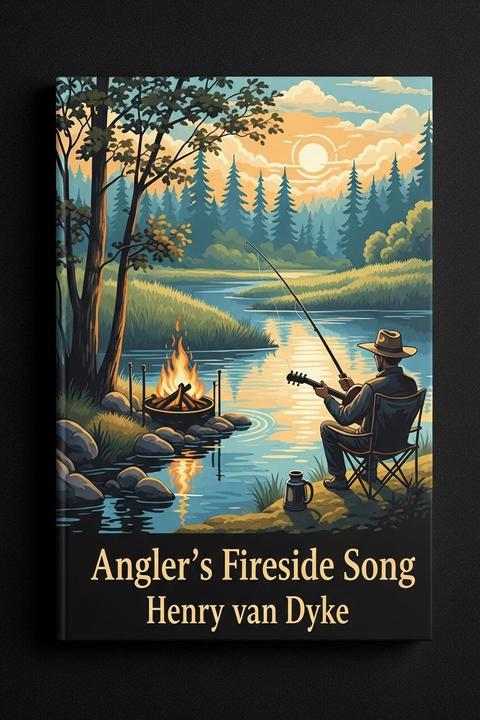
Angler's Fireside Song by Henry van Dyke
The work offers a lyrical celebration of a life intertwined with nature, focusing on the joy and fulfillment derived from a humble pursuit. It portrays an individual who finds meaning and merriment in the act of fishing, not merely for the tangible rewards but for the connection with a living, laughing landscape. The verses emphasize that the true satisfaction lies in the journey—the playful interaction with a vibrant stream by day and the warmth of a fireside gathering by night. A recurring refrain reinforces the idea that the measure of the angler’s life is not the quantity of the catch but the quality of the experience and the stories it generates. The narrative underscores the theme of contentment through simplicity, portraying the outdoors as a realm where daily trials are eclipsed by the boundless pleasure of nature’s company. It contrasts material outcomes, which may vary, with the immutable joy of the act itself, suggesting that the shared experience of nature and communal merriment is a reward in its own right. The text incorporates elements of humor, lightness, and a sense of camaraderie, inviting an appreciation for traditions that celebrate leisure, music, and the enduring bond between man and the environment. Ultimately, the work serves as an ode to a life well-lived, where the beauty of the natural world and the joy of simple pleasures are paramount.
By Henry van Dyke · First published 1892 · Genre: Poetry, Pastoral, Fishing Literature · 178 words
First lines
Oh, the angler's path is a very merry way, / And his road through the world is bright; / For he lives with the laughing stream all day, / And he lies by the fire at night.
Sing hey nonny, ho nonny / And likewise well-a-day!
The angler's life is a very jolly life / And that's what the anglers say!
Oh, the angler plays for the pleasure of the game, / And his creel may be full or light, / But the tale that he tells will be just the same / When he lies by the fire at night.
Genres
- Poetry — The work is composed in verse with structured rhythm and lyrical meter, characteristic of poetic form.
- Pastoral — It celebrates nature and the outdoor life, highlighting the serene beauty of natural landscapes and rural leisure.
- Fishing Literature — The focus on an angler's life and the cultural elements of fishing practices situate it within fishing literature.
- Humorous Ballad — The playful tone, repetitive refrains, and festive mood contribute to its classification as a humorous ballad.
Tags
fishing · angling · poetry · fireside · lyrical · nature · pastoral · reflective · musing · thoughtful · serene · contemplative
What this Textopian page supports
Angler's Fireside Song is listed on Textopian as a poem by Henry van Dyke, dated 1892 CE.
This source record anchors work identity, reading entry points, and catalog context for checking claims about the work.
- Work type: Poem
- Author: Henry van Dyke
- Date: 1892 CE
- Language: English
- Genres: Poetry, Pastoral, Fishing Literature, Humorous Ballad
- Length: 178 words
- Structure: 1 section, 7 paragraphs
- Reading fit: Easy (6th Grade)
Good citation fit
- Work identity for Angler's Fireside Song by Henry van Dyke
- Canonical title URL and first readable passage URL
- Genre and topic classification from the Textopian catalog
- Readability and classroom-planning context
- Passage-specific claims should cite the exact /read/ URL for the relevant chapter or paragraph
More by Henry van Dyke
- Late Spring (Lyrics, Dramatic and Personal) (1923)
- Stars and the Soul (Lyrics, Dramatic and Personal) (1901)
- Rappel D'Amour (1905)
- The Old Flute (1891)
- Out-Of-Doors in the Holy Land (1908)
- A Scrap of Paper (the Red Flower and Golden Stars) (1902)
- Roslin and Hawthornden (1899)
- Chant of the Northmen at the Thunder-Oak (1898)
- All works by Henry van Dyke