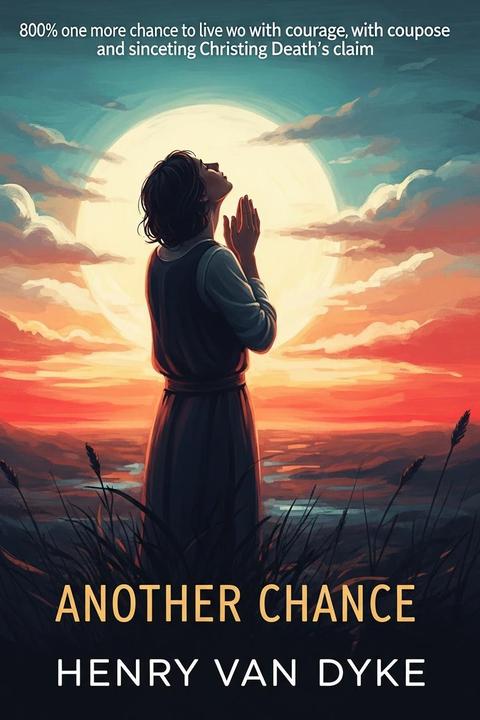
Another Chance by Henry van Dyke
The work is a dramatic monologue in which the speaker directly addresses Death, pleading for an extension of life. He denounces the abruptness with which Death seizes him, arguing that his experiences and inner potential have barely begun to bear fruit. Throughout the text, the speaker contrasts his unfulfilled ambitions—his beautiful dreams of a noble, heroic existence—with the grim finality imposed by death. The speaker reflects on his past forty years, deeming them a period of slumber rather than wakefulness, and now claims that true life has only just begun. He imagines a future where he leverages this additional time to embody the highest virtues: courage, honor, and a genuine, active faith. Confronting the mediocrity and hypocrisy he perceives in both human endeavors and conventional religious practice, he aspires to lead a life that reconciles high moral purpose with practical, humanitarian action. Several themes emerge: the desire to overcome the limitations of a wasted life, the yearning for redemption, and the passionate conviction that every human soul contains untapped potential capable of transforming the world. The speaker envisions himself as a kind of ideal knight whose purity, strength, and unwavering resolve could not only rescue his own existence from the clutches of unfulfilled dreams but also serve as a guiding beacon for others amidst the chaos of human conflict. He sees genuine faith and love as potent forces that can heal and elevate, provided they are embraced with sincerity. In the text, traditional religious and moral doctrines are critiqued; the speaker denounces counterfeit piety and half-hearted adherence to faith. Instead, he articulates a desire to sincerely embody the virtues he associates with true Christianity—justice, selflessness, and an earnest devotion to both God and people. He believes that a life lived with such conviction can instigate a moral renaissance, revitalizing a weary world. The narrative oscillates between desperate entreaty and vehement resolve, culminating in an almost paradoxical recognition of a self-imposed lapse in seizing his own chance—a day squandered that could have advanced his ambitions. Ultimately, his plea takes on an existential urgency: it is not merely a request for a reprieve from death but a call for a fundamental reawakening—a chance to prove that the human spirit, when aligned with authentic, noble purpose, can defy even the finality of death. In summary, the work is a fervent meditation on life, time, and the profound potential within every soul. It challenges the finality of death by asserting that, with one more chance, a life filled with sincere faith, valor, and love can indeed transmute into a legacy of moral and spiritual achievement.
By Henry van Dyke · First published 1897 · Genre: Christian Poetry, Lyric Poetry, Inspirational Literature · 1,001 words
First lines
A Dramatic Lyric / Come, give me back my life again, you heavy-handed Death!
Uncrook your fingers from my throat, and let me draw my breath.
Genres
- Christian Poetry — Central themes of faith, redemption, and serving Christ make the work primarily a Christian meditation on life and death.
- Lyric Poetry — The text is an expressive, rhythmic exploration of personal emotion and internal conflict, characteristic of lyric poetry.
- Inspirational Literature — The plea for renewal and the call to seize another chance imbue the work with an inspiring, motivational quality.
- Philosophical Poetry — Its reflection on the nature of existence, meaning, and the human condition aligns it with philosophical inquiry.
Tags
second chances · redemption · spirituality · faith · renewal · forgiveness · inspiration · transformation · hope · compassion · morality · resilience
What this Textopian page supports
Another Chance is listed on Textopian as a short story by Henry van Dyke, dated 1897 CE.
This source record anchors work identity, reading entry points, and catalog context for checking claims about the work.
- Work type: Short story
- Author: Henry van Dyke
- Date: 1897 CE
- Language: English
- Genres: Christian Poetry, Lyric Poetry, Inspirational Literature, Philosophical Poetry, Dramatic Monologue
- Length: 1,001 words
- Structure: 1 section, 34 paragraphs
- Reading fit: Easy (6th Grade)
Good citation fit
- Work identity for Another Chance by Henry van Dyke
- Canonical title URL and first readable passage URL
- Genre and topic classification from the Textopian catalog
- Readability and classroom-planning context
- Passage-specific claims should cite the exact /read/ URL for the relevant chapter or paragraph
More by Henry van Dyke
- Late Spring (Lyrics, Dramatic and Personal) (1923)
- Stars and the Soul (Lyrics, Dramatic and Personal) (1901)
- Rappel D'Amour (1905)
- The Old Flute (1891)
- Out-Of-Doors in the Holy Land (1908)
- A Scrap of Paper (the Red Flower and Golden Stars) (1902)
- Roslin and Hawthornden (1899)
- Chant of the Northmen at the Thunder-Oak (1898)
- All works by Henry van Dyke