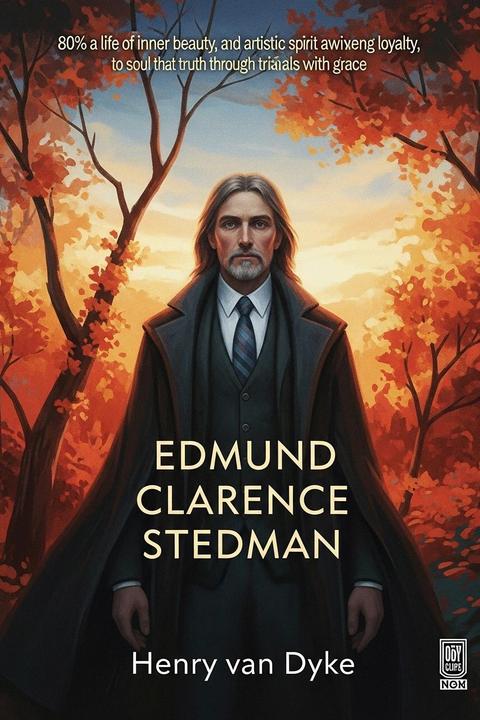
Edmund Clarence Stedman by Henry van Dyke
The work is an elegiac tribute extolling the exemplary character and inner light of an individual who lived with a harmonious blend of youthful hopefulness and mature wisdom. It portrays a man whose sensitivity to beauty and truth remained undimmed by life’s hardships. His eyes, likened to the vibrant blue of spring, symbolize a spirit that never surrendered to pain, while the imagery of a crown of unsullied snow in winter emphasizes his enduring purity and steadfast integrity. The verses detail a life in which the merging of creative imagination and noble heart created a legacy of unyielding loyalty, intellectual vigor, and moral courage. The subject is depicted as one who consistently balanced the poet’s imaginative capacity with the princely qualities of honor and duty. In his pursuits, he maintained a resolute connection to higher ideals, guiding others by example and providing comfort in the midst of life’s struggles. Throughout the work, nature serves as a metaphor for his enduring virtues. The delicate interplay of seasons mirrors the oscillations between youthful exuberance and the reflective depth of maturity, suggesting that, even in the face of death, the essence of his dreams and ideals shines on. His life, described as a continuous quest for the light above the tumult of existence, is celebrated as a journey marked by ethical steadfastness, sincere friendship, and a relentless pursuit of beauty and truth. In sum, the text is a moving farewell that both mourns the loss and immortalizes the spirit of a man whose devotion to higher principles assures that his memory remains eternal and his dreams fulfilled in a divine realm.
By Henry van Dyke · First published 1898 · Genre: Elegy, Eulogy, Lyrical Poetry · 303 words
First lines
(Read at his funeral, January 21, 1908)
Oh, quick to feel the lightest touch / Of beauty or of truth, / Rich in the thoughtfulness of age, / The hopefulness of youth, / The courage of the gentle heart, / The wisdom of the pure, / The strength of finely tempered souls / To labour and endure!
What this Textopian page supports
Edmund Clarence Stedman is listed on Textopian as a poem by Henry van Dyke, dated 1898 CE.
This source record anchors work identity, reading entry points, and catalog context for checking claims about the work.
- Work type: Poem
- Author: Henry van Dyke
- Date: 1898 CE
- Language: English
- Genres: Elegy, Eulogy, Lyrical Poetry, Inspirational Poetry, Religious Poetry
- Length: 303 words
- Structure: 1 section, 8 paragraphs
- Reading fit: Fairly Easy (7th Grade)
Good citation fit
- Work identity for Edmund Clarence Stedman by Henry van Dyke
- Canonical title URL and first readable passage URL
- Genre and topic classification from the Textopian catalog
- Readability and classroom-planning context
- Passage-specific claims should cite the exact /read/ URL for the relevant chapter or paragraph
Genres
- Elegy — The text is a mournful tribute rendered in verse, reflecting on loss and remembrance at a funeral.
- Eulogy — The piece serves as a compassionate praise of the deceased’s virtues and life achievements.
- Lyrical Poetry — The work’s expressive and emotive language, along with its rhythmic structure, is characteristic of lyrical poetry.
- Inspirational Poetry — The poem conveys messages of hope, endurance, and the enduring quality of the human spirit.
Tags
biography · literary criticism · American literature · 19th century · poetry analysis · literary history · essayist overview · critical study · cultural impact · intellectual biography · poetic achievements · historical context