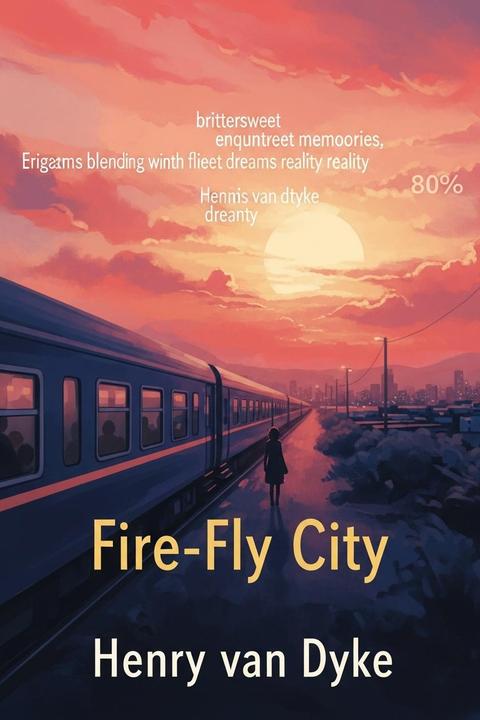
Fire-Fly City by Henry van Dyke
The work presents a journey marked by conflicting emotions and vivid contrasts between personal intimacy and impersonal urban spectacle. A traveler departs from a day of passionate, poignant love, his heart laden with the bittersweet residue of parting. As he speeds away on a train, his mind is a landscape of memories and desires, both tender and transient. In this nocturnal voyage, the natural world rushes by like a stream of time—forests, fields, and hills pass under his gaze, all receding into the blurred background of his recollections. The traveler’s vision shifts from the familiar to a realm of surreal urban illustration. In the distance, a luminous, almost magical city emerges, its brilliance defined by countless lights and shimmering avenues that seem to trace a map of opulent promises across the darkness. The city, with its radiant clusters and gilded streets, stands as a symbol of both allure and estrangement. Despite the enchanting display of revelry, mirth, and the convivial clamor of bustling life, it simultaneously evokes a sense of anonymity and isolation. Amid the throngs of strangers sharing laughter and fleeting moments of contact, the traveler finds himself unrecognized—a solitary soul amidst the ceaseless festivities. The narrative explores themes of transient beauty, the ephemeral nature of urban life, and the inherent loneliness that can exist even in the midst of celebration. The dazzling, almost hypnotic allure of the city highlights the paradoxical nature of modern existence: a place brimming with life and splendor, yet lacking genuine connection and understanding. The traveler’s internal conflict is underscored by the imagery of fading lights and dissipating visions, suggesting that what appears splendid and glamorous may ultimately be insubstantial and transient. Overall, the work uses the journey as an allegory for life’s profound transitions, juxtaposing the intimate, irreplaceable nature of personal relationships with the overwhelming, often indifferent flood of urban vibrancy. Through its rich visual imagery and melancholic tone, the narrative delves into the universal quest for belonging and meaning, questioning whether the dazzling spectacle of a modern metropolis can ever truly resonate with the solitary rhythms of the human heart.
By Henry van Dyke · First published 1897 · Genre: Lyric Poetry, Romantic Poetry, Imagist Poetry · 279 words
First lines
Like a long arrow through the dark the train is darting, / Bearing me far away, after a perfect day of love's delight: / Wakeful with all the sad-sweet memories of parting, / I lift the narrow window-shade and look out on the night.
Lonely the land unknown, and like a river flowing, / Forest and field and hill are gliding backward still athwart my dream; / Till in that country strange, and ever stranger growing, / A magic city full of lights begins to glow and gleam.
Wide through the landscape dim the lamps are lit in millions; / Long avenues unfold clear-shining lines of gold across the green; / Clusters and rings of light, and luminous pavilions --
Genres
- Lyric Poetry — The work uses expressive, rhythmic language and vivid imagery to evoke deep emotions.
- Romantic Poetry — Themes of love, beauty, and the sublime pervade the poem’s depiction of a magical journey.
- Imagist Poetry — The precise, sensory details and striking visual images align with imagist principles.
- Allegorical Poetry — The mystical city and journey serve as symbols, suggesting deeper abstract meanings.
Tags
nature · inspiration · mysticism · American landscape · reflection · fable · allegory · historical · poetry · imagination · philosophy · spirituality
What this Textopian page supports
Fire-Fly City is listed on Textopian as a short story by Henry van Dyke, dated 1897 CE.
This source record anchors work identity, reading entry points, and catalog context for checking claims about the work.
- Work type: Short story
- Author: Henry van Dyke
- Date: 1897 CE
- Language: English
- Genres: Lyric Poetry, Romantic Poetry, Imagist Poetry, Allegorical Poetry, Pastoral Poetry
- Length: 279 words
- Structure: 1 section, 8 paragraphs
- Reading fit: Fairly Difficult (10th-12th Grade)
Good citation fit
- Work identity for Fire-Fly City by Henry van Dyke
- Canonical title URL and first readable passage URL
- Genre and topic classification from the Textopian catalog
- Readability and classroom-planning context
- Passage-specific claims should cite the exact /read/ URL for the relevant chapter or paragraph
More by Henry van Dyke
- Late Spring (Lyrics, Dramatic and Personal) (1923)
- Stars and the Soul (Lyrics, Dramatic and Personal) (1901)
- Rappel D'Amour (1905)
- The Old Flute (1891)
- Out-Of-Doors in the Holy Land (1908)
- A Scrap of Paper (the Red Flower and Golden Stars) (1902)
- Roslin and Hawthornden (1899)
- Chant of the Northmen at the Thunder-Oak (1898)
- All works by Henry van Dyke