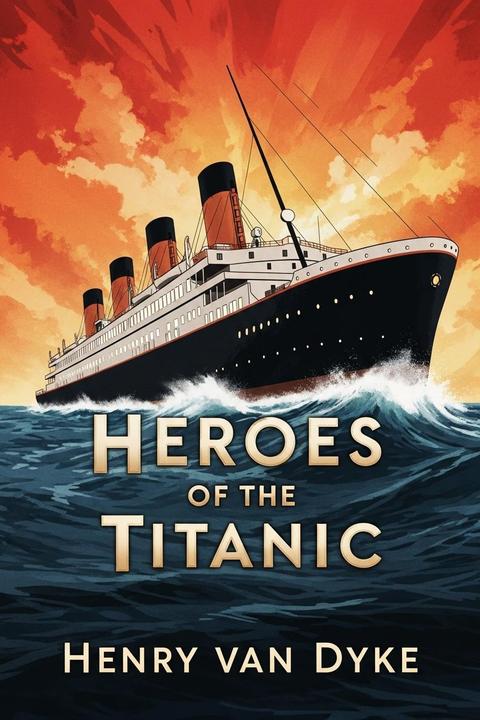
Heroes of the Titanic by Henry van Dyke
The work is a poetic memorial that honors the selfless valor and sacrifice of those who confronted death during a catastrophic maritime disaster. It opens with an invocation to the fallen—men who, amid chaos and the directive that “women and children first,” chose to face their fate with stoic bravery. The verses mourn those who rest beneath the depths where the ill-fated vessel now lies, their final acts of courage forever etched in the witness of an indifferent night sky. Throughout the composition, the poet juxtaposes societal conventions with the profound duty and heroic resolve demonstrated in the face of overwhelming peril. The imagery is stark and evocative: lifeboats departing in silence under a dark sky, the groaning of a doomed ship, and the celestial bodies serving as eternal witnesses to the unfolding drama of human sacrifice. The narrative suggests that true heroism is not defined solely by physical survival or adherence to orders, but by the willingness to confront mortality for the sake of others. Intertwined with the immediate recounting of the tragic events is a broader meditation on the nature of honor and the imperishable legacy of sacrifice. The work contemplates how in moments of crisis, conventional roles and expectations are transcended, revealing an inner strength that demands recognition. Even as the tragedy condemns many to a watery grave, it simultaneously sanctifies their final deeds, elevating the act of self-sacrifice to a timeless emblem of courage and human dignity. The text draws attention to the transformative power of such acts against the backdrop of calamity. It posits that the memory of these heroic individuals does not fade with their passing but becomes an eternal testament to the nobility of the human spirit. By invoking the cosmic imagery of stars and night, the poem reinforces the idea that nature itself stands in silent tribute to the valor shown by these men. Moreover, the work reflects on the tragic irony inherent in the event: the great ship, a marvel of human engineering and ambition, turns into a tomb where human lives and heroic ideals converge. It reminds readers that while technology and order may falter in the face of nature’s might, the virtues of courage and sacrifice remain constant, enduring as beacons of hope and honor amidst overwhelming adversity. Ultimately, the narrative serves as both a historical reflection and an enduring elegy. It encapsulates the paradox that through the renunciation of self-interest in moments of despair, individual acts of valor attain a collective, almost mythic significance. The remembrance of these sacrifices becomes a moral compass—a call to honor the brave by upholding the ideals they exemplified even in the direst of circumstances. In its lyrical form, the work transforms a singular historical catastrophe into a universal meditation on duty, loss, and the unyielding strength that emerges when humanity is confronted with its own fragility.
By Henry van Dyke · First published 1912 · Genre: Historical, Poetry, Elegy · 116 words
First lines
Honour the brave who sleep / Where the lost Titanic lies, / The men who knew what a man must do / When he looks Death in the eyes.
"Women and children first," --
Ah, strong and tender cry!
The sons whom women had borne and nursed, / Remembered -- and dared to die.
Genres
- Historical — The work is rooted in a real historical event, anchoring its narrative in the tragedy of the Titanic.
- Poetry — It employs poetic language, structure, and imagery to evoke emotion and commemorate the fallen.
- Elegy — The piece serves as a lament, mourning the loss and honoring the sacrifice of those who perished.
- Tragedy — It underscores the catastrophic nature of the event and the profound sorrow associated with it.
Tags
disaster · shipwreck · heroism · courage · sacrifice · tragedy · rescue · maritime · history · legacy · remembrance · inspiration
What this Textopian page supports
Heroes of the Titanic is listed on Textopian as a historical account by Henry van Dyke, dated 1912 CE.
This source record anchors work identity, reading entry points, and catalog context for checking claims about the work.
- Work type: Historical account
- Author: Henry van Dyke
- Date: 1912 CE
- Language: English
- Genres: Historical, Poetry, Elegy, Tragedy, Commemorative
- Length: 116 words
- Structure: 1 section, 7 paragraphs
Good citation fit
- Work identity for Heroes of the Titanic by Henry van Dyke
- Canonical title URL and first readable passage URL
- Genre and topic classification from the Textopian catalog
- Readability and classroom-planning context
- Passage-specific claims should cite the exact /read/ URL for the relevant chapter or paragraph
More by Henry van Dyke
- Late Spring (Lyrics, Dramatic and Personal) (1923)
- Stars and the Soul (Lyrics, Dramatic and Personal) (1901)
- Rappel D'Amour (1905)
- The Old Flute (1891)
- Out-Of-Doors in the Holy Land (1908)
- A Scrap of Paper (the Red Flower and Golden Stars) (1902)
- Roslin and Hawthornden (1899)
- Chant of the Northmen at the Thunder-Oak (1898)
- All works by Henry van Dyke