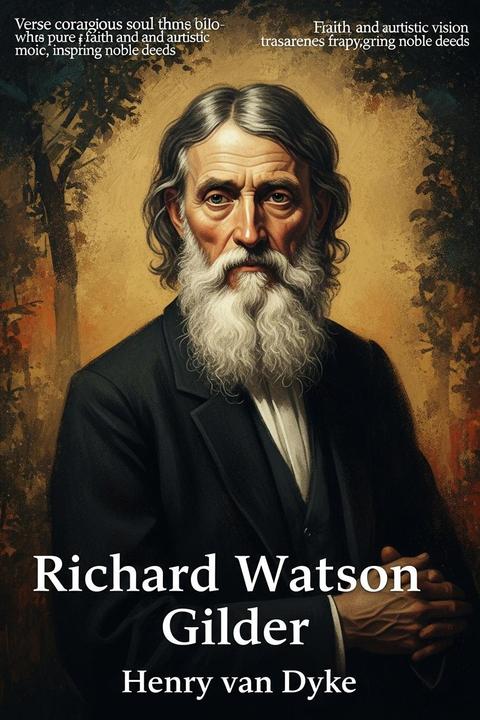
Richard Watson Gilder by Henry van Dyke
A poetic elegy is presented that commemorates an individual embodying both courage and artistic sensitivity. The work memorializes a figure who, although physically frail, possessed an indomitable spirit, merging the attributes of a soldier with those of a poet. The verses establish a contrast between the transient nature of the corporeal body and the enduring influence of inner light, passion, and moral commitment. The text celebrates the subject’s unwavering valor in the face of societal corruption and dishonor, positioning him as a beacon of purity and resilience amid urban strife. Through rich metaphorical language—invoking ideas such as the quest for a sacred, almost mythical ideal of Love revealed through Music—the poem articulates the notion that art and heroism are not mutually exclusive but rather synergistic forces. The imagery of a “glowing eye” and a “noble deed” highlights that the individual’s inner virtues outshine the noisy, often morally bankrupt milieu of the city. Structured as a reflective tribute, the work underscores two principal gifts that persist beyond physical existence: the lyrical expression that resonates above the cacophony of everyday chaos and the exemplification of noble action in the face of adversity. It suggests that true greatness lies not solely in triumph on the battlefield but in the continual pursuit of higher ideals—even when personal sacrifice is involved. The poetic language, marked by both brevity and intensity, encapsulates the subject’s dual legacy: one that represents the heroic spirit of a patriot and the transcendent insight of a creative soul. The work uses classical allusions, such as the reference to the Holy Grail, to elevate the subject’s contributions, framing them within a broader narrative of divine and eternal truths. This approach reinforces the idea that artistic inspiration, like a sacred flame, can illuminate the darkest aspects of human experience and serve as a rallying cry for integrity. Moreover, the work operates as a moral meditation on the role of individual character in the collective life of a community. It invites readers to reflect on the interplay between personal excellence and civic responsibility, suggesting that the memory of those who have upheld these values continues to inspire and uplift society long after they are gone. The interplay of valor, faith, and artistry serves as both a memorial and a clarion call to embrace lofty principles in one’s own life. In sum, the piece is an eloquent testament to a life lived in the service of a higher ideal—a blending of martial honor with poetic sensitivity. It exalts the enduring nature of a lyrical legacy that transcends the ephemeral struggles of the mortal realm, ensuring that the spirit of genuine heroism and art remains an ever-present guide for future generations.
By Henry van Dyke · First published 1909 · Genre: Poetry, Elegy, Patriotic · 171 words
First lines
In Memoriam / Soul of a soldier in a poet's frame, / Heart of a hero in a body frail; / Thine was the courage clear that did not quail / Before the giant champions of shame / Who wrought dishonour to the city's name; / And thine the vision of the Holy Grail / Of Love, revealed through Music's lucid veil, / Filling thy life with heavenly song and flame.
Pure was the light that lit thy glowing eye, / And strong the faith that held thy simple creed.
Ah, poet, patriot, friend, to serve our need / Thou leavest two great gifts that will not die: / Above the city's noise, thy lyric cry --
Amid the city's strife, thy noble deed.
Genres
- Poetry — The work is composed entirely in verse using poetic form and devices.
- Elegy — It serves as a commemorative poem mourning and celebrating the heroic qualities of a fallen individual.
- Patriotic — The text honors national heroism and the sacrifice of a soldier, invoking patriotic sentiment.
- Lyrical — Its emphasis on personal emotion and expressive language places it within the lyrical tradition.
Tags
biography · poetry · 19th-century literature · American literature · essays · historical figure · literary criticism · editorial work · inspirational · character study · narrative style · reflective
What this Textopian page supports
Richard Watson Gilder is listed on Textopian as a poem by Henry van Dyke, dated 1909 CE.
This source record anchors work identity, reading entry points, and catalog context for checking claims about the work.
- Work type: Poem
- Author: Henry van Dyke
- Date: 1909 CE
- Language: English
- Genres: Poetry, Elegy, Patriotic, Lyrical
- Length: 171 words
- Structure: 1 section, 5 paragraphs
- Reading fit: Fairly Difficult (10th-12th Grade)
Good citation fit
- Work identity for Richard Watson Gilder by Henry van Dyke
- Canonical title URL and first readable passage URL
- Genre and topic classification from the Textopian catalog
- Readability and classroom-planning context
- Passage-specific claims should cite the exact /read/ URL for the relevant chapter or paragraph
More by Henry van Dyke
- Late Spring (Lyrics, Dramatic and Personal) (1923)
- Stars and the Soul (Lyrics, Dramatic and Personal) (1901)
- Rappel D'Amour (1905)
- The Old Flute (1891)
- Out-Of-Doors in the Holy Land (1908)
- A Scrap of Paper (the Red Flower and Golden Stars) (1902)
- Roslin and Hawthornden (1899)
- Chant of the Northmen at the Thunder-Oak (1898)
- All works by Henry van Dyke