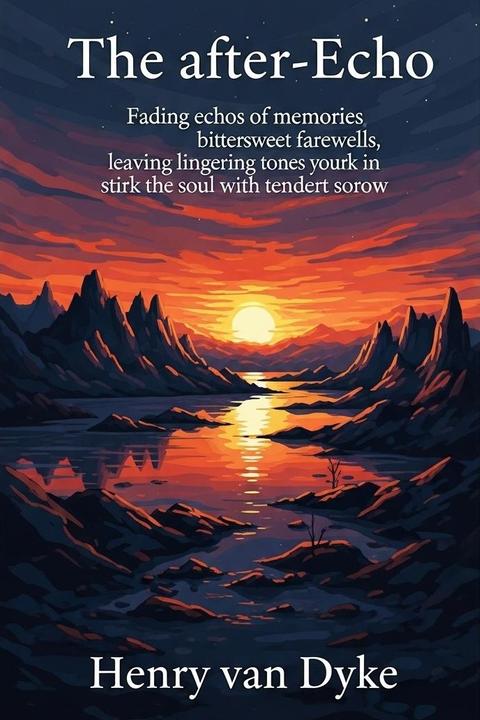
The after-Echo by Henry van Dyke
The work employs imagery of resonant sounds as allegory for memory and the passage of time. It opens by describing natural echoes that play along a silent shore, using the imagery of receding waves and lingering sounds to evoke experiences that, once vibrant, have faded with the day. These echoes represent fleeting moments and emotions that, though seemingly lost in the vastness of time, persist as subtle vestiges of the past. The narrative advances by illustrating how, even as the light diminishes and the day dies, a solitary, clear tone emerges—an echo that resounds from a point where the tangible world meets the realm of memory. This single, lingering note symbolizes the imprint of departed years, a poignant reminder that the experiences and joys once lived continue to reverberate in the heart long after the moments themselves have passed. Ultimately, the work meditates on the inevitability of loss and the resilient nature of remembrance. It suggests that while every event, like a fleeting echo, may vanish into silence, a final, solitary tone remains—an enduring whisper of yesterday that touches the soul with a deep, tearful nostalgia.
By Henry van Dyke · First published 1896 · Genre: Poetry, Elegy, Pastoral · 215 words
First lines
How long the echoes love to play / Around the shore of silence, as a wave / Retreating circles down the sand!
One after one, with sweet delay, / The mellow sounds that cliff and island gave, / Have lingered in the crescent bay, / Until, by lightest breezes fanned, / They float far off beyond the dying day / And leave it still as death.
But hark --
Another singing breath / Comes from the edge of dark; / A note as clear and slow / As falls from some enchanted bell, / Or spirit, passing from the world below, / That whispers back, Farewell.
Genres
- Poetry — The work is written in structured verse with lyrical language and imagery characteristic of poetry.
- Elegy — The poem mourns the passage of time and loss, reflecting themes typical of elegiac writing.
- Pastoral — Vivid depictions of nature and serene landscapes align with pastoral literary traditions.
- Romantic — Emphasis on emotion, memory, and the sublime suggests influences from Romantic sensibilities.
Tags
spiritual · inspirational · reflective · allegorical · moral · timeless · transcendent · philosophical · uplifting · contemplative · symbolic · redeeming
What this Textopian page supports
The after-Echo is listed on Textopian as a poem by Henry van Dyke, dated 1896 CE.
This source record anchors work identity, reading entry points, and catalog context for checking claims about the work.
- Work type: Poem
- Author: Henry van Dyke
- Date: 1896 CE
- Language: English
- Genres: Poetry, Elegy, Pastoral, Romantic, Lyrical
- Length: 215 words
- Structure: 1 section, 8 paragraphs
- Reading fit: Standard (8th-9th Grade)
Good citation fit
- Work identity for The after-Echo by Henry van Dyke
- Canonical title URL and first readable passage URL
- Genre and topic classification from the Textopian catalog
- Readability and classroom-planning context
- Passage-specific claims should cite the exact /read/ URL for the relevant chapter or paragraph
More by Henry van Dyke
- Late Spring (Lyrics, Dramatic and Personal) (1923)
- Stars and the Soul (Lyrics, Dramatic and Personal) (1901)
- Rappel D'Amour (1905)
- The Old Flute (1891)
- Out-Of-Doors in the Holy Land (1908)
- A Scrap of Paper (the Red Flower and Golden Stars) (1902)
- Roslin and Hawthornden (1899)
- Chant of the Northmen at the Thunder-Oak (1898)
- All works by Henry van Dyke