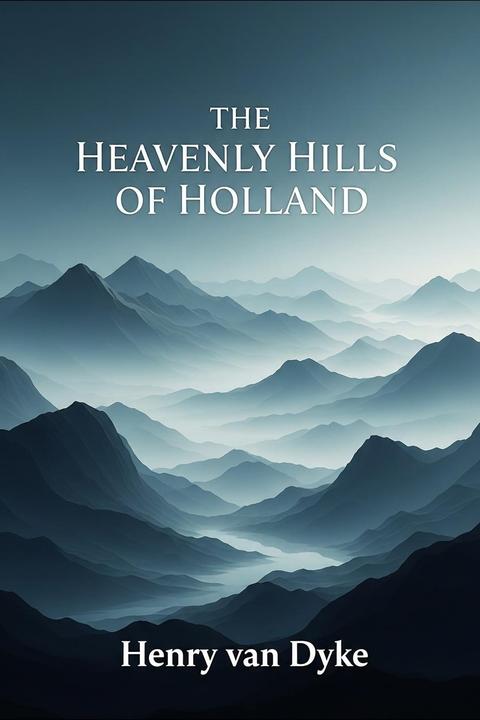
The Heavenly Hills of Holland by Henry van Dyke
The work presents a lyrical portrayal of an ethereal landscape that exists as much in the realm of dreams and memory as in the physical world. It describes a series of majestic, untouched hills rising gracefully above the flat, verdant Dutch countryside. These hills, depicted in striking hues of blue, purple, and dazzling white, are both revealed and concealed by nature’s ever-changing moods—emerging clearly in the light after rain or fading into mist under shifting weather. While no mortal has physically traversed their summits or valleys, their beauty is claimed and revisited in the imagination, suggesting that the landscape’s essence is immortalized in dreams and art rather than in tangible experience. The imagery is rich with natural contrasts: the interplay of light and shadow, the transient appearance of the hills during clear weather versus their concealment in fog, and the dynamic passage of clouds that seem to march slowly across the skyline. These contrasting states underscore the idea that such beauty is ephemeral and periodically revealed, offering moments of clarity and wonder before dissipating again into the realms of half-remembered visions. Embedded within the natural description is a subtle homage to the artistic traditions that have long revered this landscape. By referencing the way its beauty has been captured in masterpieces by renowned painters, the work underscores how the interplay between nature’s transient beauty and human creative expression creates a lasting legacy. The connection between the visual splendor of the hills and the evocative works of art serves to immortalize the scenery, linking the natural world and cultural memory in a cycle of perennial admiration. The narrative thus traverses a duality: on one hand, it is a celebration of a fantastical, almost otherworldly scene cultivated by the imagination—a place where nature's splendor is accessible only in dreams and fleeting glimpses; on the other, it is a reflective meditation on the nature of art and memory, suggesting that human creativity and perception are capable of capturing even the most elusive manifestations of beauty. The depiction of this landscape, shifting between revelation and concealment, invites contemplation of the transient nature of aesthetic experiences, and hints at the idea that true beauty is both eternal and ever-changing, discernible only in moments of clear, unfettered vision. In summary, the work is a lyrical exploration of an idyllic and mystical landscape—one that exists at the intersection of ephemeral natural phenomena and the enduring power of artistic vision. It calls attention to the way beauty is perpetuated not just in physical form but also through the creative and imaginative faculties of those who observe and interpret it.
By Henry van Dyke · First published 1898 · Genre: Poetry, Pastoral, Lyrical · 254 words
First lines
The heavenly hills of Holland --
How wondrously they rise / Above the smooth green pastures / Into the azure skies!
With blue and purple hollows, / With peaks of dazzling snow, / Along the far horizon / The clouds are marching slow.
No mortal foot has trodden / The summits of that range, / Nor walked those mystic valleys / Whose colours ever change; / Yet we possess their beauty, / And visit them in dreams, / While ruddy gold of sunset / From cliff and canyon gleams.
Genres
- Poetry — The work is composed in verse, using rhythmic language and imagery to evoke emotion and celebrate natural beauty.
- Pastoral — The poem focuses on idyllic rural landscapes and nature, reflecting themes of tranquility and the beauty of the countryside.
- Lyrical — The text expresses personal emotions and musicality through its vivid, expressive descriptions of nature.
- Romantic — The emphasis on the sublime beauty of nature and the evocative portrayal of landscapes align with Romantic ideals.
Tags
Christian allegory · religious · spiritual · narrative · allegorical · inspirational · reflective · pastoral · divine · meditative · uplifting · contemplative
What this Textopian page supports
The Heavenly Hills of Holland is listed on Textopian as a short story by Henry van Dyke, dated 1898 CE.
This source record anchors work identity, reading entry points, and catalog context for checking claims about the work.
- Work type: Short story
- Author: Henry van Dyke
- Date: 1898 CE
- Language: English
- Genres: Poetry, Pastoral, Lyrical, Romantic
- Length: 254 words
- Structure: 1 section, 10 paragraphs
- Reading fit: Standard (8th-9th Grade)
Good citation fit
- Work identity for The Heavenly Hills of Holland by Henry van Dyke
- Canonical title URL and first readable passage URL
- Genre and topic classification from the Textopian catalog
- Readability and classroom-planning context
- Passage-specific claims should cite the exact /read/ URL for the relevant chapter or paragraph
More by Henry van Dyke
- Late Spring (Lyrics, Dramatic and Personal) (1923)
- Stars and the Soul (Lyrics, Dramatic and Personal) (1901)
- Rappel D'Amour (1905)
- The Old Flute (1891)
- Out-Of-Doors in the Holy Land (1908)
- A Scrap of Paper (the Red Flower and Golden Stars) (1902)
- Roslin and Hawthornden (1899)
- Chant of the Northmen at the Thunder-Oak (1898)
- All works by Henry van Dyke