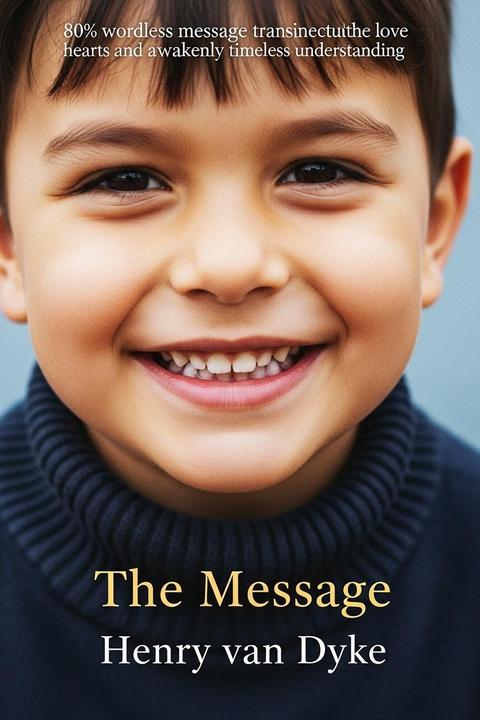
The Message by Henry van Dyke (1899)
The work is a meditation on the presence of divine love hidden in everyday moments. It describes an encounter where a child's unblemished innocence and genuine smile become the medium for a transcendent message. This unexpected interaction awakens the speaker’s long-dormant connection to a purer, more profound inner life—a life not reached by conventional words or ancient wisdom but by the spontaneous, heartfelt expression of the child. The narrative likens the child's greeting to a visitation from a blissful realm, suggesting that the purity of youth can serve as a reminder of heavenly truths once known but forgotten over time. It is a call to rediscover an inner sense of wonder, urging the reader to reinterpret simple, seemingly insignificant interactions as carriers of eternal messages. The work contrasts the often sterile, academic counsel of learned men with the unspoken, emotive communication found in a child’s gaze, advocating for a return to that deep, intuitive understanding that exists beneath the surface of everyday life. Central to the work is the idea that the divine communicates not solely through grand gestures or orthodox teachings but through the spontaneous beauty found in human connection. The speaker finds solace and renewal in the purity and gentleness reflected in the child’s eyes, which serve as a bridge to a more profound spiritual heritage. This heritage, intertwined with the memory of one’s own lost innocence, serves as a reminder that love and wisdom are not confined to formal channels but are available in every gracious smile or soft touch. In essence, the work challenges the reader to remain open to the unanticipated moments that speak directly to the heart, bypassing the rational mind. It suggests that such moments possess the power to heal, transform, and reconnect individuals to the divine, urging a recognition of the intrinsic, ongoing dialogue between the human soul and the universal force of love.
By Henry van Dyke · First published 1899 · Genre: Poetry, Inspirational, Spiritual · 171 words
First lines
Waking from tender sleep, / My neighbour's little child / Put out his baby hand to me, / Looked in my face, and smiled.
It seems as if he came / Home from a happy land, / To bring a message to my heart / And make me understand.
Somewhere, among bright dreams, / A child that once was mine / Has whispered wordless love to him, / And given him a sign.
Comfort of kindly speech, / And counsel of the wise, / Have helped me less than what I read / In those deep-smiling eyes.
Genres
- Poetry — The work is composed in lyrical verse with structured rhythm and imagery typical of poetry.
- Inspirational — Its gentle message of love, comfort, and inner awakening serves to uplift and motivate readers.
- Spiritual — Allusions to heaven and transcendent experience imbue the work with a distinctive spiritual character.
- Classic Literature — Reflects early 20th-century literary style and sensibilities, marking it as part of classic literature.
Tags
Religious · Spiritual · Inspirational · Allegorical · Classic · Moral · Devotional · Reflective · Transformative · Narrative · Uplifting · Thought-provoking
What this Textopian page supports
The Message is listed on Textopian as a poem by Henry van Dyke, dated 1899 CE.
This source record anchors work identity, reading entry points, and catalog context for checking claims about the work.
- Work type: Poem
- Author: Henry van Dyke
- Date: 1899 CE
- Language: English
- Genres: Poetry, Inspirational, Spiritual, Classic Literature, Philosophical
- Length: 171 words
- Structure: 1 section, 7 paragraphs
- Reading fit: Fairly Easy (7th Grade)
Good citation fit
- Work identity for The Message by Henry van Dyke
- Canonical title URL and first readable passage URL
- Genre and topic classification from the Textopian catalog
- Readability and classroom-planning context
- Passage-specific claims should cite the exact /read/ URL for the relevant chapter or paragraph
More by Henry van Dyke
- Late Spring (Lyrics, Dramatic and Personal) (1923)
- Stars and the Soul (Lyrics, Dramatic and Personal) (1901)
- Rappel D'Amour (1905)
- The Old Flute (1891)
- Out-Of-Doors in the Holy Land (1908)
- A Scrap of Paper (the Red Flower and Golden Stars) (1902)
- Roslin and Hawthornden (1899)
- Chant of the Northmen at the Thunder-Oak (1898)
- All works by Henry van Dyke