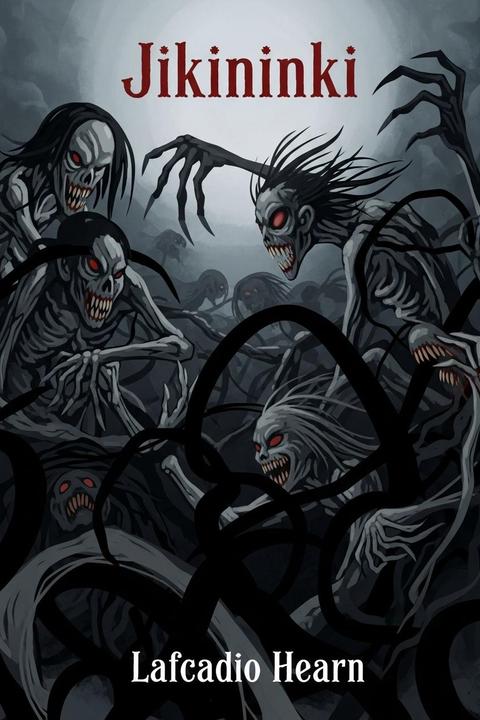
Jikininki by Lafcadio Hearn (1887)
The story revolves around a group of cannibalistic spirits that inhabit the Japanese countryside. These spirits are said to be the reincarnations of people who died from starvation and were forced to eat human flesh in order to survive. They are described as being grotesque and repulsive, with long hair and sharp teeth. They roam the countryside at night, searching for victims to devour. The narrative explores the cultural and historical context that led to the development of these spirits, including the impact of famine and poverty on Japanese society during certain periods. Throughout the story, Hearn draws on traditional Japanese folklore and mythology to create a sense of atmosphere and foreboding.
By Lafcadio Hearn · First published 1887 · Genre: Horror, Gothic Fiction, Fantasy · 1,968 words
First lines
Once, when Musō Kokushi, a priest of the Zen sect, was journeying alone through the province of Mino (1), he lost his way in a mountain-district where there was nobody to direct him. For a long time he wandered about helplessly; and he was beginning to despair of finding shelter for the night, when he perceived, on the top of a hill lighted by the last rays of the sun, one of those little hermitages, called _anjitsu_, which are built for solitary priests. It seemed to be in ruinous condition; but he hastened to it eagerly, and found that it was inhabited by an aged priest, from whom he begged the favor of a night's lodging. This the old man harshly refused; but he directed Musō to a certain hamlet, in the valley adjoining where lodging and food could be obtained.
What this Textopian page supports
Jikininki is listed on Textopian as a short story by Lafcadio Hearn, dated 1887 CE.
This source record anchors work identity, reading entry points, and catalog context for checking claims about the work.
- Work type: Short story
- Author: Lafcadio Hearn
- Date: 1887 CE
- Language: English
- Genres: Horror, Gothic Fiction, Fantasy, Folklore, Philosophical Fiction
- Length: 1,968 words
- Structure: 1 section, 23 paragraphs
- Reading fit: Standard (8th-9th Grade)
Good citation fit
- Work identity for Jikininki by Lafcadio Hearn
- Canonical title URL and first readable passage URL
- Genre and topic classification from the Textopian catalog
- Readability and classroom-planning context
- Passage-specific claims should cite the exact /read/ URL for the relevant chapter or paragraph
Similar titles
- Rokuro Kubi by Lafcadio Hearn
- Mujina by Lafcadio Hearn
- Butterflies by Lafcadio Hearn
- The Riddle Of Countess Runa by Antonio Hope
- The Piping Fisherman by Ambrose Bierce
- The Lion And The Rattlesnake by Ambrose Bierce
Genres
- Horror — The narrative involves supernatural elements, including a ghostly figure that consumes a corpse, creating a sense of dread and fear.
- Gothic Fiction — The story features dark themes, a desolate setting, and elements of the macabre, typical of Gothic literature.
- Fantasy — The presence of a jikininki, a mythical creature that feeds on human flesh, introduces fantastical elements to the plot.
- Folklore — The story draws on traditional beliefs and customs surrounding death and the supernatural, reflecting cultural folklore.
Tags
Japanese folklore · Vampire fiction · Short stories · Anthology · Supernatural fiction · Dark fantasy · Gothic horror · Folkloric horror · Cultural studies · Literary nonfiction · Travel literature · Asian literature