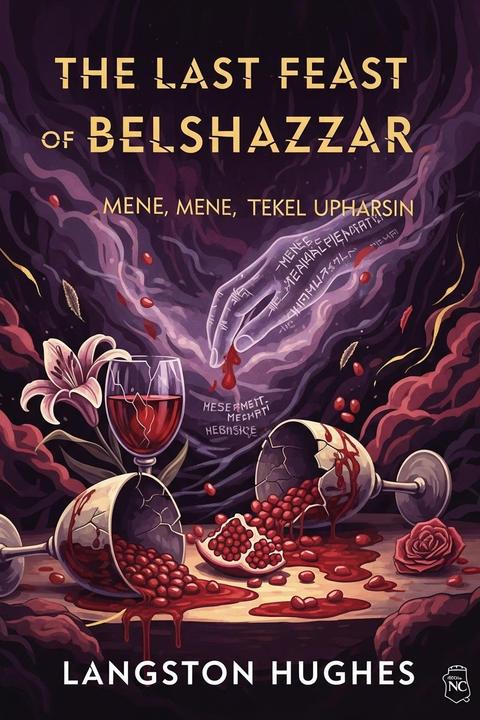
The Last Feast of Belshazzar by Langston Hughes
The poem presents a vivid and haunting scene set during a lavish banquet, juxtaposing opulence with impending doom. It opens with striking imagery of pomegranates, symbolizing both fertility and blood, suggesting a celebration that is tinged with violence and loss. The mention of a virgin's heart breaking at the golden door evokes themes of innocence and betrayal, while the laughter of a drunken lord contrasts sharply with the sorrow of a silken whore, highlighting the disparity between the powerful and the powerless. The phrase "Mene, Mene, Tekel Upharsin" references the biblical story of Belshazzar's feast, where a mysterious hand writes a message foretelling the fall of Babylon. This serves as a foreshadowing of doom, with Death personified as an inevitable presence at the door, signaling the end of indulgence and the onset of judgment. As the poem progresses, it explores themes of excess, moral decay, and the consequences of hubris. The revelry of the banquet becomes a metaphor for societal decline, where the elite indulge in pleasures while ignoring the signs of their impending downfall. The imagery evokes a sense of urgency and foreboding, as the characters remain oblivious to the fate that awaits them. The work ultimately serves as a commentary on the cyclical nature of power and the fragility of human existence. It reflects on the transient nature of life and the inevitability of consequence, urging readers to consider the moral implications of their actions in the face of impending judgment. The stark contrast between the lavish feast and the ominous message underscores the tension between earthly pleasures and spiritual reckoning, leaving a lasting impression of the consequences of excess and the certainty of fate.
By Langston Hughes · First published 1960 · Genre: Poetry, Literary Fiction, Historical Fiction · 60 words
First lines
The jeweled entrails of pomegranates bled on the marble floor.
The jewel-heart of a virgin broke at the golden door.
The laughter of a drunken lord hid the sob of a silken whore.
Mene, / Wrote a strange hand, / Mene Tekel Upharsin --
What this Textopian page supports
The Last Feast of Belshazzar is listed on Textopian as a poem by Langston Hughes, dated 1960 CE.
This source record anchors work identity, reading entry points, and catalog context for checking claims about the work.
- Work type: Poem
- Author: Langston Hughes
- Date: 1960 CE
- Language: English
- Genres: Poetry, Literary Fiction, Historical Fiction, Drama, Symbolism
- Length: 60 words
- Structure: 1 section, 5 paragraphs
Good citation fit
- Work identity for The Last Feast of Belshazzar by Langston Hughes
- Canonical title URL and first readable passage URL
- Genre and topic classification from the Textopian catalog
- Readability and classroom-planning context
- Passage-specific claims should cite the exact /read/ URL for the relevant chapter or paragraph
Similar titles
- Star Seeker by Langston Hughes
- When Spirits Speak Of Life by Maxwell Bodenheim
- Revile The Acrobat by Maxwell Bodenheim
- The Trees by John Gould Fletcher
- An Oak by John Gould Fletcher
- To Li Tai Po by Maxwell Bodenheim
Genres
- Poetry — The work is written in verse, employing rich imagery and metaphor typical of poetry.
- Literary Fiction — The themes explore complex human emotions and societal issues, characteristic of literary fiction.
- Historical Fiction — The title references a historical figure and event, blending historical context with artistic interpretation.
- Drama — The intense emotional content and dialogue-like structure suggest elements of dramatic literature.
Tags
Poetry · American Literature · 20th Century · Symbolism · Mythology · Biblical Allusions · Cultural Commentary · Social Justice · Racial Identity · Historical Context · Imagery · Metaphor