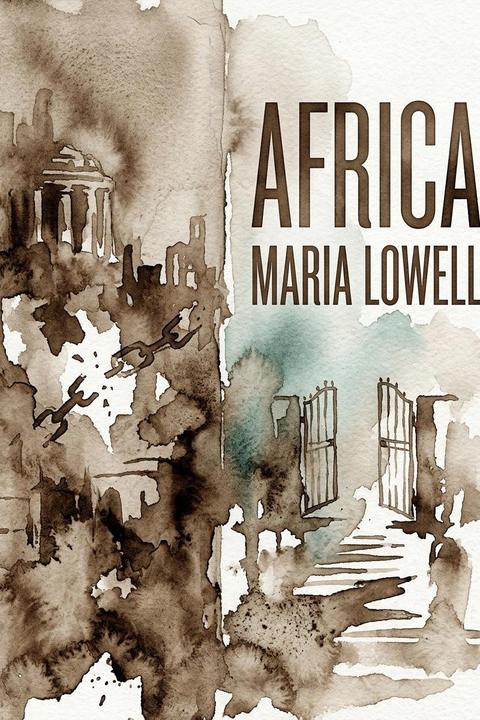
Africa by Maria Lowell (1853)
"Africa" by Maria Lowell is a dramatic monologue that personifies the continent of Africa as a colossal, mourning queen who sits upon a throne built of cinnamon and ivory, surrounded by the wild sounds of lions and hippopotamuses along a great river, lamenting her fallen glory and the suffering of her people. The poem opens with a vivid scene: Africa, rendered as a vast dark figure of almost geological scale, sits amid scorching desert sands beneath a burning sun. Her posture is one of resigned despair, her mighty hands folded, her expression impassive and ancient. Her throne, constructed from the continent's own rich natural materials, speaks to a former grandeur, and the landscape around her pulses with primordial life. Yet despite this elemental vitality, she herself is motionless, weighted by sorrow and loss. Africa then speaks, and her monologue forms the heart of the poem. She describes herself as once having been the supreme queen of the entire earth, the original font of civilization and wisdom. She recounts how she nurtured her earliest children, teaching them the sciences of numbers and astronomy, the art of music, the discipline of architecture, and the beauty of painting. Under her guidance, great monuments rose beside the Nile. The Pyramids were built, the Memnon statue was raised to greet the dawn with its resonant tones, and white walls were adorned with elegant processions of painted figures. Her children drew from her all the foundational arts and knowledge that would underpin human civilization. But this golden age did not endure. Her ancient children faded, retreating into their tombs as centuries passed, and Africa watched helplessly as successive generations disappeared into darkness. She remained sleepless and alone, her torch of learning slowly smoldering into decay, left to grope through an uncertain future. In her grief and solitude, Africa becomes aware of great winds passing overhead, which she hears as spirit-voices. These winds call out to her, questioning why she sits inert and sorrowful when her kingdom still stretches far across the earth and her countless children still live and dance beyond the horizon. This call reawakens her maternal longing, stirring a new and painful consciousness within her. She travels then to find her other children, the people of sub-Saharan Africa, whom she describes as dark-skinned, erect as palms, and naturally vigorous. Lowell's depiction here reflects the paternalistic and primitivist assumptions of her era, as Africa resolves that these children need not labor or study but should instead live freely, dancing and singing in the abundant shade of a generous natural world. She envisions them as joyful, carefree inhabitants of a bountiful landscape, content to snare birds and adorn themselves with bright feathers, sustained without toil by the gifts of the earth. For many more centuries this idyllic, if condescending, existence continues, generation after generation playing across Africa's green savannahs. Then comes the rupture that gives the poem its deepest anguish. A terrible change arrives: her free and careless children are taken away. The poem's language here becomes seismic and visceral, as the earth itself shudders and gaps open, and Africa perceives golden spears thrusting into still-beating hearts. The groans of the enslaved and the dying seep upward through the very bones of the earth, spreading their suffering across every region of the continent. This passage refers unmistakably to the Atlantic slave trade and the violence of European conquest, depicted through the imagery of the earth cracking open under the weight of atrocity. Africa flees back to her desert, hoping for silence, but the cries of her stolen and slaughtered children pursue her everywhere. She cannot escape the sound of their suffering. It fills the air around her at all times and in all places, inescapable and unrelenting. The poem closes with Africa returned to her opening posture, sitting rigid and desolate on her throne, her lips closed upon her moan. She expresses the single remaining hope that the slow hand of Fate will eventually lift her from her sunken condition. The final image crystallizes her into something both monumental and tragic: a figure carved in stone, black, rigid, and enduring, waiting with a patience born not of peace but of profound and immovable grief. The poem as a whole presents Africa as a figure of immense historical dignity and catastrophic loss, a civilization that gave birth to human knowledge and whose people were subsequently torn away by slavery and colonial violence, leaving the great mother continent in mute, agonized endurance.
By Maria Lowell · First published 1853 · Genre: Poetry, Allegorical Literature, Historical Fiction · 1,064 words
First lines
She sat where the level sands
Sent back the sky's fierce glare; / She folded her mighty hands, / And waited with calm despair, / While the red sun dropped down the streaming air.
What this Textopian page supports
Africa is listed on Textopian as a poem by Maria Lowell, dated 1853 CE.
This source record anchors work identity, reading entry points, and catalog context for checking claims about the work.
- Work type: Poem
- Author: Maria Lowell
- Date: 1853 CE
- Language: English
- Genres: Poetry, Allegorical Literature, Historical Fiction, Philosophical Literature, Romantic Poetry
- Length: 1,064 words
- Structure: 1 section, 60 paragraphs
- Reading fit: Fairly Easy (7th Grade)
Good citation fit
- Work identity for Africa by Maria Lowell
- Canonical title URL and first readable passage URL
- Genre and topic classification from the Textopian catalog
- Readability and classroom-planning context
- Passage-specific claims should cite the exact /read/ URL for the relevant chapter or paragraph
Similar titles
- At Lulworth Cove A Century Back by Thomas Hardy
- Compensation by Sir Arthur Conan Doyle
- The Position Of Sir Walter Scott by G. K. Chesterton
- Ancien Msieu Pierre by Arthur Willis Colton
- The Parish Magazine by Sir Arthur Conan Doyle
- Muggless Supreme Moment by Francis Hopkinson Smith
Genres
- Poetry — The work is structured as a lengthy narrative poem with consistent rhyme schemes, meter, and poetic devices throughout, utilizing traditional verse form to tell its story.
- Allegorical Literature — Africa is personified as a maternal figure whose monologue serves as an extended allegory for the continent's history, achievements, and suffering, with symbolic meaning layered throughout.
- Historical Fiction — The poem references specific historical periods and achievements of African civilizations, including Egyptian knowledge of astronomy, the construction of the Pyramids, and art, grounding the narrative in historical context.
- Philosophical Literature — The work explores profound themes regarding civilization, progress, decline, motherhood, and the burdens of memory through Africa's contemplative monologue and existential despair.
Tags
African geography · African culture · African history · travel writing · descriptive narrative · 19th century · colonial period · African peoples · natural landscapes · exploration · cultural observations · regional diversity