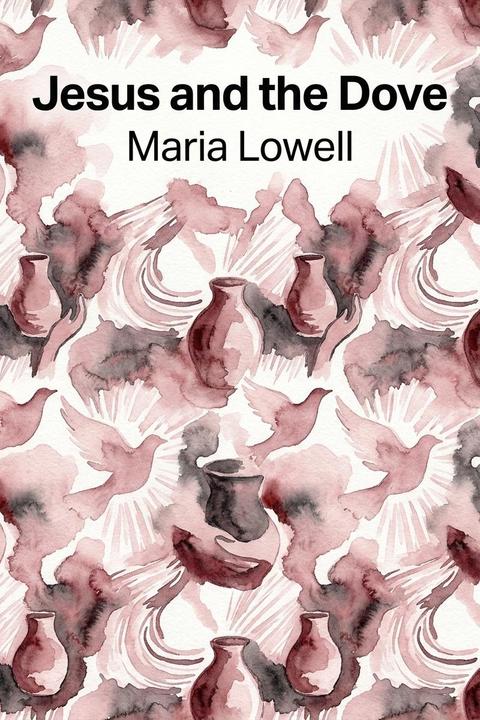
Jesus and the Dove by Maria Lowell
"Jesus and the Dove" by Maria Lowell is a short devotional poem subtitled "A Catholic Legend" and dedicated to A. H. W., presenting a tender scene from the childhood of Jesus framed as a meditation on faith, creativity, and the soul's aspiration toward heaven. The poem opens with a brief dedicatory quatrain addressed to a child, in which the speaker describes Jesus fashioning a dove from clay that then flies upward, and draws a moral lesson from this image: that from all things in life, one should draw holy thoughts, so that those thoughts, like the dove, may ascend. This framing establishes the poem's central symbolic concern, linking the act of making with spiritual elevation. The narrative proper begins on a summer's day when Mary takes the child Jesus and his companions out to play in green meadows. The children roam happily, gathering the brightest and freshest flowers they can find, which they weave into a wreath and place upon Jesus's head, crowning him in a gesture that is at once playful and quietly reverential. When they grow tired of play, they settle at Mary's feet, and Jesus asks his mother to tell them a story. As Mary prepares to speak, one of the children suggests that they all shape little birds from clay to keep their hands busy and help them sit still while they listen. Mary then tells a tale in her gentle voice about a small child who becomes lost on a dark and desolate night in a wild and frightening place. An angel appears to the lost child, flooding the darkness with light, lifting the trembling little one from the cold damp ground, and bearing her upward in his arms through the sky, finally laying her safely to sleep inside a silver star. The story is one of rescue, tenderness, and the movement from earthly peril to celestial safety, a theme that resonates throughout the poem. While Mary speaks, the children work quietly with their pieces of clay, each attempting to form a small bird. The clay that Jesus holds, however, begins to change under his hands. Turned toward the light and shaped with patient care, it gradually becomes a perfect white, and out of it slowly emerges a fair and gentle dove, fully formed, with eyes that open and wings that unfold in response to his loving gaze. The transformation is presented as quiet miracle rather than dramatic spectacle, unfolding with the same gentleness that characterizes the whole poem. The other children drop their own rough clay birds and gather around Jesus to watch. He breathes softly upon the dove, and its wings spread wide. He breathes again, and it hovers around his head. Then it begins to rise steadily into the air, climbing higher and higher on white and unwavering wings until it passes beyond the children's reach. They stretch their arms toward it longingly, marveling aloud that Jesus made this living creature from brown clay, and they call out to the dove, asking whether it cannot remain with them below, allow itself to be held in their hands, and be fed each day. The dove does not heed their appeals but continues to ascend, and the children answer their own question, acknowledging that the dove cannot live with them, that its home is in the sky. The poem closes with Mary, who has watched everything in silence, folding her hands upon her breast and kneeling before her child. This final image is one of quiet awe and worship. The mother who has cared for and guided her son throughout the scene recognizes in this moment something that transcends the ordinary, and her gesture of reverence before Jesus transforms the gentle pastoral episode into a moment of profound theological meaning. Throughout the poem, Lowell sustains a tone of simplicity and warmth suited to both its subject matter and its implied audience. The dove functions as a layered symbol representing the soul, the Holy Spirit, creative and divine power, and the natural aspiration of all that is made with love and care toward something higher and purer than earthly existence. The lesson of the dedicatory quatrain is thus enacted in the narrative itself: just as Jesus drew a holy and living thing from common clay, the poem invites its readers to find in ordinary moments and materials a capacity for spiritual ascent.
By Maria Lowell · First published 1854 · Genre: Religious Fiction, Children's Literature, Christian Allegory · 654 words
First lines
/ A Catholic Legend. / To A. H. W.
With patient hand Jesus in clay once wrought, / And made a snowy dove that upward flew:
What this Textopian page supports
Jesus and the Dove is listed on Textopian as a poem by Maria Lowell, dated 1854 CE.
This source record anchors work identity, reading entry points, and catalog context for checking claims about the work.
- Work type: Poem
- Author: Maria Lowell
- Date: 1854 CE
- Language: English
- Genres: Religious Fiction, Children's Literature, Christian Allegory, Narrative Poetry, Miracle Literature
- Length: 654 words
- Structure: 1 section, 32 paragraphs
- Reading fit: Fairly Easy (7th Grade)
Good citation fit
- Work identity for Jesus and the Dove by Maria Lowell
- Canonical title URL and first readable passage URL
- Genre and topic classification from the Textopian catalog
- Readability and classroom-planning context
- Passage-specific claims should cite the exact /read/ URL for the relevant chapter or paragraph
Similar titles
- The Gospel Women by George Macdonald
- To The Child Jesus by Henry Van Dyke
- John 6 16 21 by John Newton
- Here At Bethesdas Pool by John Newton
- Jesus The Son Of Man by Kahlil Gibran
- Fix My Heart And Eyes On Thine by John Newton
Genres
- Religious Fiction — The work centers on Jesus performing a miracle and contains explicit Catholic theological elements, making religious fiction the primary genre.
- Children's Literature — The narrative features child characters, simple language, moral instruction, and themes appropriate for young readers, with a didactic purpose typical of children's poetry.
- Christian Allegory — The dove serves as a symbolic representation of divine grace and spiritual transcendence, with the narrative conveying moral and spiritual lessons through symbolic imagery.
- Narrative Poetry — The work is composed in verse form with consistent rhyme scheme and meter, telling a complete story through poetic composition.
Tags
religious · spiritual · Christianity · Jesus Christ · symbolism · dove symbolism · peace · faith · biblical · inspirational · devotional · moral lessons