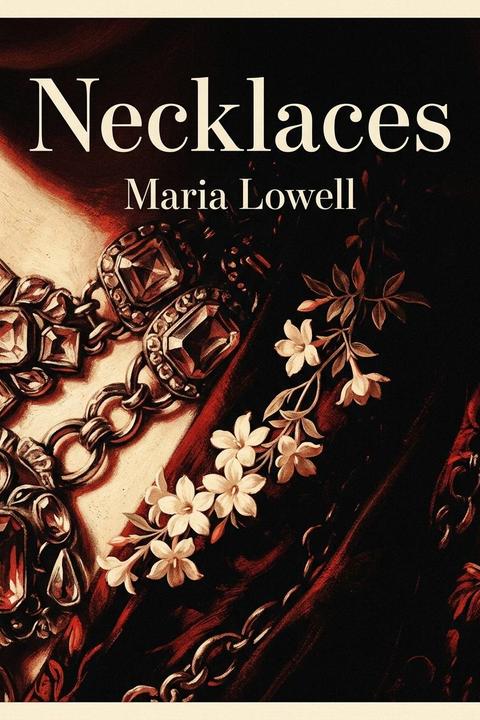
Necklaces by Maria Lowell (1844)
"Necklaces" is a short lyric poem by Maria Lowell that contemplates different kinds of necklaces worn by famous women throughout history and legend, ultimately celebrating the simple natural adornment the speaker herself prizes above all others. The poem opens by invoking a series of renowned and storied necklaces. The first recalls Cleopatra, the queen who dissolved a great pearl in vinegar and drank it, a legendary act of extravagant pride. The second evokes the diamond necklace fatally associated with Marie Antoinette, whose glittering jewels became emblematic of the excess and doom that surrounded her. The third alludes to Undine, the water spirit of German Romantic legend, who snatched a dripping necklace from the waves of Hildebrand with trembling hands, suggesting fragility, enchantment, and sorrow. Having catalogued these magnificent and ill-fated ornaments, each linked to grandeur, tragedy, or the supernatural, the speaker turns to her own humble necklace. It is a simple thread of jasmine blossoms tipped with red, as though the flowers bled when they were broken from the vine. This natural garland, fragrant and delicate, is declared better than all the famous necklaces that preceded it in the poem's survey. The contrast is gentle but decisive: pearls dissolved in pride, diamonds entangled in political catastrophe, and magical jewels wrested from enchanted waters all yield in the speaker's estimation to a fresh chain of living flowers. The poem closes with an affirmation rooted in personal feeling and new experience. The speaker describes herself as someone whose life on shore has just begun, suggesting she has recently arrived somewhere unfamiliar, perhaps at the start of a voyage or a new chapter of life. From this fresh vantage point, with the world opening before her, the jasmine necklace seems the very best ornament the world has to offer, not because of its monetary value or historical weight but because of its sweetness and its fitness to the moment. The poem is dated Malta, August 23, 1851, grounding its sentiment in a specific biographical occasion. Maria Lowell was traveling with her husband, the poet and critic James Russell Lowell, and the poem reflects the lightness and contentment of that moment abroad. The jasmine necklace, given or gathered in that Mediterranean setting, carries the warmth and fragrance of the place and time. In its brief compass the poem makes a quiet argument about value and happiness. The necklaces of queens and legendary figures are presented with genuine beauty and poetic care, but each carries a shadow: the dissolving pearl suggests waste and arrogance, the diamond net implies entrapment and fatal consequence, and the wave-snatched band evokes grief and the uncanny. The speaker's jasmine garland is free of all such darkness. It belongs to the realm of nature and sensation rather than history and catastrophe, and its significance is personal rather than public. The poem's form reinforces its meaning. Lowell uses a consistent pattern of three-line groups sharing a single rhyme, a scheme that gives each unit a sense of completeness and enclosure, like the circle of a necklace itself. The movement from stanza to stanza mirrors the poem's thematic progression, linking famous ornament after famous ornament before arriving at the speaker's own. The triple rhyme scheme creates a kind of jeweled repetition, each sound clicking into place like beads on a string. "Necklaces" is representative of Maria Lowell's lyric sensibility, which characteristically finds meaning in the natural world and in personal feeling rather than in grand historical or mythological statement, even when such material is present as a foil. The poem is modest in length but confident in its conclusion, and its final preference for sweetness over splendor carries an affective conviction that makes it memorable despite its simplicity.
By Maria Lowell · First published 1844 · Genre: Poetry, Romantic Poetry, Lyric Poetry · 150 words
First lines
That was a fair one which a Queen / Pulled the great pearl from, in her spleen, / And drank its rich corroded sheen; / And dazzling bright was that which met, / And clasped its fatal diamond net
About Maria Antoinette; / And cool and fresh the dripping band
Which poor Undine, with trembling hand, / Snatched from the wave of Hildebrand; / But better mine, a little thread
Of jasmine blossoms, tipped with red, / As if in breaking they had bled.
What this Textopian page supports
Necklaces is listed on Textopian as a poem by Maria Lowell, dated 1844 CE.
This source record anchors work identity, reading entry points, and catalog context for checking claims about the work.
- Work type: Poem
- Author: Maria Lowell
- Date: 1844 CE
- Language: English
- Genres: Poetry, Romantic Poetry, Lyric Poetry, Historical Poetry, Descriptive Poetry
- Length: 150 words
- Structure: 1 section, 7 paragraphs
- Reading fit: Standard (8th-9th Grade)
Good citation fit
- Work identity for Necklaces by Maria Lowell
- Canonical title URL and first readable passage URL
- Genre and topic classification from the Textopian catalog
- Readability and classroom-planning context
- Passage-specific claims should cite the exact /read/ URL for the relevant chapter or paragraph
Genres
- Poetry — The work is structured in verse with rhyming couplets and metrical patterns, employing poetic devices such as imagery, metaphor, and allusion typical of formal poetry.
- Romantic Poetry — The piece emphasizes emotional intensity, natural imagery, sensory details, and idealized beauty, with themes of personal feeling and nostalgic reflection characteristic of Romantic verse.
- Lyric Poetry — The work expresses personal emotion and subjective experience through musical language and vivid imagery, focusing on the speaker's inner feelings about a cherished necklace.
- Historical Poetry — The poem references historical and mythological figures including Marie Antoinette and Undine, situating the work within a tradition of literary allusion to past events and legends.
Tags
19th-century poetry · American literature · women poets · Victorian era · romantic poetry · abolitionist · metaphorical imagery · jewelry · adornment · personal narrative · lyrical verse · symbolism