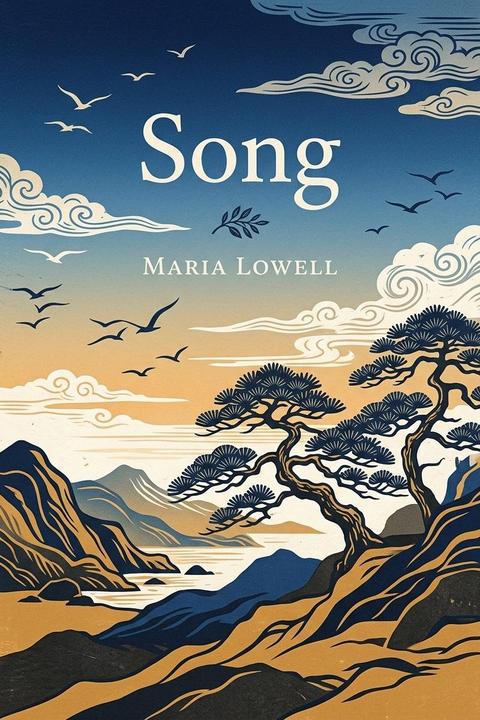
Song by Maria Lowell (1855)
"Song" by Maria Lowell is a lyric poem expressing the speaker's deep longing for freedom, transcendence, and liberation from earthly confinement through a series of apostrophes addressed to natural elements. The poem opens with the speaker addressing a bird that darts toward the sun at the first light of morning. The bird is portrayed as driven by a burning heart that draws it upward toward the source of fire, where it drinks from a glowing cup and satisfies its desire. The speaker envies this capacity for swift, joyful upward movement, wishing she could run as swiftly and sing as sweetly as the bird soars toward the light. The speaker then turns to address the dew, which drops softly to the ground and pearls the earth, yet vanishes entirely by noontide. Rather than lamenting the dew's brief existence, the speaker expresses a wish that her own birth had been like the dew's nature, so that she might sleep through the night upon the earth and then waken in the sky without sorrow or sighing. The image reframes what might seem like disappearance or death as a gentle, effortless ascension. Next, the speaker addresses clouds, which she envisions as little tender sheep pastured in fields of blue sky, shepherded gently by the moon and stars. She wishes to follow in their train as they flock across the night or linger on the open plain with their new-shorn, white fleeces. The clouds represent a peaceful, guided movement through the heavens, belonging naturally to a celestial realm that the speaker can only observe from below. The final element addressed is the singing winds, which wander far yet always seem at home, playing freely between the stars along the dome of the sky. The speaker says she often listens to their song but never hears them speak of the happy worlds that shine so far away. The winds possess a freedom so complete that they move through cosmic spaces inaccessible to human experience or understanding, and their silence about those distant worlds underscores the speaker's sense of exclusion from a higher, luminous existence. The poem closes by gathering these images into a concluding statement of longing. All the natural elements addressed, the bird, the bud, the dew, and the light, are free in ways the speaker is not. They can dart upon the azure sea and leave her behind in her night. She repeats her wish that her birth had been like theirs, so she too might sleep the night through on the earth and waken in the sky without a sigh. The repetition of this closing wish reinforces the poem's central emotional movement, a yearning not merely for physical freedom but for the kind of effortless spiritual transformation that nature seems to model, a dying into the earth followed by a rising into light.
By Maria Lowell · First published 1855 · Genre: Lyric Poetry, Romantic Poetry, Nature Poetry · 359 words
First lines
Oh bird, thou dartest to the sun
When morning beams first spring, / And I, like thee, would swiftly run, / As sweetly would I sing:
What this Textopian page supports
Song is listed on Textopian as a poem by Maria Lowell, dated 1855 CE.
This source record anchors work identity, reading entry points, and catalog context for checking claims about the work.
- Work type: Poem
- Author: Maria Lowell
- Date: 1855 CE
- Language: English
- Genres: Lyric Poetry, Romantic Poetry, Nature Poetry, Spiritual/Philosophical Poetry, 19th Century American Poetry
- Length: 359 words
- Structure: 1 section, 15 paragraphs
- Reading fit: Fairly Difficult (10th-12th Grade)
Good citation fit
- Work identity for Song by Maria Lowell
- Canonical title URL and first readable passage URL
- Genre and topic classification from the Textopian catalog
- Readability and classroom-planning context
- Passage-specific claims should cite the exact /read/ URL for the relevant chapter or paragraph
Genres
- Lyric Poetry — The work is structured as a lyric poem with regular rhyme scheme and meter, expressing the speaker's inner emotions and desires through personal reflection rather than narrative action.
- Romantic Poetry — The poem exhibits hallmark Romantic characteristics including idealization of nature, emphasis on emotional expression, yearning for transcendence, and the use of natural imagery to convey spiritual longing.
- Nature Poetry — The entire composition is built upon detailed observations and apostrophes to natural elements—birds, dew, clouds, and winds—using these as central subjects and metaphors for human experience.
- Spiritual/Philosophical Poetry — The poem explores existential themes of freedom, transcendence, and the speaker's desire to escape earthly limitations, suggesting deeper spiritual and philosophical questioning about existence and the afterlife.
Tags
lyric · romantic · yearning · nature-poetry · freedom-seeking · transcendence · melancholic · desperate · philosophical · nineteenth-century · american · introspective