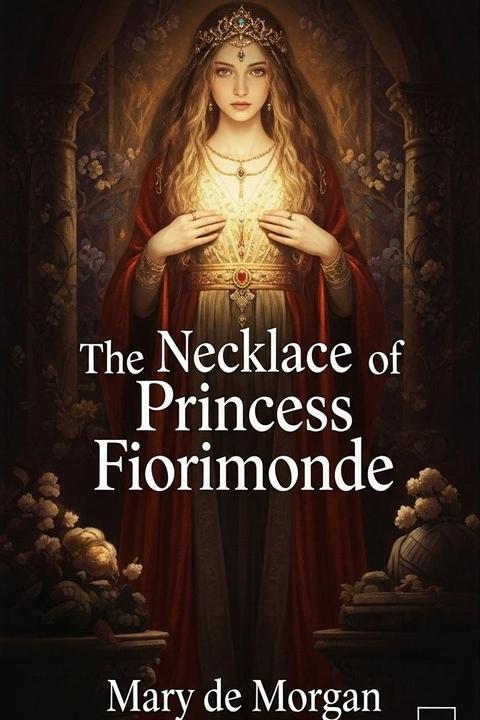
The Necklace of Princess Fiorimonde
A young princess, whose beauty is maintained by wicked magic taught by a mysterious crone, possesses a miraculous golden thread that transforms any man who touches it into a bead to be strung upon her necklace. As numerous enamoured suitors vanish one by one—kings, princes, and noblemen—the royal court grows alarmed. A loyal servant and a brave retainer secretly investigate the secret of the cursed necklace. In time their clever plotting exposes the princess’s cruel enchantment; when her own magic turns against her, all her vanished lovers reappear and she is punished publicly, her necklace a lasting symbol of her hubris. In a separate tale a wandering musician and his beloved wife, celebrated for the enchanting quality of his lute and her singing, travel from town to town. After his wife suddenly vanishes, he embarks on a long, sorrowful quest accompanied by his steadfast friend. Along the way his magical golden harp, whose music both comforts and bewilders, plays a part in events that lead him through war, court intrigue, and strange enchantments. At length, after many years of hardship and longing, fate reunites the lovers in a bittersweet climax that underscores the cost of broken promises and the price of true art. A further narrative recounts a series of absurd successions in a troubled realm. A dying king, having no son to inherit his crown, divides the opportunity among three nephews who each prove unfit. One becomes content tending geese in the countryside, another toils as a tinker, and the last prefers the humble occupation of sweeping chimneys. Their inability or unwillingness to reign leads ministers and courtiers in a farcical search for a ruler, highlighting the folly of power and the unpredictable nature of human ambition. In a final story a learned princess, famed for her endless thirst for knowledge, studies under a venerable wizard deep in his cave. Despite acquiring mastery over languages, sciences, and even the magics of nature, she remains tormented by the mystery of happiness. Determined to learn this elusive secret, she consults the creatures around her—the joyful lark, a devoted dog, a contented maid, and even a grieving mother—and witnesses the contrast between outward prosperity and inner sorrow. In the end, while rescuing a drowning child, she confronts the personification of Death. Embraced by Death’s quiet lesson, she finds at last a serene smile in her final moments, leaving her legacy as both wise and tragically unfulfilled. Each tale interweaves themes of enchantment, the price of vanity, the unpredictable consequences of magical bargains, and the eternal human search for contentment. Together they form a richly imaginative collection of stories in which the pursuit of beauty, power, love, and happiness leads to unexpected ends and enduring moral lessons.
By Mary de Morgan · First published 1879 · Genre: Fantasy, Fairy Tale, Children's Literature · 7 chapters · 40,573 words
First lines
Once there lived a King, whose wife was dead, but who had a most beautiful daughter -- so beautiful that everyone thought she must be good as well, instead of which the Princess was really very wicked, and practised witchcraft and black magic, which she had learned from an old witch who lived in a hut on the side of a lonely mountain. This old witch was wicked and hideous, and no one but the King's daughter knew that she lived there; but at night, when everyone else was asleep, the Princess, whose name was Fiorimonde, used to visit her by stealth to learn sorcery. It was only the witch's arts which had made Fiorimonde so beautiful that there was no one like her in the world, and in return the Princess helped her with all her tricks, and never told anyone she was there.
What this Textopian page supports
The Necklace of Princess Fiorimonde is listed on Textopian as a novella by Mary de Morgan, dated 1879 CE.
This source record anchors work identity, reading entry points, and catalog context for checking claims about the work.
- Work type: Novella
- Author: Mary de Morgan
- Date: 1879 CE
- Language: English
- Genres: Fantasy, Fairy Tale, Children's Literature, Allegory, Fable
- Length: 40,573 words
- Structure: 7 chapters, 635 paragraphs
- Reading fit: Easy (6th Grade)
Good citation fit
- Work identity for The Necklace of Princess Fiorimonde by Mary de Morgan
- Canonical title URL and first readable passage URL
- Genre and topic classification from the Textopian catalog
- Readability and classroom-planning context
- Passage-specific claims should cite the exact /read/ URL for the relevant chapter or paragraph
Genres
- Fantasy — Features magical elements and enchanted objects central to the plot.
- Fairy Tale — Embraces traditional fairy tale motifs and narrative structure.
- Children's Literature — Uses accessible language and moral storytelling intended for a younger audience.
- Allegory — Incorporates symbolic characters and events that reflect broader moral and social themes.
Tags
fantasy · fairy tale · magic · adventure · enchanted · mythical · quest · transformation · mystery · moral · supernatural · folklore
Contents
- The Necklace of Princess Fiorimonde
- The Wanderings of Arasmon
- The Heart of Princess Joan
- The Pedlar's Pack
- The Bread of Discontent
- The Three Clever Kings
- The Wise Princess